📌 这节课讲了什么
后置定语这一条语法,放到两个真实场景里去用:
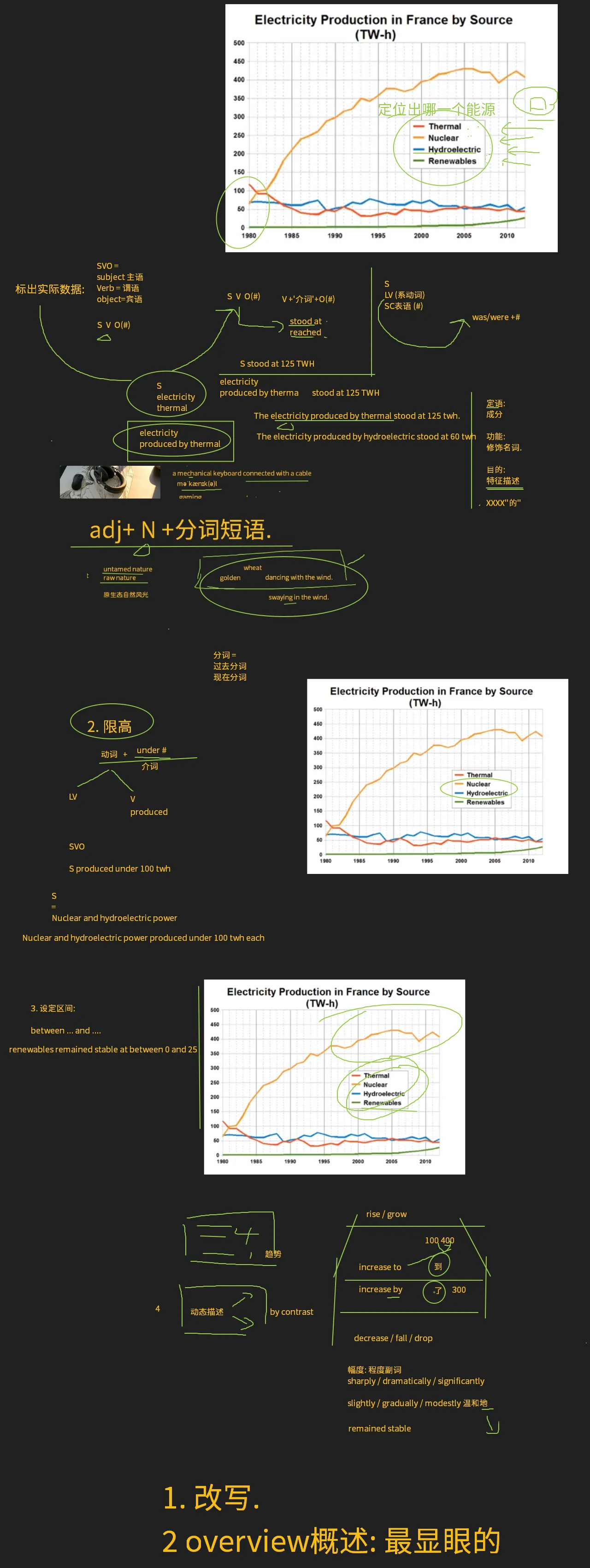
- 线图描述(法国发电量 Electricity Production in France by Source (TW-h)):用"名词 + 分词短语"把数据说清楚 —— The electricity produced by thermal stood at 125 TWh.
- P1 口语:morning / evening 的喜好题,以及"Gen Z 是没有科技的最后一代"这一套说法 —— kids born after Y2K read more than those born after 2020**。
外加一个发音点:TH(舌尖放在两牙之间、吹气),和 scroll 的读法。
📐 语法点:后置定语 —— adj + N + 分词短语
板书的核心公式:adj + N + 分词短语。
- 分词 = 过去分词 / 现在分词,放名词后面当修饰;
- 功能:修饰名词;目的是特征描述 —— 相当于中文里"……的";
- 成分上,它就是定语。
板书上的例子:
| 短语 | 说明 |
|---|---|
| a mechanical keyboard connected with a cable | 名词 + 过去分词短语(被动:键盘被连了线) |
| electricity produced by thermal | 名词 + 过去分词短语(电被火电发出来) |
| wheat dancing with the wind | 名词 + 现在分词短语(麦子在风里跳舞 —— 主动) |
| golden swaying in the wind | 现在分词短语 |
| untamed nature / raw nature | 原生态自然风光 |
过去分词 vs 现在分词:被动的、已经发生完的用过去分词(connected、produced);主动的、正在进行的用现在分词(dancing、swaying)。
同一个公式用在数据描述里,就得到:
The electricity produced by thermal stood at 125 TWh.
The electricity produced by hydroelectric stood at 60 TWh.
Nuclear and hydroelectric power produced under 100 TWh each.
本来要说 "The electricity comes from thermal. It stood at 125 TWh." 两句 —— 用后置定语一句就压完了。
📝 线图描述:Electricity Production in France by Source
图:横轴 1980–2010,纵轴 0–500,四条线 —— Thermal(火电)、Nuclear(核电)、Hydroelectric(水电)、Renewables(可再生)。
板书第一步:定位出哪一个能源。 先把图例圈出来,确定每条线是谁(nuclear 是那条一路涨到 400 以上的;thermal 在 100 上下;hydroelectric 最低的蓝线;renewables 在底部接近 0)。
句子骨架(语法板书):
- SVO = subject 主语 + Verb 谓语 + object 宾语
- S V O(#) —— 宾语是数字
- V + 介词 + O(#) —— stood at / reached(数字前常配介词)
- S + LV(系动词)+ SC 表语(#) —— 系动词后面接表语,数字前面加 was / were
数据句里的两个动作:
- 标出实际数据(把图上的数写进句子:LV / V produced → S produced under 100 TWh)
- 设定区间:between ... and ... —— renewables remained stable at between 0 and 25.
🧱 框架:线图四步
板书大字列了四步:
- 改写(把题目改写一遍,不要照抄);
- overview 概述:最显眼的 —— 例如 "N and H, R 趋势"(板书用 T = Thermal、N = Nuclear、H = Hydroelectric、R = Renewables 简写);
- 静态"在哪"点(某个时间点停在哪个数:stood at / remained stable at);
- 动态(增加 / 减少)。
动态部分的词表(板书):
- 增加:rise / grow;increase to(到)/ increase by(了)—— 板书用 100→400 演示:increase to 400、increase by 300
- 减少:decrease / fall / drop
- 对比:by contrast(还有 CC 连贯性—— 用连接词把两句接起来)
- 幅度:程度副词
- 大幅度:sharply / dramatically / significantly
- 温和:slightly / gradually / modestly(板书注:温和地)
- 不变:remained stable
板书给这组图的示范搭配:nuclear + increase;by contrast,thermal + decrease;H relatively stable, but R small rise。
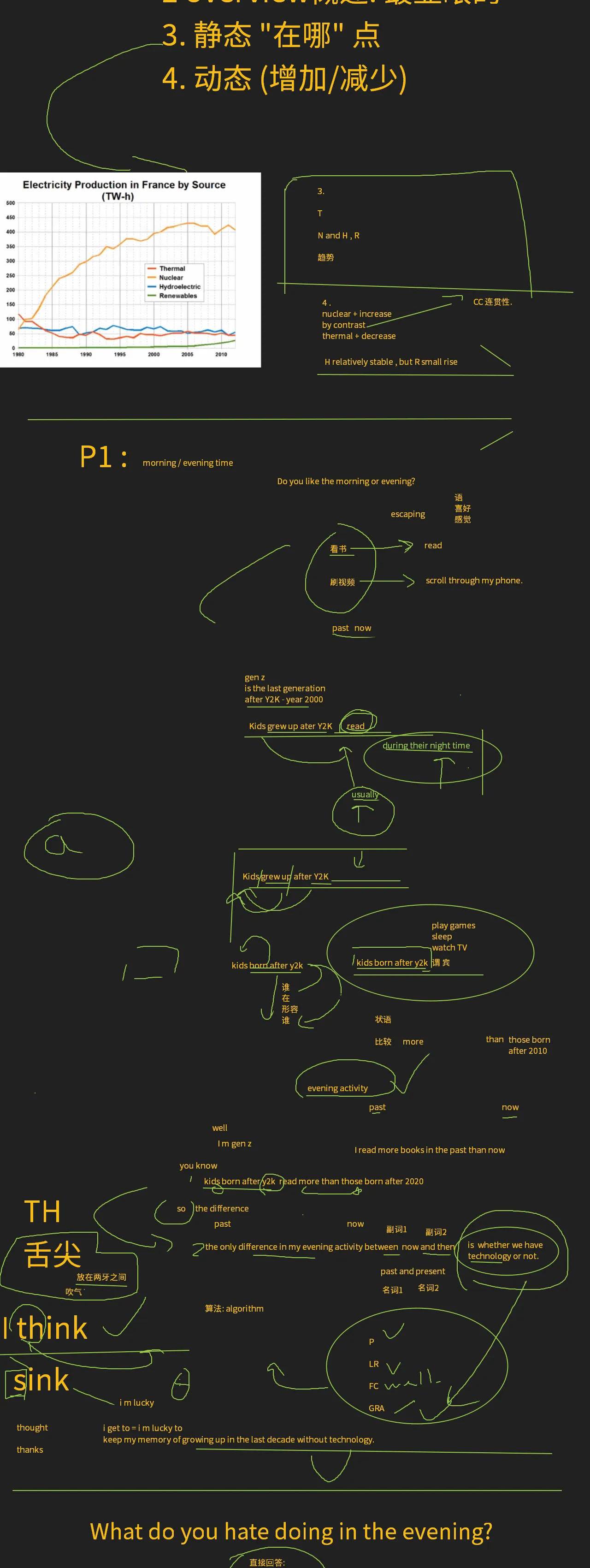
💬 P1:Do you like the morning or evening? —— Gen Z 的十年
答题方向(板书):escaping(把"喜欢早晨/晚上"讲成一种逃离)、语(语气)、喜好、感觉。
两个动作词:
- 看书 → read
- 刷视频 → scroll through my phone
past / now 的对比:
gen Z is the last generation after Y2K – year 2000
kids born after Y2K read more than those born after 2020
I read more books in the past than now
(板书把 kids born after Y2K 圈出来 —— 这就是"名词 + 分词短语"做后置定语;比较用 more ... than;"谁/在/形容/谁" 的填空题式笔记,标的是这个结构的四个槽位。)
把话说满的一句:
so the difference past / now —— the only difference in my evening activity between now and then is whether we have technology or not.
(板书标:副词 1 / 副词 2:now / then;名词 1 / 名词 2:past and present;后面接 is whether ... or not。)
口语开头的小词(板书):well / I'm gen Z / you know —— 说出来先垫一下,连贯性(FC)就上来了。
收尾的句子:
I'm lucky I get to keep my memory of growing up in the last decade without technology.
板书注释:I get to = I'm lucky to —— "get to" 就是"有幸能"。
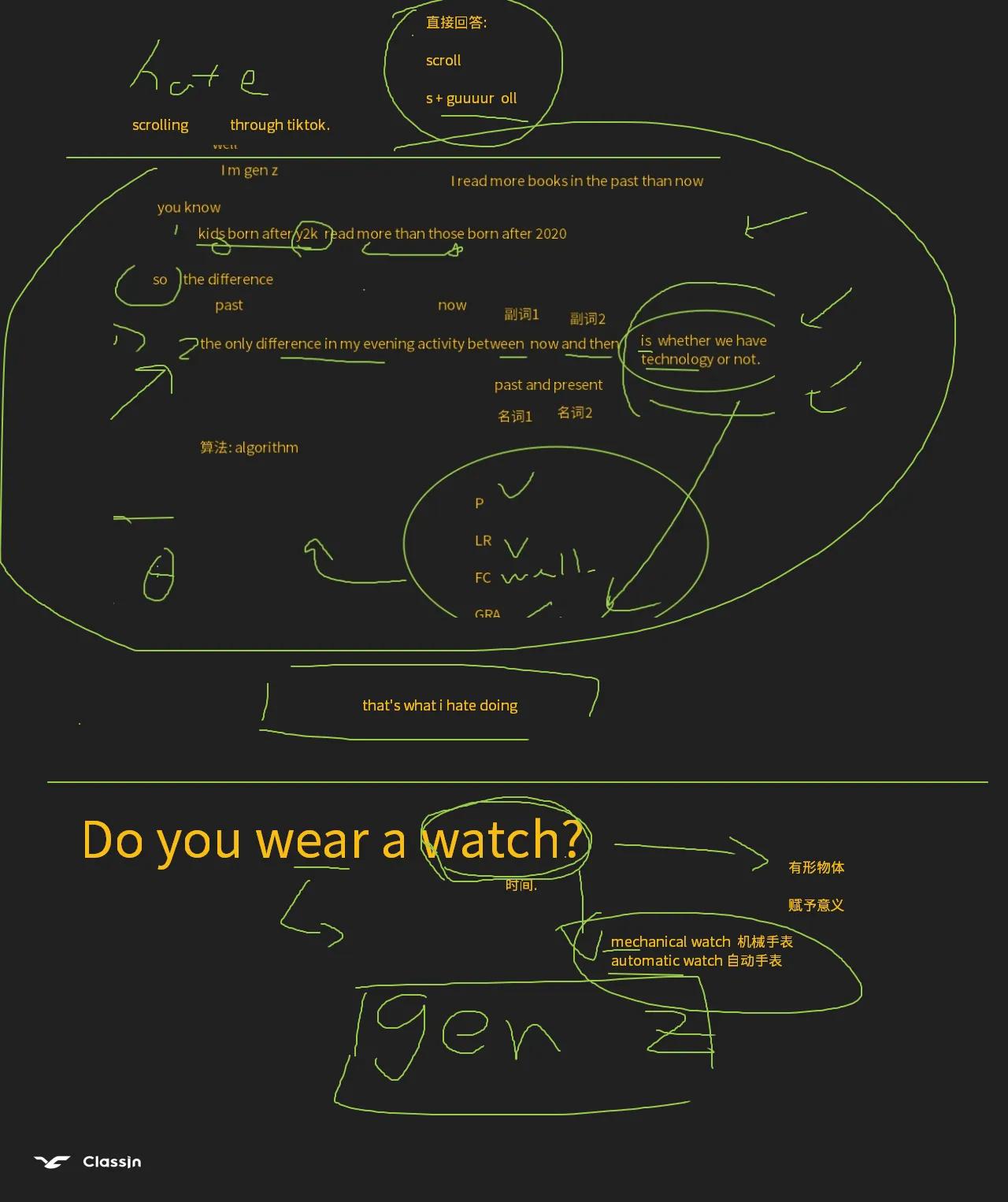
What do you hate doing in the evening?
直接回答:scrolling through TikTok.(板书标了 scroll 的读法:s + …oll)
that's what I hate doing.
💬 P1:Do you wear a watch?
板书的思路:watch?(时间)→ 有形物体 → 赋予意义。
也就是说:手表是有形物体,答题时往上赋予意义 —— 它代表的是时间、记忆、身份。
两个词:
- mechanical watch 机械手表
- automatic watch 自动手表
板书最后把 gen Z 写得大大的 —— 把"手表"和"Gen Z"的印象串起来说。
🔊 发音:TH 与 scroll
- TH:舌尖放在两牙之间,吹气。
- 对比练习:I think / sink;thought / thanks。
- scroll:板书把它拆成 s + …oll 标音,注意中间的卷舌音。
📖 词汇与表达
| 英文 | 中文 | 搭配 / 用法 |
|---|---|---|
| thermal | 火电的、热的 | The electricity produced by thermal stood at 125 TWh |
| nuclear | 核电的 | Nuclear and hydroelectric power |
| hydroelectric | 水电的 | The electricity produced by hydroelectric stood at 60 TWh |
| renewables | 可再生能源 | renewables remained stable at between 0 and 25 |
| stand at | (数字)停在 | stood at 125 TWh |
| reach | 达到 | V + 介词 + O(#) |
| remain stable | 保持稳定 | H relatively stable, but R small rise |
| increase to / increase by | 增加到 / 增加了 | increase to 400; increase by 300 |
| decrease / fall / drop | 下降 | by contrast, thermal + decrease |
| by contrast | 相比之下 | 对比连接词(CC 连贯性) |
| sharply / dramatically / significantly | 大幅地 | 幅度副词 |
| slightly / gradually / modestly | 略微、逐渐地 | 温和地 |
| trend | 趋势 | N and H, R 趋势 |
| overview | 概述 | 写最显眼的那一点 |
| scroll | 刷(手机) | scroll through my phone / scrolling through TikTok |
| generation | 一代人 | gen Z is the last generation after Y2K |
| Y2K | 千年虫(2000 年) | year 2000 |
| get to | 有幸能 | I get to = I'm lucky to |
| keep my memory of | 保有……的记忆 | keep my memory of growing up in the last decade without technology |
| algorithm | 算法 | 板书:算法:algorithm |
| mechanical watch | 机械手表 | 有形物体 |
| automatic watch | 自动手表 | 有形物体 |
| connected with a cable | 用线连着 | a mechanical keyboard connected with a cable |
| produced by | 由……发(产)出 | electricity produced by thermal |
| sway | 摇摆 | golden swaying in the wind |
⚠️ 提醒 / 易错
- 后置定语是"一句话压两句"的工具。 想说"电是火电发的,它停在 125"——不要拆成两句,直接 The electricity produced by thermal stood at 125 TWh.
- 过去分词 vs 现在分词:被动/完成用 -ed(produced、connected),主动/进行用 -ing(dancing、swaying)。
- 写线图先定图例。 第一步"定位出哪一个能源",四条线认错一条,后面全错。
- increase to 是"到",increase by 是"了"。 100→400 是 increase to 400 / increase by 300,别混。
- 数字句的动词分三类:stood at / reached(实义动词 + 介词)、was / were(系动词 + 表语)、rose / fell / dropped(不及物动词)。选动词之前先想清楚要不要介词。
- 口语里"now / then""past and present"是一对固定搭配。 "the only difference ... between now and then is whether we have technology or not." 这种对比句式,背下来直接能用。