📌 这节课讲了什么
这节课继续练阅读:读完一篇学术味很重的文章,要能用接地气的话把它总结出来。
文章是 Music and the emotions——先讲 Jonah Lehrer 对音乐情感力量的分析,再讲蒙特利尔研究团队用 fMRI + PET 做的实验(音乐触发多巴胺,而且是在「最爱的那一段到来之前」最活跃),最后用音乐学家 Leonard Meyer 对贝多芬升 C 小调弦乐四重奏的分析,解释「音乐的情绪来自期待落空」。
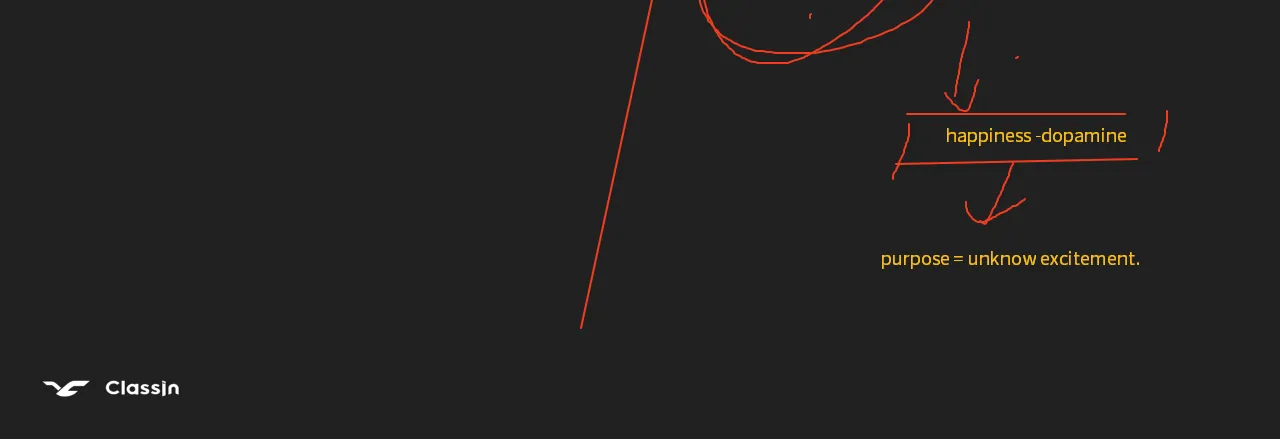
课上做了 Questions 32–36 五道单选,并在板书上把 subject 这个词的几种意思单独拎出来讲。最后落在几个大白话的总结词上:happiness – dopamine、purpose = unknown excitement。
🧱 方法:总结要落到"人话"上
板书最下面留了这么几组词,这就是这一课示范的接地气总结该长什么样:
| 板书上的落点 | 说的是什么 |
|---|---|
| events / symphony / notes | 文章从「事件」讲到「交响乐」再到「音符」,一层层往小里收 |
| predictable / unpredictable | 全文的轴:可预测 vs 不可预测 |
| happiness – dopamine | 幸福,对应到生理上就是多巴胺 |
| purpose = unknown excitement | 这件事的目的,就是那份「未知」带来的兴奋 |
一篇文章读完了,如果你只能说「讲了音乐和情绪」,那还是没读懂。要能说成:音乐好听,是因为它让你猜、又不让你猜中——这才叫总结。
板书角落里还留了一个词:battle symphony。
📝 这篇文章讲了什么
第一段:音乐凭什么能打动我们?
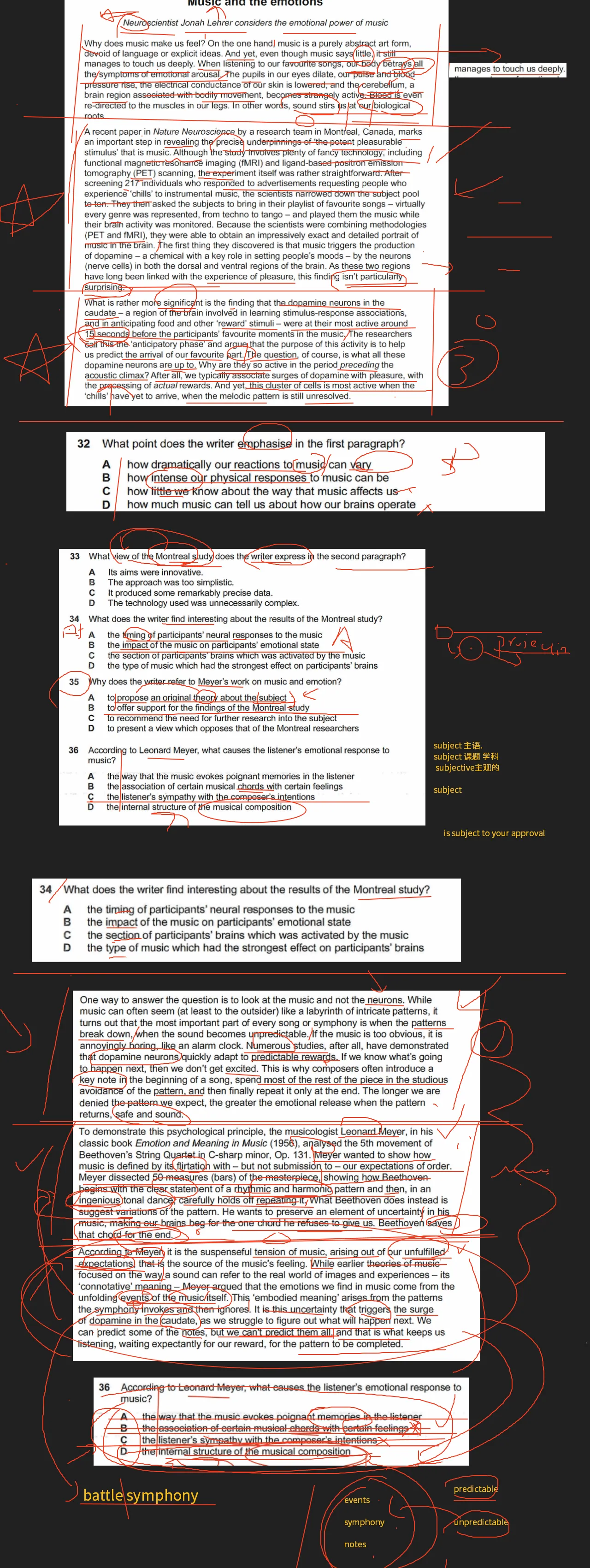
On the one hand, music is a purely abstract art form, devoid of language or explicit ideas. And yet, even though music says little, it still manages to touch us deeply.
接下来是一串身体的反应,全部是细节词,读的时候要能一眼扫出这是一组并列:
When listening to our favourite songs, our body betrays all the symptoms of emotional arousal. The pupils in our eyes dilate, our pulse and blood pressure rise, the electrical conductance of our skin is lowered, and the cerebellum, a brain region associated with bodily movement, becomes strangely active. Blood is even re-directed to the muscles in our legs. In other words, sound stirs us at our biological roots.
第二段:蒙特利尔研究
实验本身不复杂,复杂的是技术:
Although the study involves plenty of fancy technology, including functional magnetic resonance imaging (fMRI) and ligand-based positron emission tomography (PET) scanning, the experiment itself was rather straightforward.
受试者是筛选出来的——217 个应征者里,最后只留下 10 个人:
After screening 217 individuals who responded to advertisements requesting people who experience 'chills' to instrumental music, the scientists narrowed the subject pool to ten.
结果分两层。第一层不稀奇:音乐让多巴胺分泌,而多巴胺和愉悦有关的脑区早就在一起了。
As these two regions have long been linked with the experience of pleasure, this finding isn't particularly surprising.
第二层才是重点——多巴胺最活跃的时刻,是在「最爱的那一段」之前 15 秒:
What is rather more significant is the finding that the dopamine neurons in the caudate … were at their most active around 15 seconds before the participants' favourite moments in the music.
The researchers call this the 'anticipatory phase' and argue that the purpose of this activity is to help us predict the arrival of our favourite part.
文章自己也把这个疑问挑明了:
Why are they so active in the period preceding the acoustic climax? After all, we typically associate surges of dopamine with pleasure, with the processing of actual rewards. And yet, this cluster of cells is most active when the 'chills' have yet to arrive, when the melodic pattern is still unresolved.
第三段:答案在音乐本身,不在神经元
One way to answer the question is to look at the music and not the neurons.
While music can often seem (at least to the outsider) like a labyrinth of intricate patterns, it turns out that the most important part of every song or symphony is when the patterns break down, when the sound becomes unpredictable. If the music is too obvious, it is annoyingly boring, like an alarm clock.
Numerous studies, after all, have demonstrated that dopamine neurons quickly adapt to predictable rewards. If we know what's going to happen next, then we don't get excited.
This is why composers often introduce a key note in the beginning of a song, spend most of the rest of the piece in the studious avoidance of the pattern, and then finally repeat it only at the end. The longer we are denied the pattern we expect, the greater the emotional release when the pattern returns, safe and sound.
第四段:Meyer 与贝多芬
To demonstrate this psychological principle, the musicologist Leonard Meyer, in his classic book Emotion and Meaning in Music (1956), analysed the 5th movement of Beethoven's String Quartet in C-sharp minor, Op. 131.
Meyer wanted to show how music is defined by its flirtation with — but not submission to — our expectations of order.
According to Meyer, it is the suspenseful tension of music, arising out of our unfulfilled expectations, that is the source of the music's feeling.
Meyer argued that the emotions we find in music come from the unfolding events of the music itself. This 'embodied meaning' arises from the patterns the symphony invokes and then ignores.
We can predict some of the notes, but we can't predict them all, and that is what keeps us listening, waiting expectantly for our reward, for the pattern to be completed.
📝 五道题在问什么
| 题号 | 问的是 | 回原文哪一句 |
|---|---|---|
| 32 | 第一段想强调什么 | sound stirs us at our biological roots —— 一整段的瞳孔、脉搏、皮肤、小脑,都是在证明身体反应有多强烈 |
| 33 | 作者怎么看蒙特利尔研究 | marks an important step + an impressively exact and detailed portrait of music in the brain —— 作者是认可的,而且认可的是数据精确 |
| 34 | 研究结果里作者觉得有意思的是什么 | around 15 seconds before the participants' favourite moments —— 是时间点,不是情绪、不是脑区、不是音乐类型 |
| 35 | 为什么要提 Meyer | To demonstrate this psychological principle —— Meyer 是拿来印证前面那个心理机制的 |
| 36 | Meyer 认为情绪来自哪里 | the emotions we find in music come from the unfolding events of the music itself —— 来自音乐内部的结构/走向,不是回忆、不是和弦联想、不是作曲家的意图 |
看这几道题的关键动作:题目问 "what does the writer find interesting" 时,答案一定在 "rather more significant / particularly / impressively" 这类评价词后面。第 34 题的定位词就是 What is rather more significant is the finding that …。
💬 值得记住的英文原句
…even though music says little, it still manages to touch us deeply.
…the experiment itself was rather straightforward.
…narrowed the subject pool to ten.
…they were able to obtain an impressively exact and detailed portrait of music in the brain.
The longer we are denied the pattern we expect, the greater the emotional release when the pattern returns, safe and sound.
Music is defined by its flirtation with — but not submission to — our expectations of order.
It is the suspenseful tension of music, arising out of our unfulfilled expectations, that is the source of the music's feeling.
We can predict some of the notes, but we can't predict them all, and that is what keeps us listening, waiting expectantly for our reward.
📖 词汇与表达
| 英文 | 中文 | 搭配 / 用法 |
|---|---|---|
| abstract art form | 抽象艺术形式 | a purely abstract art form |
| devoid of | 缺乏 | devoid of language or explicit ideas |
| explicit | 明确的 | explicit ideas |
| manage to do | 设法做成 | it manages to touch us deeply |
| betray | 暴露、显露 | our body betrays all the symptoms |
| symptom | 症状 | the symptoms of emotional arousal |
| arousal | 唤起、激发 | emotional arousal |
| pupil | 瞳孔 | the pupils in our eyes dilate |
| dilate | 放大 | |
| pulse | 脉搏 | our pulse and blood pressure rise |
| electrical conductance | 导电性 | the electrical conductance of our skin |
| cerebellum | 小脑 | |
| bodily movement | 身体运动 | a brain region associated with bodily movement |
| re-direct | 改道、重新导向 | Blood is even re-directed to the muscles in our legs |
| stir | 激起 | sound stirs us at our biological roots |
| biological roots | 生物层面的根 | |
| mark an important step | 标志着重要一步 | marks an important step in revealing … |
| underpinnings | 基础、底层机制 | the precise underpinnings of the potent pleasurable stimulus |
| potent | 强烈的 | a potent pleasurable stimulus |
| stimulus | 刺激 | |
| fancy technology | 高级技术 | the study involves plenty of fancy technology |
| functional magnetic resonance imaging (fMRI) | 功能性磁共振成像 | |
| positron emission tomography (PET) | 正电子发射断层扫描 | ligand-based PET scanning |
| straightforward | 简单直接的 | the experiment itself was rather straightforward |
| screen | 筛选 | screening 217 individuals |
| respond to advertisements | 回应广告 | |
| chills | 战栗、起鸡皮疙瘩 | people who experience 'chills' to instrumental music |
| instrumental music | 器乐 | |
| narrow … to | 把……缩小到 | narrowed the subject pool to ten |
| subject pool | 受试者池 | |
| playlist | 歌单 | bring in their playlist of favourite songs |
| virtually | 几乎 | virtually every genre was represented |
| genre | 流派 | |
| techno / tango | 电子乐 / 探戈 | from techno to tango |
| monitor | 监测 | while their brain activity was monitored |
| methodology | 研究方法 | combining methodologies (PET and fMRI) |
| impressively | 令人印象深刻地 | an impressively exact and detailed portrait |
| portrait | 画像、描绘 | a portrait of music in the brain |
| trigger | 触发 | music triggers the production of dopamine |
| dopamine | 多巴胺 | |
| neuron | 神经元 | the dopamine neurons |
| dorsal / ventral | 背侧 / 腹侧 | the dorsal and ventral regions of the brain |
| caudate | 尾状核 | the dopamine neurons in the caudate |
| stimulus-response associations | 刺激—反应联结 | learning stimulus-response associations |
| anticipate | 预期 | in anticipating food and other 'reward' stimuli |
| at their most active | 最活跃的时候 | |
| anticipatory phase | 预期阶段 | the researchers call this the 'anticipatory phase' |
| predict | 预测 | help us predict the arrival of our favourite part |
| preceding | 在……之前 | in the period preceding the acoustic climax |
| acoustic climax | 声音的高潮 | |
| surge | 激增 | surges of dopamine |
| cluster of cells | 细胞群 | this cluster of cells |
| melodic pattern | 旋律模式 | the melodic pattern is still unresolved |
| unresolved | 未解决的 | |
| labyrinth | 迷宫 | like a labyrinth of intricate patterns |
| intricate | 繁复的 | |
| break down | 瓦解、不成立 | when the patterns break down |
| unpredictable | 不可预测的 | when the sound becomes unpredictable |
| obviously | 显而易见地 | If the music is too obvious |
| annoyingly boring | 无聊得让人烦 | |
| alarm clock | 闹钟 | like an alarm clock |
| adapt to | 适应 | dopamine neurons quickly adapt to predictable rewards |
| composer | 作曲家 | |
| key note | 关键的那个音 | introduce a key note in the beginning of a song |
| studious avoidance | 刻意的回避 | in the studious avoidance of the pattern |
| deny | 不给、拒绝给予 | The longer we are denied the pattern we expect |
| emotional release | 情绪的释放 | the greater the emotional release |
| safe and sound | 安然无恙 | when the pattern returns, safe and sound |
| musicologist | 音乐学家 | the musicologist Leonard Meyer |
| movement | 乐章 | the 5th movement |
| String Quartet in C-sharp minor, Op. 131 | 升 C 小调弦乐四重奏,作品 131 | Beethoven's String Quartet in C-sharp minor, Op. 131 |
| flirtation with | 与……若即若离 | its flirtation with our expectations of order |
| submission to | 屈服于 | but not submission to our expectations |
| dissect | 剖析 | Meyer dissected 50 measures |
| measure / bar | 小节 | 50 measures (bars) of the masterpiece |
| masterpiece | 杰作 | |
| rhythmic and harmonic pattern | 节奏与和声的模式 | |
| ingenious | 巧妙的 | in an ingenious tonal dance |
| tonal dance | 调性之舞 | |
| hold off | 推迟、压着不来 | carefully holds off repeating it |
| variation | 变体 | suggest variations of the pattern |
| preserve | 保留 | He wants to preserve an element of uncertainty |
| uncertainty | 不确定 | |
| beg for | 渴求 | making our brains beg for the one chord |
| chord | 和弦 | the one chord he refuses to give us |
| suspenseful tension | 悬而未决的张力 | the suspenseful tension of music |
| unfulfilled expectations | 未被满足的期待 | arising out of our unfulfilled expectations |
| connotative meaning | 内涵意义 | its 'connotative' meaning |
| unfolding events | 层层展开的事件 | the unfolding events of the music itself |
| embodied meaning | 具身的意义 | This 'embodied meaning' |
| invoke | 唤起 | the patterns the symphony invokes |
| ignore | 略过、不理 | and then ignores |
| figure out | 弄明白 | as we struggle to figure out what will happen next |
| expectantly | 满怀期待地 | waiting expectantly for our reward |
⚠️ 易错:subject 一家子
板书上专门辟了一块:
| 词 | 意思 | 例子 |
|---|---|---|
| subject | 主语 | 语法里的主语 |
| subject | 课题、学科 | the subject pool / the subject of the study |
| subjective | 主观的 | |
| be subject to | 取决于、须经…… | is subject to your approval |
同一个 subject,在文章里是「受试者 / 课题」,在语法里是「主语」,形容词形式又是「主观的」——这种词考试最爱拿来出干扰项。
另外两个读阅读时要小心的点:
- 文章里 turns out / rather more significant / particularly / impressively 这类词后面,往往就是出题点;
- 问到 "according to someone" 时,只认那个人的观点,别把作者在前面铺垫的话混进去。第 36 题问的是 Meyer 的看法,答案就只能落在 Meyer argued that … 那一句上。
🔁 同义替换核对
| 题目里的说法 | 原文里的说法 |
|---|---|
| how intense our physical responses to music can be | the pupils dilate / pulse and blood pressure rise / blood re-directed to the muscles |
| the approach was too simplistic | 原文相反:the experiment itself was rather straightforward |
| it produced some remarkably precise data | an impressively exact and detailed portrait of music in the brain |
| the timing of participants' neural responses | at their most active around 15 seconds before the favourite moments |
| the impact of the music on participants' emotional state | 原文强调的是 predict / anticipatory phase,不是情绪状态本身 |
| to offer support for the findings of the Montreal study | To demonstrate this psychological principle |
| the association of certain musical chords with certain feelings | 原文否定了这类说法,只留 the unfolding events of the music itself |
| the internal structure of the musical composition | the unfolding events of the music itself / 'embodied meaning' |