📌 这节课讲了什么
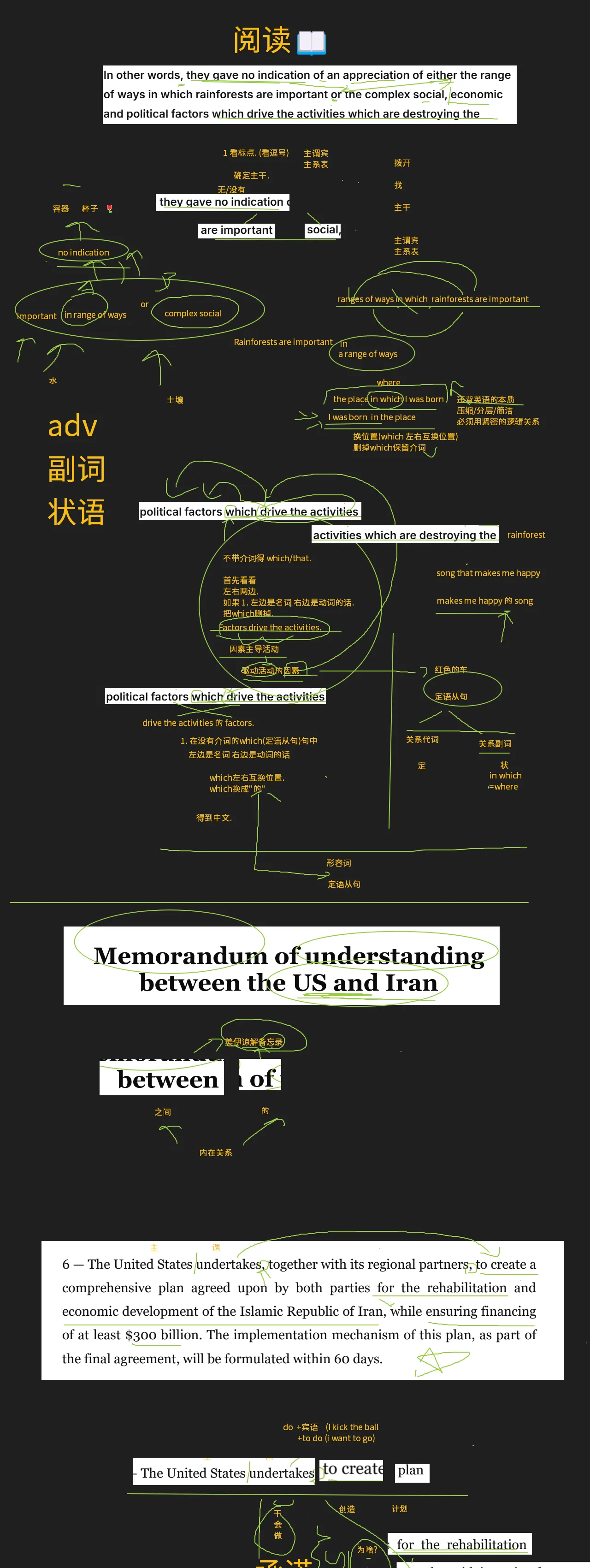
这节课解决一个问题:英语的长句子为什么看不懂。 板书给的答案很直接——句子的骨架只有主谓宾 / 主系表,其余的(adv 副词、状语、定语从句)都是后挂上去的;所以读句子要先做减法:先看标点、找逗号,确定主干,再回头处理挂在主干上的修饰。
课上过了三份材料:
- 一句 rainforest 的长句,示范「拨开修饰、找主干」,重点是定语从句里的 which / that 怎么处理,以及 in which = where;
- 《Memorandum of understanding between the US and Iran》里的一句话,演示逐词翻译、看语序;
- 真题 Roman shipbuilding and navigation:T/F/NG 第 1–5 题,以及 summary completion 第 6–13 题。
板书把第一步压成一句口诀:
1 看标点(找逗号) 主谓宾 / 主系表 —— 确定主干。无 / 没有。
🧱 方法一:容器思维 —— 主干是容器,修饰是倒进去的东西
板书用了一组比喻:容器 / 杯子是主干,水、土壤是往里加的东西。
课上的长句:
In other words, they gave no indication of an appreciation of either the range of ways in which rainforests are important or the complex social, economic and political factors which drive the activities which are destroying the rainforests.
板书的处理是:先把主干圈出来 —— they gave no indication(无 / 没有),其余部分一层层拨开:
| 板书原文 | 说明 |
|---|---|
| 宾:100% 名词 | 动词后面的宾语一定是名词性的东西 |
| indication of an appreciation | 「欣赏的表示」——of 前后套了两层名词 |
| an appreciation 的 indication,功能一样 | 前后两个名词指同一类东西,直接连成「……的」 |
| 定语 ==== 的 | 定语从句翻成中文,就是「……的」 |
| 主谓宾 / 主系表 | 定主干的两种基本形状 |
板书还在句子上标了「主、谓、宾」,以及关系代词(定)、关系副词(状)两类标记。
🧱 方法二:which / that 的两条处理路线
板书写的规则:
不带介词的 which / that:首先看看左右两边。如果左边是名词、右边是动词的话,把 which 删掉。 1. 在没有介词的 which(定语从句)中,左边是名词、右边是动词的话:which 左右互换位置; 2. which 换成「的」,得到中文。
套进句子:
political factors which drive the activities which are destroying the rainforests.
把 which 删掉,句子回到最朴素的主谓宾:Factors drive the activities.(因素主导活动)板书在旁边补了一步:被动 —— 活动为因素所主导。
而「的」的翻法是左右对调:
a song that makes me happy → makes me happy 的 song
the range of ways in which rainforests are important → rainforests are important in the range of ways
也就是板书上的两步:① 左右两边对调位置;② 把 which 删掉,保留介词 in。
两个对照:
| 形式 | 板书标注 |
|---|---|
| which / that | 关系代词 → 作定语 |
| in which | 关系副词 → 作状语;in which = where |
板书的例子:
the place (in which) I was born = I was born in the place
a place which / that → where
这一节最后落到「英语的本质」上:
注意英语的本质:压缩 / 分写 / 简洁,必须用紧密的逻辑关系。
🧱 方法三:逐词翻译,看语序
板书的标题句:Memorandum of understanding between the US and Iran。
处理方式:逐词翻,先看语序——
- between → 之间
- of → 的
- 板书批注:内在关系
🔍 第 6 条:一个长句怎么分层
The United States undertakes, together with its regional partners, to create a comprehensive plan agreed upon by both parties for the rehabilitation and economic development of the Islamic Republic of Iran, while ensuring financing of at least $300 billion. The implementation mechanism of this plan, as part of the final agreement, will be formulated within 60 days.
板书先给了结构提示:
do + 宾语(I kick the ball) / + to do(I want to go)
然后取主干:The United States undertakes / to create / plan(主 · 谓 · 宾),旁边标注:
- 承诺(undertake)
- 干什么:做、创造、计划
- 为啥? → for the rehabilitation
同一屏的英文色块把层次标了出来:
- together with its regional partners —— 如何 / 方式
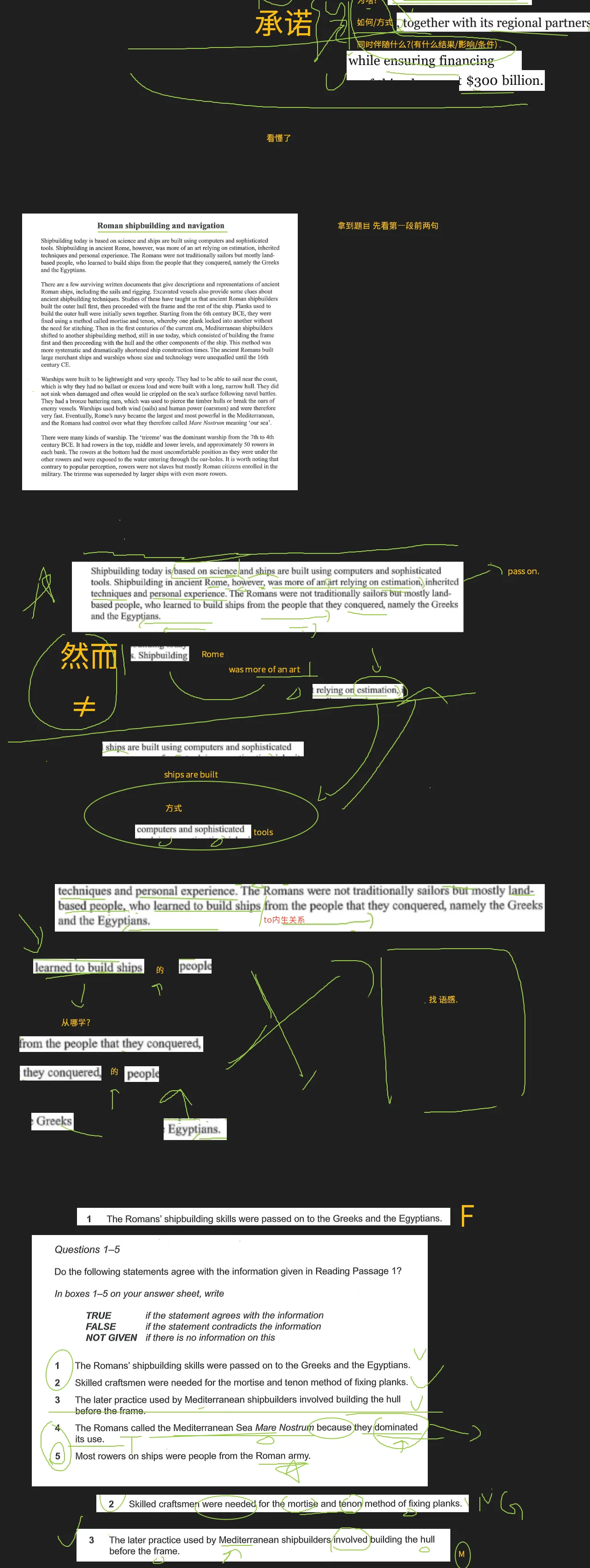
- while ensuring financing(of at least)$300 billion —— 同时伴随什么(有什么结果 / 影响 / 危害)
📝 这节课练了什么:Roman shipbuilding and navigation
第一段(先看前两句)
板书提醒:拿到题目,先看第一段前两句。
Shipbuilding today is based on science and ships are built using computers and sophisticated tools. Shipbuilding in ancient Rome, however, was more of an art relying on estimation, inherited techniques and personal experience. The Romans were not traditionally sailors but mostly land-based people, who learned to build ships from the people that they conquered, namely the Greeks and the Egyptians.
板书的批注:
- 然而 ≠ —— however 一出现,前后就是相反的两半:今天是 science,古罗马是 art;
- ships are built using computers and sophisticated tools —— 标了「方式」;
- learned to build ships 的 people —— 「的」字结构;
- 从哪学? → from the people that they conquered;they conquered 的 people;
- to 内生关系;找语感。
T/F/NG(第 1–5 题)
Instruction:TRUE if the statement agrees with the information / FALSE if the statement contradicts the information / NOT GIVEN if there is no information on this.
| 题 | 题干 | 板书标注 |
|---|---|---|
| 1 | The Romans' shipbuilding skills were passed on to the Greeks and the Egyptians. | F |
| 2 | Skilled craftsmen were needed for the mortise and tenon method of fixing planks. | NG |
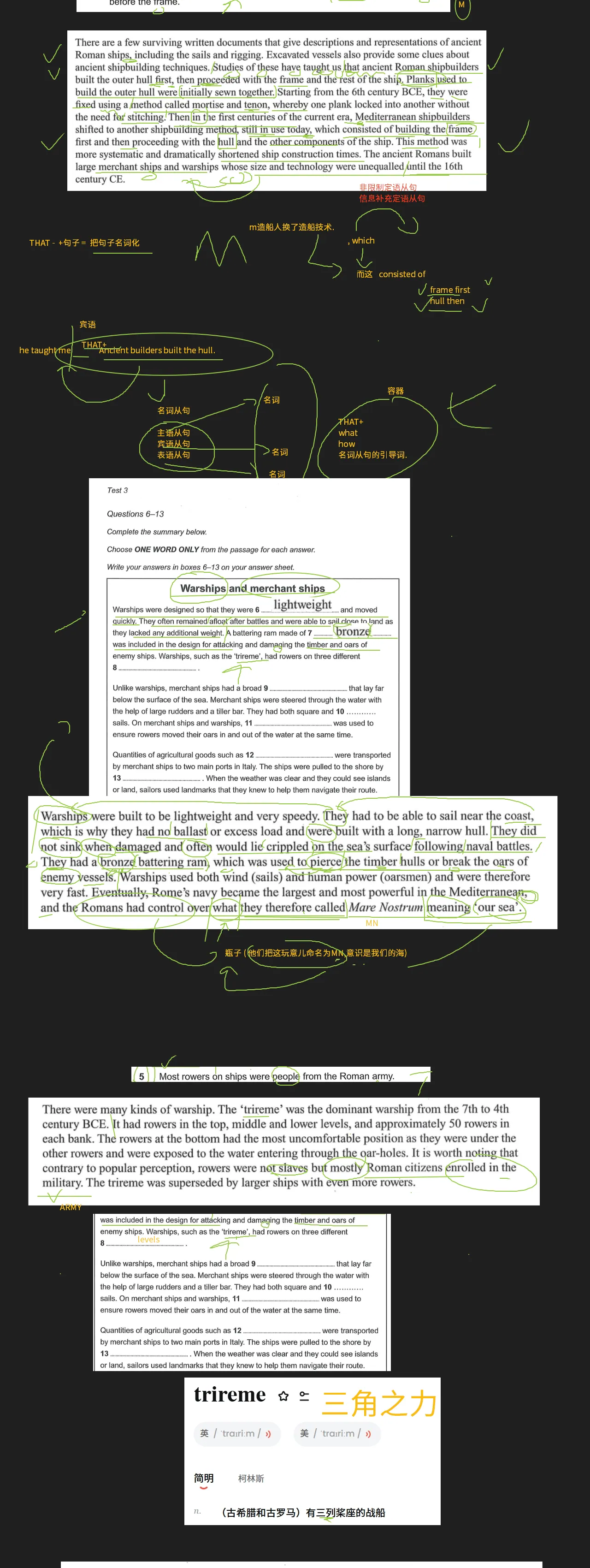
| 3 | The later practice used by Mediterranean shipbuilders involved building the hull before the frame. | 板书未标出可辨认的答案 |
| 4 | The Romans called the Mediterranean Sea Mare Nostrum because they dominated its use. | 板书未标出可辨认的答案 |
| 5 | Most rowers on ships were people from the Roman army. | 板书未标出可辨认的答案 |
- 第 1 题的原文依据就是第一段最后一句:Romans 是 learned to build ships from the Greeks and the Egyptians ——「从希腊人和埃及人那里学」,题目说「传给希腊人和埃及人」,方向正相反,所以 F。
- 第 2 题:原文只写到 mortise and tenon 是一种把木板锁在一起、不用缝的方法(one plank locked into another without the need for stitching),没有出现 craftsmen,题目多出来的信息原文没有,标 NG。
- 第 4、5 题板书上圈的是题眼:Mare Nostrum 那句圈了 Nostrum / because they dominated;第 5 题圈了 people。这两题板书没有标答案。
summary completion(第 6–13 题)
Test 3 的 Warships and merchant ships,Choose ONE WORD ONLY from the passage。板书上填出来的答案:
| 题 | 答案 |
|---|---|
| 6 | lightweight |
| 7 | bronze |
| 8 | levels |
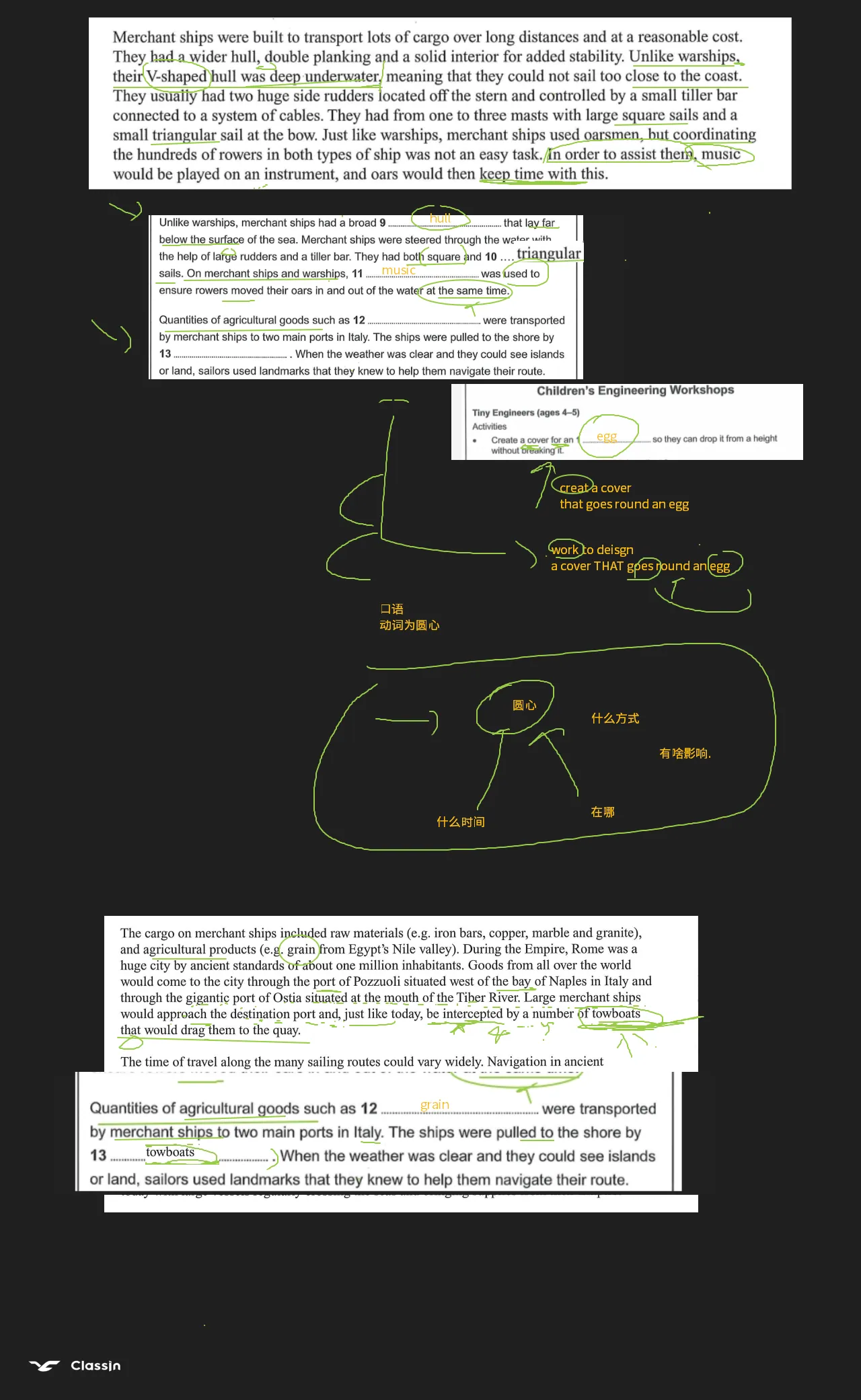
| 9 | hull |
| 10 | triangular |
| 11 | music |
| 12 | grain |
| 13 | towboats |
对应的原文(板书逐句划过线):
Warships were built to be lightweight and very speedy. ... They had a bronze battering ram, which was used to pierce the timber hulls or break the oars of enemy vessels. ... Warships, such as the 'trireme', had rowers on three different levels.
Unlike warships, merchant ships had a broad hull that lay far below the surface of the sea. ... They had both square and triangular sails. On merchant ships and warships, music was used to ensure rowers moved their oars in and out of the water at the same time.
Quantities of agricultural goods such as grain were transported by merchant ships to two main ports in Italy. The ships were pulled to the shore by towboats.
板书还贴了词典释义:trireme 英 /ˈtraɪriːm/ 美 /ˈtraɪriːm/,名词,(古希腊和古罗马)有三列桨座的战船;旁边写着 三角之力。
时间线:段落里的时间词
Starting from the 6th century BCE, they were fixed using a method called mortise and tenon ... Then in the first centuries of the current era, Mediterranean shipbuilders shifted to another shipbuilding method, still in use today, which consisted of building the frame first and then proceeding with the hull and the other components of the ship. ... were unequalled until the 16th century CE.
板书在这句上标了:非限制性定语从句 / 信息补充定语从句 —— which 引导的这一段是给前面的 method 做补充说明,不参与主干。旁边还标了这层意思:造船人换了(改)方法。
名词从句:THAT + 句子 = 把句子名词化
板书用一整个圈图讲 THAT + 句子 = 把句子名词化,把名词从句分成三类:
| 类型 | 说明 |
|---|---|
| 主语从句 | 从句放到句子开头当主语 |
| 宾语从句 | 从句放到动词后面当宾语 |
| 表语从句 | 从句放到系动词后面 |
引导词:that / what / how。板书把名词从句整体画成一个容器;例句:
he taught me that Ancient builders built the hull.
🗣 顺带的口语点:动词为圆心
板书在 Children's Engineering Workshops 那段材料旁边做了迁移:
Tiny Engineers (ages 4–5) Activities: Create a cover for an egg so they can drop it from a height without breaking it.
板书改写成:
create a cover that goes round an egg
work to design a cover THAT goes round an egg
然后画了一个圆心,写着:口语,动词为圆心;四周挂着四个问题:
- 什么时间
- 在哪
- 什么方式
- 有啥影响
📖 词汇与表达
| 英文 | 中文 | 搭配 / 用法 |
|---|---|---|
| indication | 表示、迹象 | give no indication of ... |
| appreciation | 欣赏、感激 | an appreciation of ... |
| range of ways | 一系列方式 | in a range of ways |
| rainforest | 雨林 | destroying the rainforests |
| undertake | 承诺、着手 | The United States undertakes to ... |
| rehabilitation | 重建、恢复 | for the rehabilitation and economic development of ... |
| implementation mechanism | 执行机制 | The implementation mechanism of this plan |
| formulate | 制定 | will be formulated within 60 days |
| however | 然而 | 前后意思相反 |
| estimation | 估计 | rely on estimation |
| inherited | 继承来的 | inherited techniques |
| conquer | 征服 | the people that they conquered |
| hull | 船体 | build the outer hull first |
| frame | 骨架、框架 | building the frame first |
| plank | 木板 | planks were initially sewn together |
| mortise and tenon | 榫卯 | fixed using a method called mortise and tenon |
| stitching | 缝合 | without the need for stitching |
| current era | 公元初 | the first centuries of the current era |
| rigging | 索具 | including the sails and rigging |
| excavated vessels | 出土的船 | provide some clues |
| clue | 线索 | provide some clues about ... |
| systematic | 系统的 | This method was more systematic |
| unequalled | 无与伦比 | whose size and technology were unequalled |
| warship | 战舰 | 板书标:战列舰 |
| merchant ship | 商船 | transport lots of cargo |
| lightweight | 轻的 | built to be lightweight |
| battering ram | 撞角 | a bronze battering ram |
| bronze | 青铜 | made of bronze |
| timber | 木材 | pierce the timber hulls |
| oars | 桨 | break the oars of enemy vessels |
| ballast | 压舱物 | they had no ballast or excess load |
| crippled | 被打残的 | lie crippled on the sea's surface |
| pierce | 刺穿 | used to pierce the timber hulls |
| oarsmen | 桨手 | used both wind and human power |
| navy | 海军 | Rome's navy became the largest |
| Mare Nostrum | 「我们的海」 | meaning 'our sea' |
| trireme | 三列桨座战船 | had rowers on three different levels |
| rower | 桨手 | approximately 50 rowers in each bank |
| oar-holes | 桨孔 | water entering through the oar-holes |
| enrolled | 入伍、注册 | citizens enrolled in the military |
| superseded | 被取代 | superseded by larger ships |
| cargo | 货物 | transport lots of cargo |
| double planking | 双层船板 | a wider hull, double planking |
| stability | 稳定性 | a solid interior for added stability |
| V-shaped | V 形的 | their V-shaped hull was deep underwater |
| rudders | 舵 | two huge side rudders |
| stern | 船尾 | located off the stern |
| tiller bar | 舵柄 | controlled by a small tiller bar |
| masts | 桅杆 | from one to three masts |
| square sails | 方帆 | large square sails |
| triangular sail | 三角帆 | a small triangular sail at the bow |
| bow | 船头 | at the bow |
| keep time | 跟着节拍 | oars would then keep time with this |
| raw materials | 原材料 | iron bars, copper, marble and granite |
| grain | 谷物 | grain from Egypt's Nile valley |
| inhabitants | 居民 | about one million inhabitants |
| port | 港口 | the port of Pozzuoli |
| quay | 码头 | drag them to the quay |
| towboats | 拖船 | pulled to the shore by towboats |
| intercepted | 被拦截、被接应 | be intercepted by a number of towboats |
| landmarks | 地标 | sailors used landmarks |
| navigate | 导航 | help them navigate their route |
⚠️ 提醒 / 易错
- however 一出现,后面就是对前面的反转 —— 板书标的「然而 ≠」,阅读里这种地方最常出题。
- 方向类改写要盯住:pass on to ↔ learn from,一个是「我教你」、一个是「我跟你学」,方向反了,答案就是 F。
- 题目里多出来的信息 = 无中生有:第 2 题的 skilled craftsmen 原文没有,标 NG。
- which 前有没有介词,是两条路:没介词 → 删掉 which 直接拿到主谓宾;有介词 → 删掉 which、保留介词(in which = where)。
- 非限制性定语从句是补充信息,读的时候可以先跳过,主干照样成立。
- 时间词是最好用的定位词:6th century BCE / first centuries of the current era / 16th century CE。
- 先看标点、找逗号,把逗号当层次线;主干的判断标准永远是主谓宾 / 主系表。