📌 这节课讲了什么
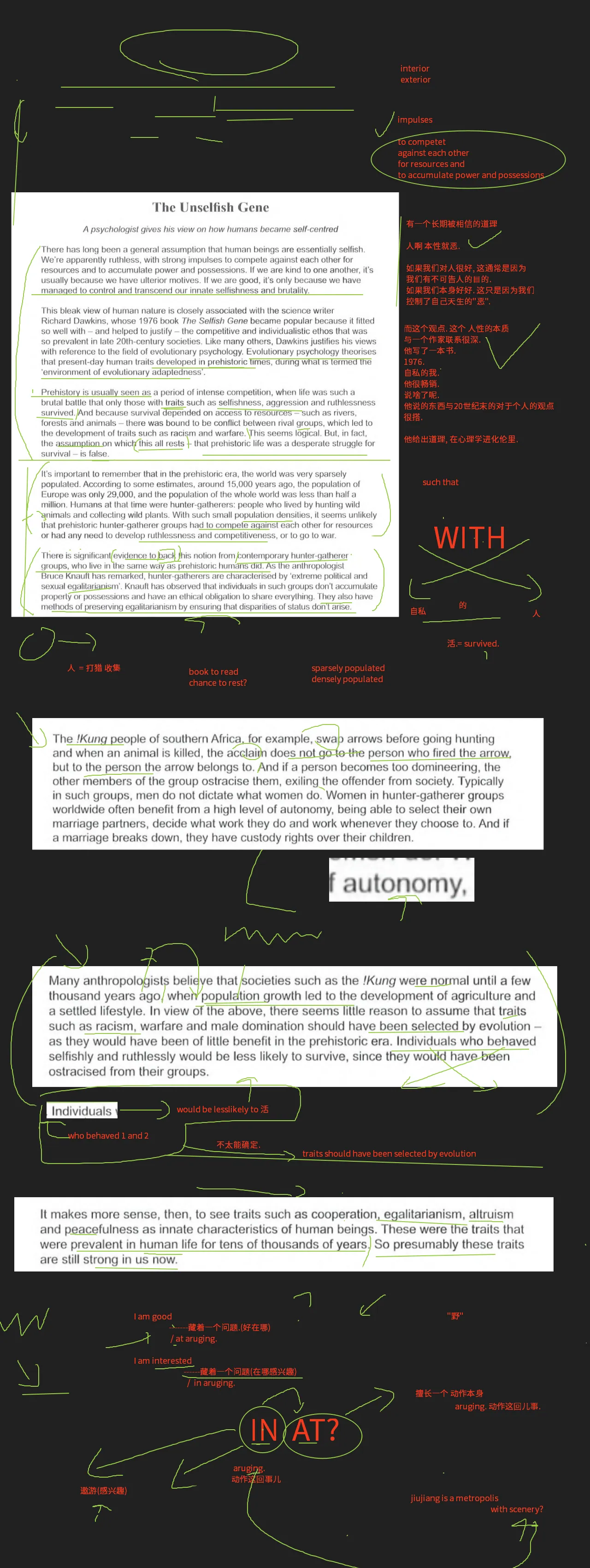
这节课用的是一篇阅读文章 The Unselfish Gene(副标题 A psychologist gives his view on how humans became self-centred),做完 27–30 四道选择题。但重点不在答案,在读句子的方式和读选项的思维:
- 把文章里几处「看起来很长、其实主干很短」的句子拆开,反复确认谁在做什么;
- 把几个容易被忽略的介词和结构钉死:
with、such ... that、see ... as、in(领域/方式)、be good at / be interested in; - 用四道选择题练选项语言的辨析 —— justifying his opinion、describing a belief、explaining why 说的其实不是一回事。
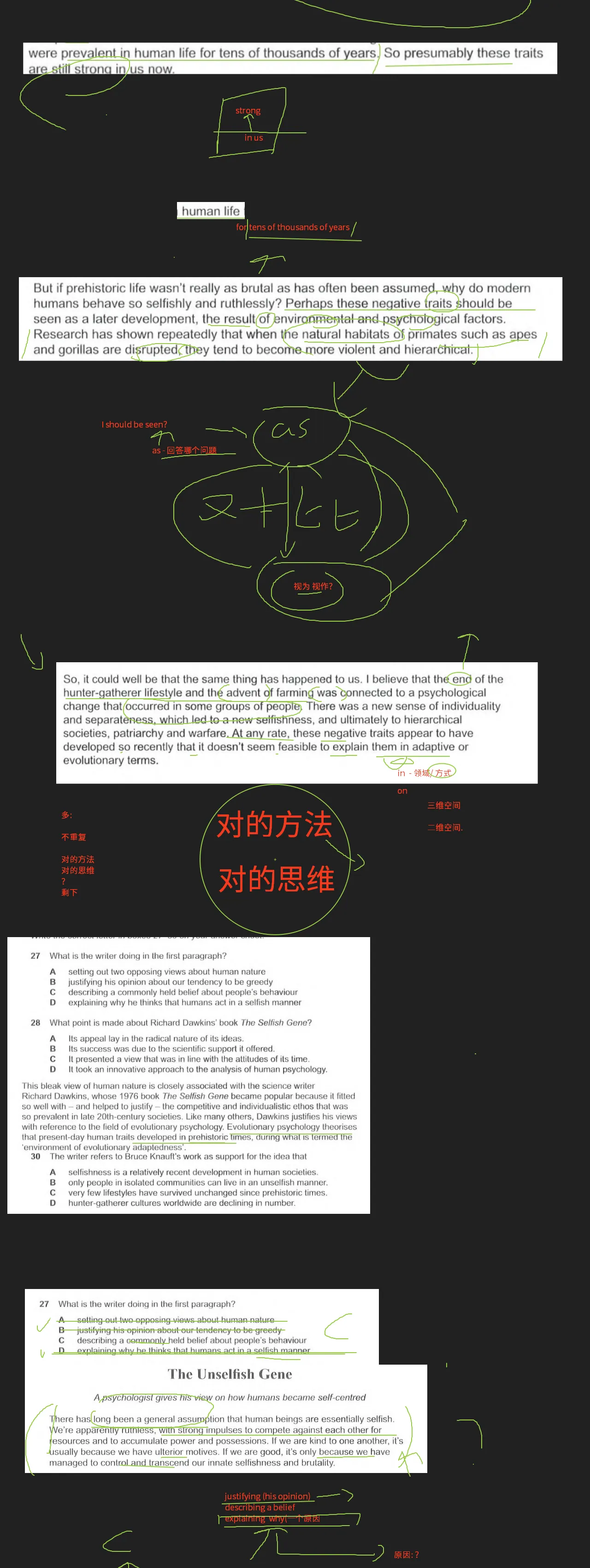
板书上给这节课定的题眼,是圈成大字的两行:对的方法 · 对的思维。旁边还留了一列小字:多: 不重复 对的方法 对的思维 ? 剩下。
课题叫「阅读不要浮躁」,讲的正是这件事:别在长句子上慌,也别在长选项上飘。
🧱 方法:句子先读成骨架
板书的题眼是:
对的方法 · 对的思维
围绕三个动作展开。
1. 主干先立住,修饰往里挂。
文章第一段:
We're apparently ruthless, with strong impulses to compete against each other for resources and to accumulate power and possessions.
板书的处理是先把 impulses 提出来,再把后面那一长串圈成一个整体:
- impulses
- to compete
- against each other
- for resources and
- to accumulate power and possessions
也就是说:主干只有 We're apparently ruthless;从 with 开始,全是挂在 we 身上的修饰 —— 有一堆「想跟别人抢资源、想攒权力和财产」的冲动。
2. 不要被 with 绊住。
板书中间用红笔写了一个大字 WITH,下面画了一个大叉,右边排着三个字:
自私 … 的 … 人
再往下一行:
活. = survived.
把这两行连起来看,就是老师当时拆的那一句:
Prehistory is usually seen as a period of intense competition, when life was such a brutal battle that only those with traits such as selfishness, aggression and ruthlessness survived.
读到 those with traits such as selfishness ... 时,不要停在 with 上,直接读成「自私的那种人」;survived 就是「活下来」。整句是:只有「自私、好斗、无情」的那批人活了下来。
同一段里还有一句,板书在旁边标了「人 = 打猎 收集」:
Humans at that time were hunter-gatherers: people who lived by hunting wild animals and collecting wild plants.
冒号后面的 people 就是前面的 humans,who lived by ... 是挂在 people 后面的定语 —— 人 = 靠打猎和采集野生动植物活着的人。
板书中间还留了两个「名词 + to do」的小例子:
book to read / chance to rest?
3. 分清哪句是「判断」,哪句是「事实」。
Individuals who behaved selfishly and ruthlessly would be less likely to survive, since they would have been ostracised from their groups.
板书把 Individuals 单独框出来,写成一条链:
Individuals→who behaved 1 and 2→would be less likely to 活
这里的 1 和 2,指的就是前面那两种行为:behaved selfishly and ruthlessly。后面还跟了一句提醒:
不太能确定. / traits should have been selected by evolution
—— should have been selected 这种说法语气上是不确定的(「按理说本该被进化选中」),不能读成板上钉钉的事实。
📄 文章在讲什么(The Unselfish Gene)
文章的骨架,板书上每段都在:
| 段 | 大意 |
|---|---|
| 1 | 一直有一个被相信的道理:人啊本性就恶。「如果我们对人很好,这通常是因为我们有不可告人的目的;如果我们本身好好,这只是因为我们控制了自己天生的『恶』。」 |
| 2 | 这个观点「与一个作家联系很深。他写了一本书,1976。《自私的我》。他很畅销。说啥了呢?他说的东西与 20 世纪末的对于个人的观点很搭。」 |
| 3 | 前史被看成一场恶斗,但这个前提是假的 |
| 4 | 史前世界人烟稀少,竞争资源的必要性很低 |
| 5–6 | 当代狩猎采集群体(如 !Kung)是平等主义的,女性有很高的 autonomy |
| 7 | 种族主义、战争、男性支配这些特征,在史前并无好处 |
| 8 | 合作、平等主义、利他、和平,才是人天生的特征 |
| 9–10 | 自私残暴是后来才出现的:环境与心理因素;狩猎采集生活的结束与农耕的到来,带来了新的自我意识 |
课上反复看的几句:
There has long been a general assumption that human beings are essentially selfish.
This bleak view of human nature is closely associated with the science writer Richard Dawkins, whose 1976 book The Selfish Gene became popular because it fitted so well with – and helped to justify – the competitive and individualistic ethos that was so prevalent in late 20th-century societies.
It's important to remember that in the prehistoric era, the world was very sparsely populated.
It makes more sense, then, to see traits such as cooperation, egalitarianism, altruism and peacefulness as innate characteristics of human beings. These were the traits that were prevalent in human life for tens of thousands of years. So presumably these traits are still strong in us now.
最后这一句,板书做了两处标记:human life 后面挂 for tens of thousands of years(时间挂在名词后面);strong 后面挂 in us(强在「我们身上」)。
🔍 长难句拆解
| 句子 | 板书上的标记 | 怎么读 |
|---|---|---|
| We're apparently ruthless, with strong impulses to compete against each other for resources and to accumulate power and possessions. | 把 to compete / against each other / for resources / to accumulate power and possessions 整串圈住 |
主干 We're ruthless;后面整串挂在 we 身上 |
| Prehistory is usually seen as a period of intense competition, when life was such a brutal battle that only those with traits such as selfishness, aggression and ruthlessness survived. | 标了 such that;把 WITH 打叉,写成「自私 的 人」「活. = survived.」 |
such ... that = 到这种程度以至于;those with X = 「有 X 的那种人」 |
| It makes more sense, then, to see traits such as cooperation, egalitarianism, altruism and peacefulness as innate characteristics of human beings. | 在 cooperation, egalitarianism, altruism 和 and peacefulness as innate characteristics of human beings 下划了线 |
see A as B = 把 A 看作 B |
| Perhaps these negative traits should be seen as a later development, the result of environmental and psychological factors. | 板书单独写了 I should be seen?、as - 回答哪个问题、视为 视作? |
be seen as = 被视为 / 被视作 |
| At any rate, these negative traits appear to have developed so recently that it doesn't seem feasible to explain them in adaptive or evolutionary terms. | 圈出 in adaptive or evolutionary terms,旁注 in - 领域/方式 |
in ... terms = 用…的框架 / 说法来讲 |
| Research has shown repeatedly that when the natural habitats of primates such as apes and gorillas are disrupted, they tend to become more violent and hierarchical. | 圈出 environmental and psychological factors、natural habitats、disrupted |
when 从句 + tend to do |
介词那两行小字,板书是并排写的:
in - 领域 / 方式 / on / 三维空间 / 二维空间
in 后面接的是一整块「领域、方式」;on 后面接的是「面」。
📝 这节课做的四道题(27–30)
四道选择题问的都是「作者在做什么 / 某处说明了什么」,不是找细节。板书上留的痕迹:
| 题 | 板书上的痕迹 |
|---|---|
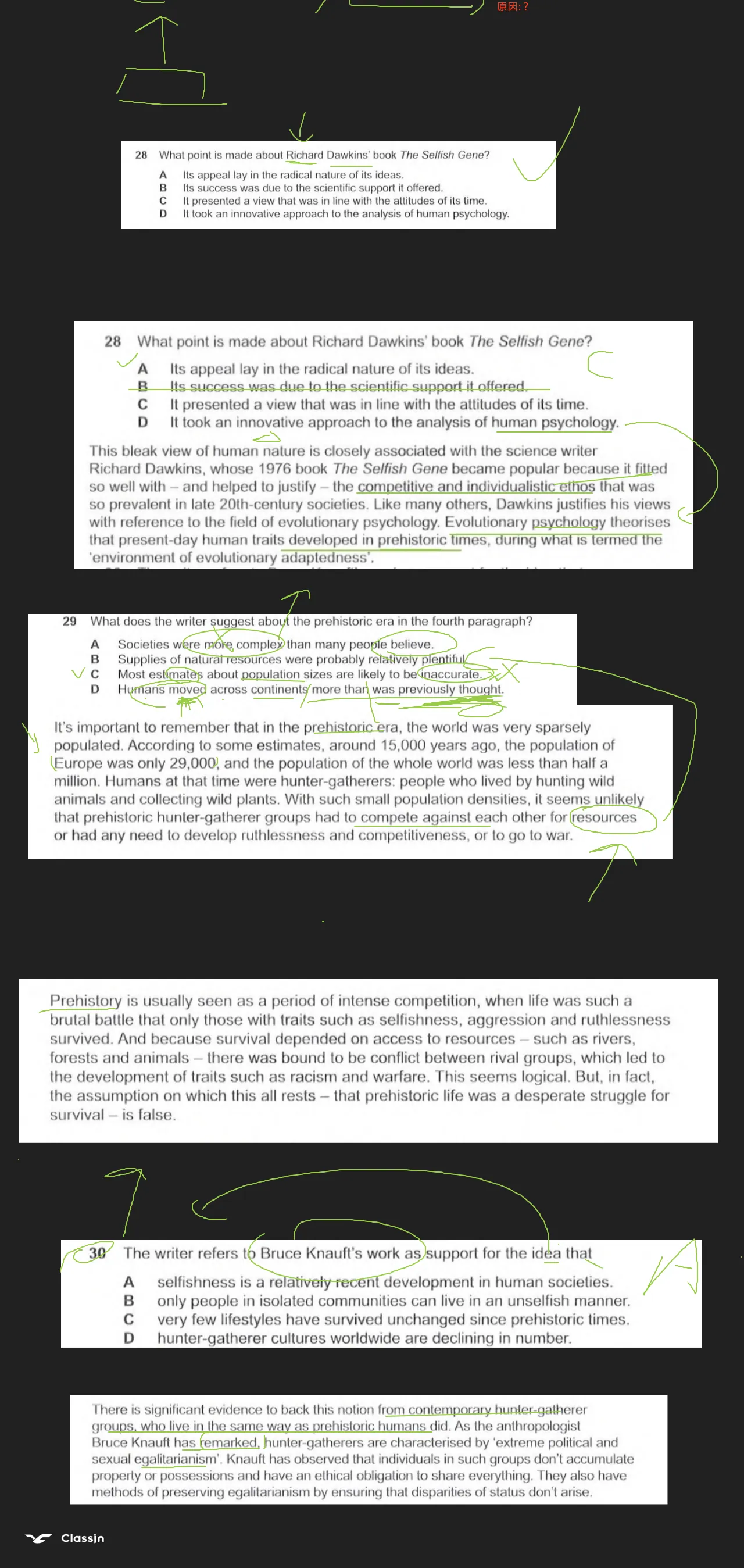
| 27 | A、B、D 全被划掉,只留 C |
| 28 | B 被划掉,A 旁边有一个勾 |
| 29 | A、C、D 都被划掉或打叉;B 里的 relatively plentiful 被圈 |
| 30 | 只在题干 support for the idea that 上圈了一下,没留答案 |
27 / What is the writer doing in the first paragraph?
题干 ↔ 原文:
There has long been a general assumption that human beings are essentially selfish. ... If we are kind to one another, it's usually because we have ulterior motives. If we are good, it's only because we have managed to control and transcend our innate selfishness and brutality.
第一段从头到尾都在陈述「有一个长期被相信的道理」,没有反驳,也没有解释原因。板书把第一段几乎每句都划了下划线,并在旁边那行红字「人啊本性就恶」后面画了一个勾。
选项词的辨析(板书专门写了三行红字,前两行还画了下划线):
| 选项里的写法 | 板书旁注 | 意思 |
|---|---|---|
| justifying (his opinion) | 为「自己的」观点辩护 —— 主语得是他本人的看法 | |
| describing a belief | 描述一个(别人持有的)信念 | |
| explaining why | (一个原因) | 解释原因 —— 后面必须跟一个原因 |
板书右边还跟着一个小问号:原因:?
28 / What point is made about Richard Dawkins' book The Selfish Gene?
题干 ↔ 原文:
whose 1976 book The Selfish Gene became popular because it fitted so well with – and helped to justify – the competitive and individualistic ethos that was so prevalent in late 20th-century societies.
板书把 competitive and individualistic ethos、prehistoric times、environment of evolutionary adaptedness 这几处划了下划线。
29 / What does the writer suggest about the prehistoric era in the fourth paragraph?
题干 ↔ 原文:
in the prehistoric era, the world was very sparsely populated ... With such small population densities, it seems unlikely that prehistoric hunter-gatherer groups had to compete against each other for resources ...
板书把原文里的 resources 圈出来,箭头指回选项 Supplies of natural resources were probably relatively plentiful;旁边另写了两个词对着看:
sparsely populated / densely populated
—— 一稀一密,「资源够不够」是从「人多人少」推出来的。
30 / The writer refers to Bruce Knauft's work as support for the idea that
这一题板书没留答案,只圈了题干里的 support for the idea that。对应的原文是:
As the anthropologist Bruce Knauft has remarked, hunter-gatherers are characterised by 'extreme political and sexual egalitarianism'. Knauft has observed that individuals in such groups don't accumulate property or possessions and have an ethical obligation to share everything.
以及后面一整段 !Kung 的例子:swap arrows before going hunting、the acclaim does not go to the person who fired the arrow、women ... benefit from a high level of autonomy。
📖 词汇与表达
| 英文 | 中文 | 搭配 / 用法 |
|---|---|---|
| assumption | 假设、想当然的看法 | There has long been a general assumption that ... |
| ruthless | 无情的 | We're apparently ruthless. |
| impulses | 冲动 | impulses to compete against each other |
| ulterior motives | 不可告人的目的 | we have ulterior motives |
| innate | 天生的、内在的 | innate selfishness and brutality |
| transcend | 超越、超脱 | control and transcend our innate selfishness |
| bleak | 黯淡的、悲观的 | This bleak view of human nature |
| ethos | 风气、思潮 | the competitive and individualistic ethos |
| prevalent | 盛行的 | so prevalent in late 20th-century societies |
| environment of evolutionary adaptedness | 进化适应环境 | 原文加了引号 |
| sparsely populated | 人口稀少 | the world was very sparsely populated |
| densely populated | 人口稠密 | 与上词相对 |
| hunter-gatherer | 狩猎采集者 | hunter-gatherer groups |
| egalitarianism | 平等主义 | extreme political and sexual egalitarianism |
| autonomy | 自主权 | benefit from a high level of autonomy |
| ostracise | 排斥、放逐 | ostracised from their groups |
| domineering | 专横的 | if a person becomes too domineering |
| acclaim | 赞誉、功劳 | the acclaim does not go to the person who fired the arrow |
| custody rights | 监护权 | they have custody rights over their children |
| altruism | 利他 | cooperation, egalitarianism, altruism and peacefulness |
| patriarchy | 父权制 | hierarchical societies, patriarchy and warfare |
| hierarchical | 分等级的 | they tend to become more violent and hierarchical |
| advent | 到来、出现 | the advent of farming |
| feasible | 可行的 | it doesn't seem feasible to explain them ... |
| disrupted | 被打乱 | the natural habitats ... are disrupted |
| in ... terms | 用…的说法 / 框架 | in adaptive or evolutionary terms |
| interior / exterior | 内部 / 外部 | 板书旁注 |
| metropolis | 大都市 | jiujiang is a metropolis with scenery? |
⚠️ 提醒 / 易错
1. 别在 with 上停住。 板书那个大叉就是提醒:those with traits such as selfishness, aggression and ruthlessness 不要读成「带着…的那些」,直接读成「自私、好斗、无情的人」。
2. such ... that 和 such as 是两回事。 同一个句子里两个都有:life was such a brutal battle that ...(…到这种程度,以至于…)对 traits such as selfishness(比如)。
3. 形容词后面藏着一个问题。 板书专门写了一组:
I am good —— 藏着一个问题.(好在哪) / at arguing.
I am interested —— 藏着一个问题(在哪感兴趣) / in arguing.
所以是 be good at + 一个动作、be interested in + 一个动作。板书中间圈了一个大大的 IN AT?,旁边写着:
擅长一个动作本身 arguing. 动作这回事儿.
遨游(感兴趣)
—— 介词后面跟的是「动作」,所以动词要变成 -ing,这就是写 arguing 而不是 argue 的原因。
4. 「按理说」不等于「事实」。 should have been selected by evolution、would have been of little benefit 这一类,板书旁标了「不太能确定」—— 读的时候要读出这层不确定。
5. 这节课的题眼。 板书上那一列小字,是老师当时记下的提醒:
多:/不重复/对的方法/对的思维/?/剩下
圈成大字、被强调的只有中间那一句。信息多、句子长、选项绕的时候,方法和思维对了,后面的自然就顺了 —— 也就是这节课的标题:阅读不要浮躁。