📌 这节课讲了什么
板书文件名是 how to write and listen —— 怎么写、怎么听,是这节课的两条腿。
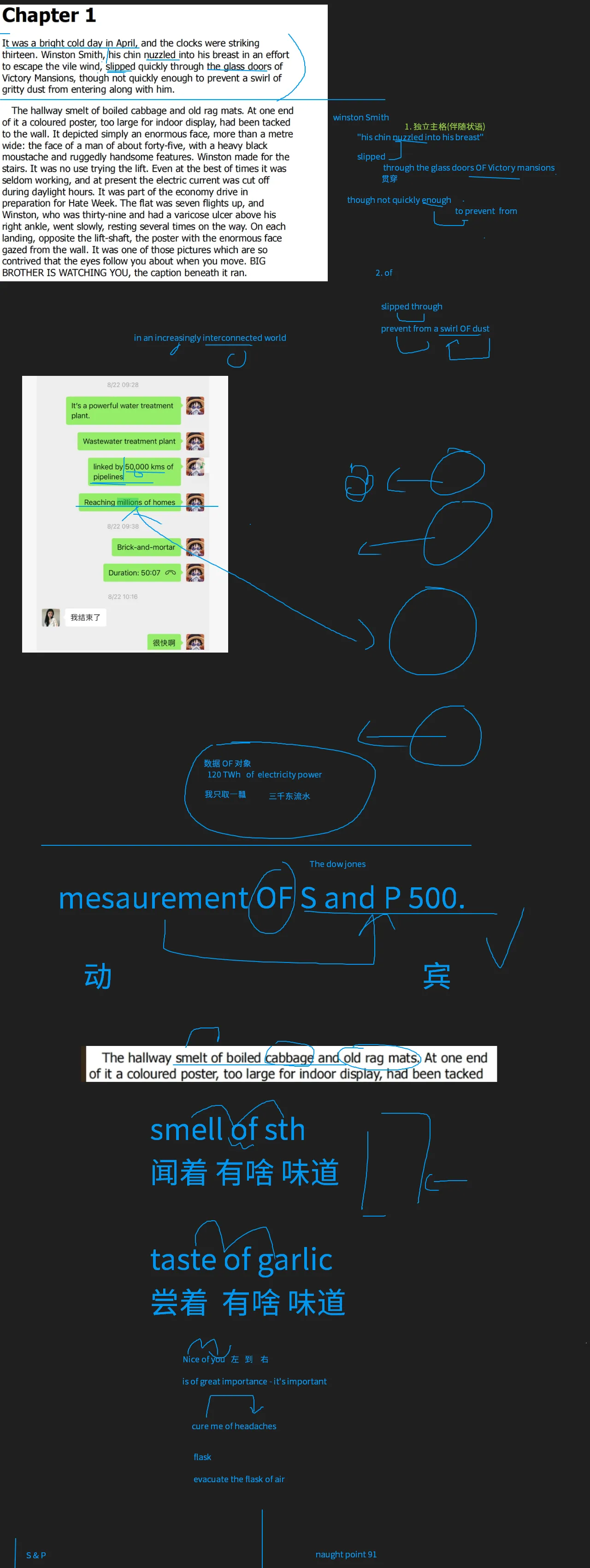
写这条腿,从《1984》的第一章第一段开始。板书把 Chapter 1 开头的两大段整段抄了下来,然后在旁边做了拆解:哪一截是独立主格(伴随状语)、of 在这句里是怎么把两端连起来的、though not quickly enough to prevent from 这一串到底挂在谁身上。拆完之后用同样的骨架做仿写 —— 地点从伦敦的公寓楼换成地铁站,人物换成 Liu wei。
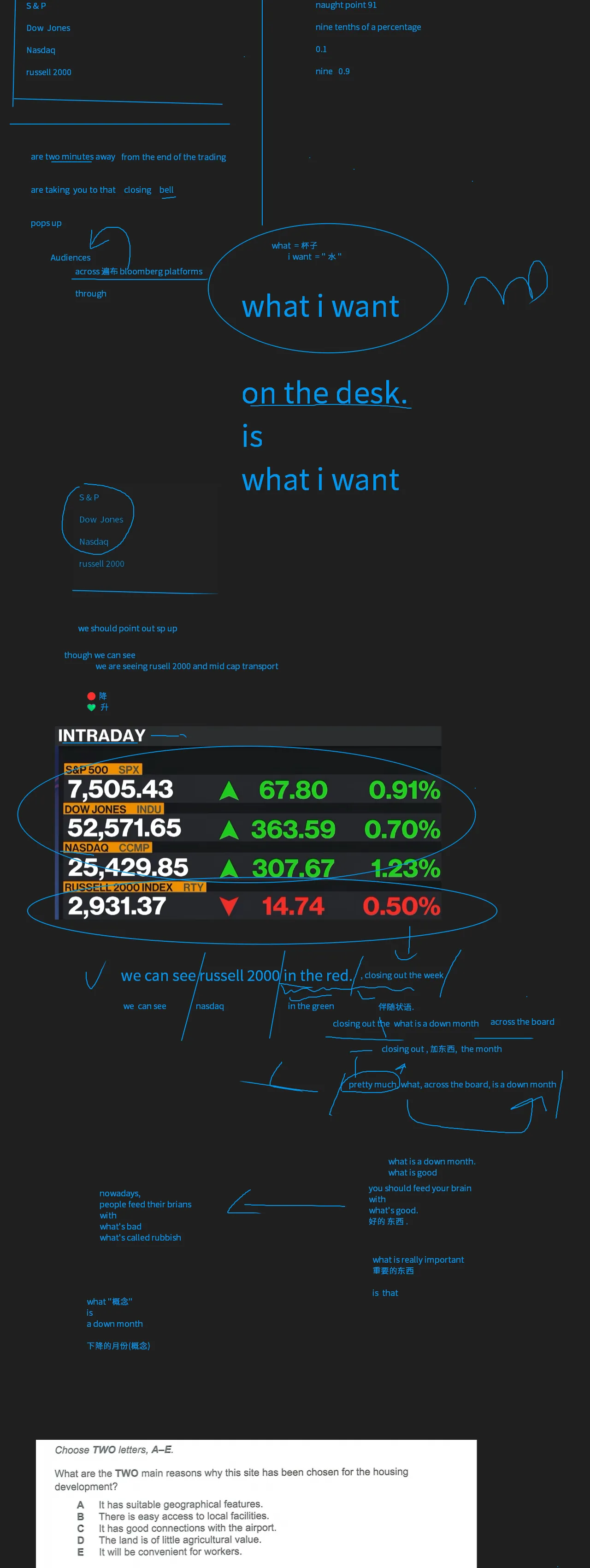
听这条腿,走的是金融播报。板书抄了 Bloomberg 播报里的原话,还配了一张 INTRADAY 的实时行情表。播报的关键是 what 这个"杯子" —— 板书用一句话讲透了。
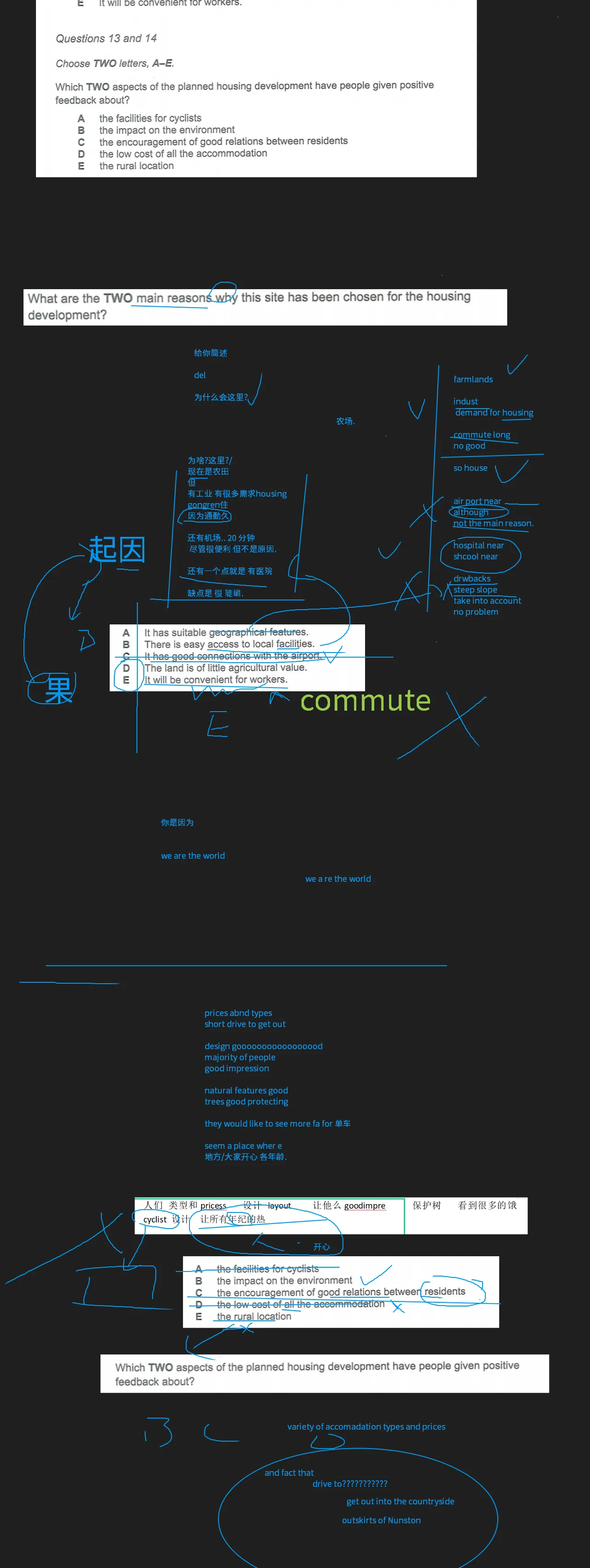
最后落到真题:剑桥雅思 18 的 Test 2 Part 2,两个双选题各选两个字母。这两题 Flora 当场做完了,板书上是完整的排除过程。
📖 Chapter 1 精读:Winston Smith 出场
板书把原文整段贴了出来,两段。
第一段 —— 主角出场:
It was a bright cold day in April, and the clocks were striking thirteen. Winston Smith, his chin nuzzled into his breast in an effort to escape the vile wind, slipped quickly through the glass doors of Victory Mansions, though not quickly enough to prevent a swirl of gritty dust from entering along with him.
第二段 —— 走廊与海报:
The hallway smelt of boiled cabbage and old rag mats. At one end of it a coloured poster, too large for indoor display, had been tacked to the wall. It depicted simply an enormous face, more than a metre wide: the face of a man of about forty-five, with a heavy black moustache and ruggedly handsome features. Winston made for the stairs. It was no use trying the lift. Even at the best of times it was seldom working, and at present the electric current was cut off during daylight hours. It was part of the economy drive in preparation for Hate Week. The flat was seven flights up, and Winston, who was thirty-nine and had a varicose ulcer above his right ankle, went slowly, resting several times on the way. On each landing, opposite the lift-shaft, the poster with the enormous face gazed from the wall. It was one of those pictures which are so contrived that the eyes follow you about when you move. BIG BROTHER IS WATCHING YOU, the caption beneath it ran.
板书在原文上划了三处线,分别对应下面三个语法点。
📐 语法点:独立主格(伴随状语)
板书在 his chin nuzzled into his breast 旁边标了:
1. 独立主格(伴随状语)
这一截的结构是 his chin(自己的主语)+ nuzzled into his breast(自己的动作)。它没有连词,也没有变成从句,就那么直接挂在主句前面,给主句补充"当时是个什么姿态"。
主句还是干干净净的主谓:
Winston Smith ... slipped ...
板书把 slipped 单独框了出来 —— 主干动词就这么一个。前面那一大坨姿态描写,是伴随状语。
连着往下读,这条线的下一步是:
slipped through the glass doors OF Victory mansions
板书在 through 旁边标了「贯穿」。
再往后:
though not quickly enough ... → to prevent from
prevent from a swirl OF dust
板书把 too... to... 这一串的走向画了出来:虽然快,但没快到能挡住那阵灰尘跟着他一块儿进去。
板书还单独写了一句,是同一路句式的现代版:
in an increasingly interconnected world
📐 语法点:OF 到底能带出什么
这是这节课的语法主干。板书把 of 的几种用法排成了一列,每一种给一句例子。
| 板书上的例子 | 这一串在干什么 |
|---|---|
| 120 TWh of electricity power | 板书旁注「数据 OF 对象」 |
| measurement OF S and P 500. | 板书标「动 / 宾」,旁边写 The dow jones,后面打了个 ✓ |
| The hallway smelt of boiled cabbage and old rag mats. | 课文原句 |
| smell of sth | 板书注「闻着 有啥味道」 |
| taste of garlic | 板书注「尝着 有啥味道」 |
| Nice of you | 板书注「左 到 右」 |
| is of great importance | 板书注 = it's important |
| cure me of headaches | |
| flask / evacuate the flask of air |
这张表的意思是:of 后面跟的,永远是"这个动作或这个东西所指向的那个对象" —— 可能是数据(120 TWh)、可能是动作的对象(measurement)、可能是味道(smell / taste)、可能是人(Nice of you)。
板书写 120 TWh of electricity power 的时候,旁边写了两行中文:
我只取一瓢
三千东流水
再看 smell of sth 和 taste of garlic 这两条 —— 板书写得很实在:闻着有啥味道 / 尝着有啥味道。smelt of boiled cabbage 就是"闻着有煮卷心菜的味道"。
👂 听力:金融播报是怎么说出口的
板书抄了一整段 Bloomberg 播报,并配了行情表。
先认名字
板书列了四个指数:
S&P / Dow Jones / Nasdaq / russell 2000
数字要这么念
这一栏是给耳朵准备的 —— 同一个数字,播报里不念小数:
| 板书写的 | 意思 |
|---|---|
| naught point 91 | 0.91 |
| nine tenths of a percentage | 十分之一个百分点 |
| 0.1 | |
| nine 0.9 |
naught 就是 0。播报里说 naught point nine one,不是 zero point nine one。
行情表(板书上贴的 INTRADAY)
| 指数 | 点位 | 涨跌 | 幅度 |
|---|---|---|---|
| S&P 500 (SPX) | 7,505.43 | ▲ 67.80 | 0.91% |
| DOW JONES (INDU) | 52,571.65 | ▲ 363.59 | 0.70% |
| NASDAQ (CCMP) | 25,429.85 | ▲ 307.67 | 1.23% |
| RUSSELL 2000 INDEX (RTY) | 2,931.37 | ▼ 14.74 | 0.50% |
板书在表旁标了颜色:红 降 / 绿 升。
播报里的原话
are two minutes away from the end of the trading
are taking you to that closing bell
pops up / Audiences / across(遍布) bloomberg platforms / through
we should point out sp up
though we can see / we are seeing russel 2000 and mid cap transport
核心:what 是个杯子
板书在正中间画了一个大椭圆,里面写:
what = 杯子
i want = "水"
what i want
这个比方是这节课的关键 —— what 本身不是内容,它是个空杯子;真正的内容("水")在后面。所以 what i want 整块是一个名词,可以搬到句子的任何名词位置上:
on the desk. is what i want.
板书把 on the desk. 划了线,is 单独一行,what i want 再一行 —— 三个成分摆得清清楚楚。
名词性从句在播报里怎么用
we can see russell 2000 in the red., closing out the week
we can see / nasdaq / in the green
closing out the what is a down month / across the board
pretty much what, across the board, is a down month
板书在 in the green 旁边标了「伴随状语」,在 closing out 旁边标了「closing out, 加东西, the month」,在 pretty much 外面圈了个框。
再往下,what 这个杯子装的东西越来越抽象:
what "概念" is a down month —— 板书注「下降的月份(概念)」
what is good / what's bad
what's called rubbish
what is really important —— 板书注「重要的东西」
于是就有了这两句:
you should feed your brain with what's good.
nowadays, people feed their brains with what's bad / what's called rubbish
板书上贴的一段对话记录(8/22)
板书里贴了一小段对话截图,里面是这几句英文:
It's a powerful water treatment plant.
Wastewater treatment plant
linked by 50,000 kms of pipelines
Reaching millions of homes
Brick-and-mortar
Duration: 50:07
📝 这节课练了什么:剑18 Test 2 Part 2 的两个双选
板书贴了原题。这段录音讲的是一片新住宅区的选址,题号 11–14,两个双选题。
11–12 题
What are the TWO main reasons why this site has been chosen for the housing development?
| 选项 | 内容 |
|---|---|
| A | It has suitable geographical features. |
| B | There is easy access to local facilities. |
| C | It has good connections with the airport. |
| D | The land is of little agricultural value. |
| E | It will be convenient for workers. |
板书的排除过程 —— 板书在选项旁边写下了整条推理线:
farmlands(农场) / industry / demand for housing
为什么会这里?现在是农田 / 但有工业 有很多需求 housing(工人 住) / 因为通勤久
commute long no good / so house
还有机场..20 分钟 / although not the main reason.
hospital near / shcool near
drwbacks / steep slope / take into account / no problem
起因 → 果
板书把 C 整行划掉(机场虽然方便,但"不是主要原因"),A 划掉。最后在选项左侧画了一个圈,把 D 和 E 两个字母一起圈住。
13–14 题
Which TWO aspects of the planned housing development have people given positive feedback about?
| 选项 | 内容 |
|---|---|
| A | the facilities for cyclists |
| B | the impact on the environment |
| C | the encouragement of good relations between residents |
| D | the low cost of all the accommodation |
| E | the rural location |
板书的排除过程:
majority of people / good impression
natural features good / trees good protecting
they would like to see more fa for 单车
seem a place where e —— 地方/大家开心 各年龄
人们 类型和 prices / 设计 layout / 让他们 good impre / 保护树
variety of accomodation types and prices / and fact that / get out into the countryside / outskirts of Nunston
板书这里划掉的是 A(旁边有横线穿过)、D 打叉、E 打叉;在 B 右端打了一个大大的勾、把 C 的 residents 圈了出来。
✅ 与官方答案核对
这段录音是剑桥雅思 18 · Test 2 · Part 2。核对官方答案(见剑18 书页 121 的 Listening answer key):
11&12  IN EITHER ORDER    B    E
13&14  IN EITHER ORDER    B    C
| 题号 | 板书圈的 | 官方答案 | |
|---|---|---|---|
| 11–12 | D + E | B + E | ⚠️ D 应是 B |
| 13–14 | B + C | B + C | ✅ 一致 |
11–12 题这里,板书圈错了。 板书圈的是 D(The land is of little agricultural value.),官方答案是 B(There is easy access to local facilities.)。后面 E 是对的。
注意板书自己在 D 上面那条写的是 farmlands(农田)、下面写的是 drwbacks / steep slope(缺点是很陡峭)——"这里是农田、有缺点"说的是这块地本身是什么样,而题目问的是"为什么选它"。
although not the main reason这句板书自己都写下来了:机场那条被排除,是因为它虽然方便但不是主因 —— 同样的判据也要用到 D 上。真正的主因是工人上下班方便(E),以及靠近本地设施(B)。两个字母的题,顺序不限。 官方两处都标了 IN EITHER ORDER,11–12 写
E B或B E都不算错。
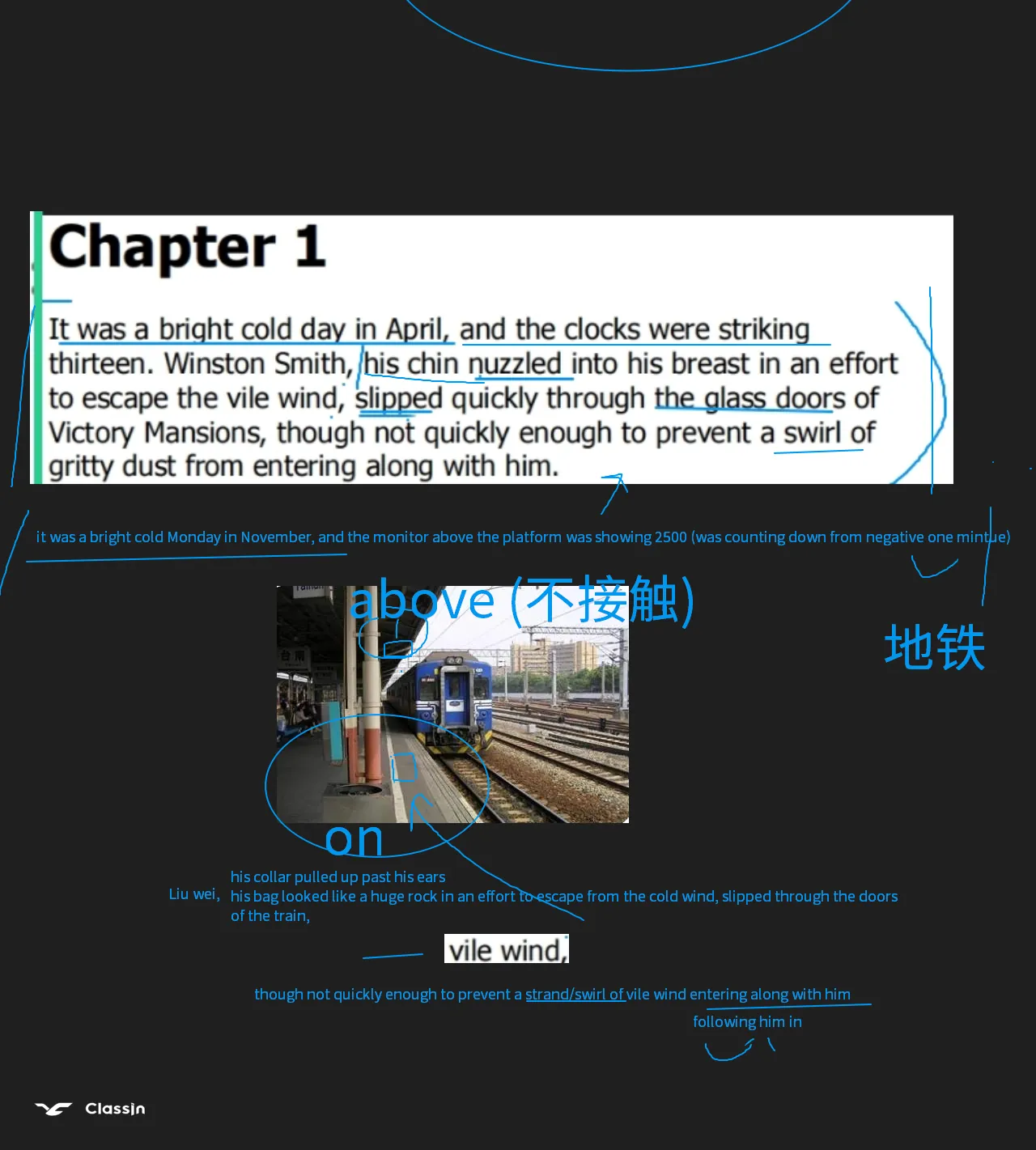
✍️ 仿写:把 1984 的第一句换成地铁站
拆完句子,板书用同一套骨架写了一段全新的场景 —— 地点换成地铁站,人物换成 Liu wei。
第一句(时间 + 环境):
It was a bright cold Monday in November, and the monitor above the platform was showing 2500 (was counting down from negative one minute)
对应原句的 It was a bright cold day in April, and the clocks were striking thirteen.
板书在这里插了一组介词对比:
above(不接触) / on / 地铁
配了一张地铁站台的照片 —— 站牌在上方但不接触(above),人站在地面上(on)。
第二句(独立主格 + 主干):
his collar pulled up past his ears
Liu wei, his bag looked like a huge rock in an effort to escape from the cold wind, slipped through the doors of the train,
对照原句:Winston Smith, his chin nuzzled into his breast in an effort to escape the vile wind, slipped quickly through the glass doors of Victory Mansions,
第三句(收尾):
vile wind,
though not quickly enough to prevent a strand/swirl of vile wind entering along with him
following him in
vile wind 被板书单独框了出来 —— 这是从原句里直接借走的词。
📖 词汇与表达
| 英文 | 中文 | 搭配 / 用法 |
|---|---|---|
| his chin nuzzled into his breast | 下巴埋进胸口 | 独立主格(伴随状语) |
| in an effort to do sth | 为了做某事 | in an effort to escape the vile wind |
| vile wind | 恶风 | 板书单独框出 |
| slip through | 溜过;穿过 | slipped through the glass doors |
| swirl of gritty dust | 一阵带沙砾的灰尘 | a swirl of gritty dust |
| prevent ... from doing | 阻止……做…… | prevent a swirl of dust from entering |
| smell of sth | 闻着有……味道 | The hallway smelt of boiled cabbage |
| taste of garlic | 尝着有大蒜味 | 板书注「尝着 有啥味道」 |
| of great importance | 很重要 | = it's important |
| cure sb of sth | 治好某人的…… | cure me of headaches |
| evacuate the flask of air | 把瓶里的空气抽空 | |
| naught point 91 | 0.91 | 播报读法,不读 zero |
| nine tenths of a percentage | 十分之一个百分点 | |
| the closing bell | 收盘铃 | are taking you to that closing bell |
| in the red / in the green | 跌 / 涨 | 板书标「红 降 / 绿 升」 |
| across the board | 全面;所有板块 | across the board, is a down month |
| close out the week / the month | 收尾这一周 / 这个月 | closing out the week |
| what's called rubbish | 所谓的垃圾 | people feed their brains with what's bad |
| facilities for cyclists | 骑行者的设施 | 13–14 题 A 选项 |
| good relations between residents | 居民之间的良好关系 | 13–14 题 C 选项 |
| take into account | 把……考虑进去 | 板书注「no problem」 |
| drwbacks / steep slope | 缺点 / 陡坡 | 板书原文拼写如此 |
⚠️ 提醒 / 易错
- 11–12 题的答案是 B + E,不是 D + E。 板书圈 D 是错的(理由见上面的核对小节)。"这块地是什么样"不等于"为什么选这块地"。
- 独立主格没有连词。
his chin nuzzled into his breast这一截自带主语(his chin)、自带动作(nuzzled),但没有 that / which / and,靠逗号挂在主句旁边。找主干的时候,这一整块可以直接跳过 —— 主干只有Winston Smith ... slipped。 of后面跟的是"对象"。 数据、动作、味道、人,都能往后面放。做阅读时看到of,先问一句:它前面那个词,指向的是什么?what是个空杯子。what i want里,what本身没有内容,内容在i want后面等着。所以读长句时看到what,要往后找"水"装进去。closing out后面要"加东西"。 板书原话是「closing out, 加东西, the month」—— 光说closing out不完整,得交代收尾的是什么(the week / the month)。- 播报里的 0 读
naught,不读zero。