📌 这节课讲了什么
一节纯口语对练课,两条主线并排走:
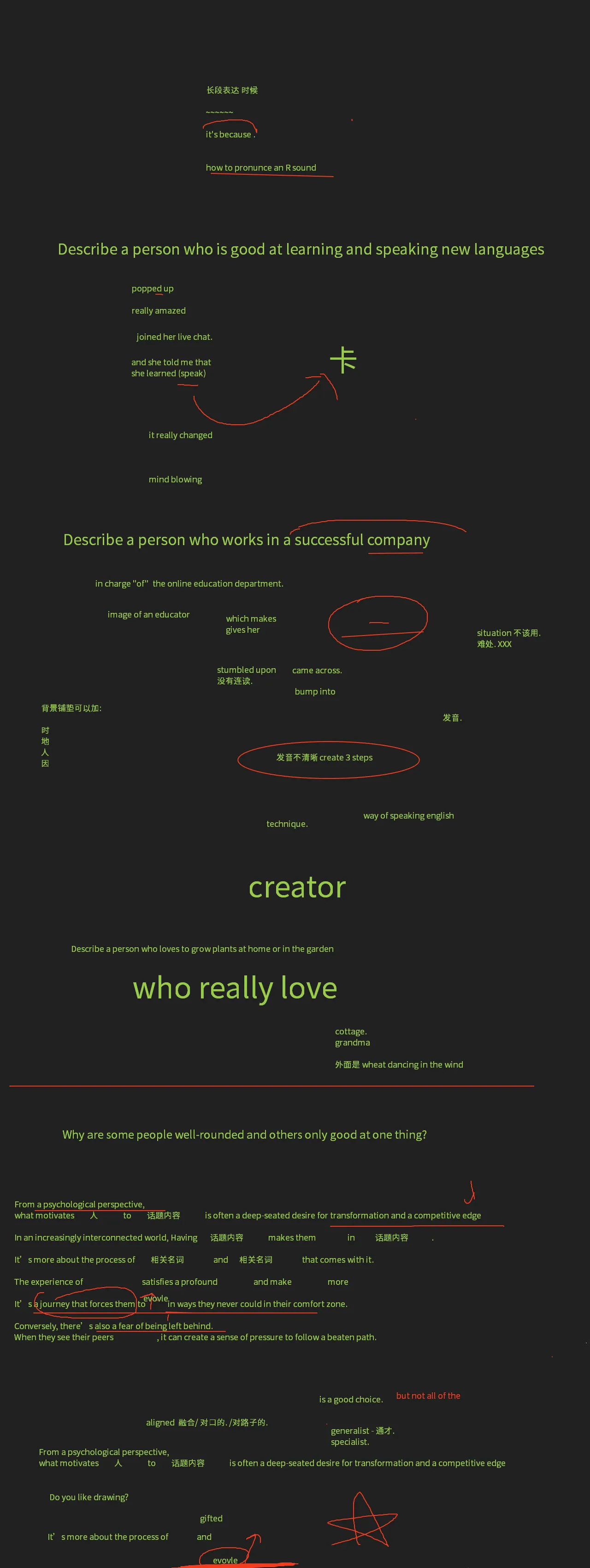
- P2 人物篇 —— 连着过了三道人物题:Describe a person who is good at learning and speaking new languages、Describe a person who works in a successful company、Describe a person who loves to grow plants at home or in the garden。三道题都在板书上留下了当场用的素材词、句型和卡壳的位置。
- P3 人文类 —— 一套「心理动机」通用句模,把 well-rounded 和只会一样、历史、传统、阅读、哲学、名人、看画这些抽象题全部装进去;另外给了三个可以直接开头的句式。
板书还单列了几条发音与流畅度的提醒:长段表达时的衔接、R 音的发音、stumbled upon 的连读,以及「发音不清晰」时要做的事。
🔊 长段表达与发音
板书最上面单独留了一块,写的是长段表达时的处理:
| 板书 | 说明 |
|---|---|
| 长段表达 时候 | 说长句、长段的时候 |
~~~~~~~ |
波浪线:声音拉长、不要断 |
| it's because . | 长段展开时的衔接语;红色弧线画在它上面,是这句话的语调走向 |
| how to pronounce an R sound | 单列出来的发音点:r 的发音(红色下划线) |
这两条放在一起,意思是:句子一长,不要停下来重新起头,用 it's because 把原因接着往下带;同时把 r 音咬清楚。
题二那片板书里还有一条关于连读的提醒,见下面「发音不清晰」那一节。
🎤 P2 人物篇(一):good at learning and speaking new languages
板书留下的是一条完整的作答链,从「怎么遇见」一路走到「被震到」:
popped up → really amazed → joined her live chat. → and she told me that she learned (speak) → it really changed → mind blowing
逐个看:
| 板书 | 作用 |
|---|---|
| popped up | 出现、弹出来(红色下划线划在 popped 上) |
| really amazed | 第一反应:特别惊讶 |
| joined her live chat. | 进了她的直播 |
| and she told me that she learned (speak) | 讲到她说自己学了(说)…… |
| it really changed | 这件事真的改变了…… |
| mind blowing | 收尾评价:震撼 |
这条板书上画了一个绿色的「卡」字,还有一支红箭头从 she told me that 下面的下划线指过去。
这是这节课最值得记的一处:人物故事讲到 that 从句的时候最容易卡住。 信息还在脑子里,句子已经撑不住了,于是整个人停在那里。板书的处理是把后面的话直接讲成一个结果句,接到 it really changed 上,再用 mind blowing 收尾 —— 从句没说完不要紧,先把这个人的故事讲完。
🎤 P2 人物篇(二):works in a successful company
题目上,红色下划线划在 successful company 上,词组上方还画了一道红色弧线 —— 这个词组要连起来读。
人物定位
in charge "of" the online education department.
of 上加了引号,是提醒这个词不能吞掉。
image of an educator
一句给「人设」:an image of an educator(教育者的形象)。
接结果的两种说法
板书把 which makes 和 gives her 竖着摆在一起,右边用红圈圈出两个空位:
which makes ___ / gives her ___
也就是说,人物描述完之后,用这两个说法各接一层结果 —— which makes ... 引出影响,gives her ... 引出她得到的东西。空位是留给现场内容填的。
一处用词纠正
situation 不该用. 难处. XXX
板书明确写了某处不该用 situation,中文意思是「难处」;后面用 XXX 表示「要用的那个词板书没写出来」。记住这条结论:想说「难处、困境」的时候,不要用 situation。
三个「偶然遇到」
| 板书 | 备注 |
|---|---|
| stumbled upon | 板书注明:没有连读 |
| came across. | 偶遇 |
| bump into | 撞见、碰见 |
三个都是「偶遇」,板书把它们并排放在一起,是让人换着用,不要一道题里重复同一个。
🧱 框架:P2 背景铺垫 = 时 · 地 · 人 · 因
题二的板书左侧竖着写了四个字:
背景铺垫可以加:时 地 人 因
这和「人物题先铺背景、再进人物」的路子完全对得上:开口先把时间、地点、人物、原因这四样铺开,再往下讲这个人是谁。
四样不一定要全上,但至少要占两样,开场才不会干。
🎤 P2 人物篇(三):loves to grow plants at home or in the garden
板书把 who really love 放得很大,这是这道题的主句式。
素材只有四个:
| 板书 | 中文 |
|---|---|
| cottage. | 小屋 |
| grandma | 奶奶 |
| 外面是 wheat dancing in the wind | 外面是风里摇的麦子 |
wheat dancing in the wind 是这道题里唯一的画面句 —— 讲种植物的人,环境和画面就靠它撑起来。
另外,紧挨着人物篇的板书上,单独放大了一个词:creator。这是板书特意强调的词。
🧱 框架:P3「心理动机」通用句模
这套句子在板书上被完整地写了两遍(两页都有),说明是这节课要背下来的主干:
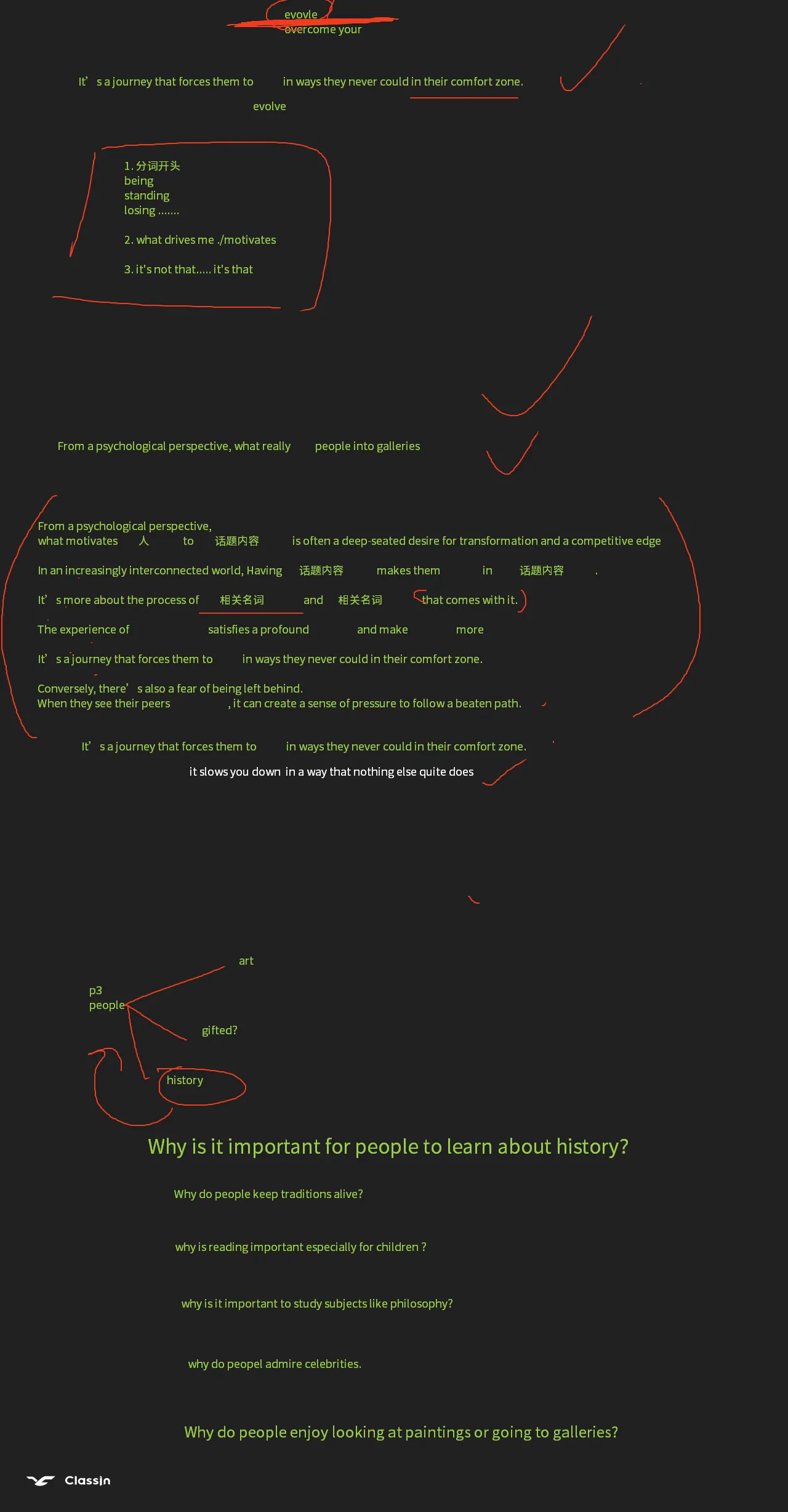
From a psychological perspective, what motivates 人 to 话题内容 is often a deep-seated desire for transformation and a competitive edge
红色下划线划在 is often a deep-seated desire for transformation and a competitive edge 上,旁边还画了红色对勾 —— 这是「说对了」的那一版。
拆开看它的骨架:
| 位置 | 内容 |
|---|---|
| 开头 | From a psychological perspective, |
| 中间 | what motivates 人 to 话题内容 |
| 落点 | is often a deep-seated desire for transformation and a competitive edge |
后面几条都是它的变体,共用同一套「填空位」写法(板书上直接用中文标出空位):
In an increasingly interconnected world, Having 话题内容 makes them ___ in 话题内容 .
It's more about the process of 相关名词 and 相关名词 that comes with it.
板书在 that comes with it. 上做了红色标记 —— 这个尾巴必须接住,不能说完 and ... 就停。
The experience of ___ satisfies a profound ___ and make ___ more ___
It's a journey that forces them to evolve in ways they never could in their comfort zone.
板书先用红圈圈住 evolve;下一页又把 evolve 划掉,在旁边改写成 overcome your —— 说明这个位置更想用的是 overcome。
Conversely, there's also a fear of being left behind.(红色下划线)
When they see their peers ___ , it can create a sense of pressure to follow a beaten path.
注意这套句模是「一正一反」两半:前半讲「渴望转变、想有竞争力」,用 Conversely 一翻,后半讲「怕被落下、于是跟着别人的老路走」。正反都说了,答案的长度和深度就够了。
结尾可以用的两个词
is a good choice. / but not all of the(红色)
aligned —— 融合 / 对口的 / 对路子的
generalist —— 通才 / specialist —— 专才
这三样都出现在「well-rounded 和只会一样」那道题的板书区,是用来收尾和对比的。
🧱 框架:P3 三个万能开头
板书用红框单独框起来的三条,是回答任何 P3 都能用的开场方式:
| # | 板书 | 怎么用 |
|---|---|---|
| 1 | 分词开头:being / standing / losing ...... | 直接用 -ing 起句,不必先想主语 |
| 2 | what drives me , motivates | What drives me is ... / What motivates me is ... |
| 3 | it's not that.... it's that | 先否掉一个说法,再给出真正的说法 |
这三条和第 1 条句模里的 what motivates 人 to 话题内容 是一套的:开头用分词或 what 从句把句子架起来,后面再把内容填进去。
📝 P3 人文类:这节课覆盖的题
板书中间画了一张小图:
p3 people → 分出三支:art / gifted? / history(history 被红圈圈住,箭头指向它)
也就是说,人文类 P3 的题眼就三块:艺术、天赋、历史。
底下是一列问题,全部可以用上面那套句模答:
Why are some people well-rounded and others only good at one thing?
Why is it important for people to learn about history?
Why do people keep traditions alive?
why is reading important especially for children ?
why is it important to study subjects like philosophy?
why do people admire celebrities.
Why do people enjoy looking at paintings or going to galleries?
最后还单列了一句「看画 / 逛美术馆」题的落点:
From a psychological perspective, what really ___ people into galleries
板书在 really 和 people 之间留了一个空,那个动词是待填的位置 —— 这句话本身也是那道题的答案开头。
🧱 P1 也能用:P3 的句子降维到 P1
板书在 Do you like drawing? 这道 P1 旁边写的是:
It's more about the process of ___ gifted ___ and ___ evolve
evolve 在这里又被红圈圈了一次,还画了一支红箭头。也就是说:P3 的句式不是只能答 P3,P1 问「你喜不喜欢画画」,照样可以用 It's more about the process of ... 把话题从「喜不喜欢」拉到「过程」上,再把 gifted、evolve 这些词塞进去。
📖 词汇与表达
| 英文 | 中文 | 搭配 / 用法 |
|---|---|---|
| popped up | 弹出来、跳出来 | 红色下划线在 popped 上 |
| really amazed | 特别惊讶 | 第一反应 |
| live chat | 直播聊天 | joined her live chat. |
| mind blowing | 震撼的、炸裂的 | 收尾评价 |
| it really changed | 真的改变了 | 接在 that 从句之后 |
| in charge of | 负责、主管 | in charge "of" the online education department. |
| image of an educator | 教育者的形象 | 给人设 |
| which makes | 这使得…… | 后面接结果(板书留空) |
| gives her | 给了她…… | 后面接结果(板书留空) |
| stumbled upon | 偶然撞见 | 板书注明:没有连读 |
| came across | 偶遇 | |
| bump into | 撞见、碰见 | 三个「偶遇」换着用 |
| cottage | 小屋 | 植物题的场景 |
| wheat dancing in the wind | 风里摇的麦子 | 画面句 |
| creator | 创作者 | 板书单独放大强调 |
| deep-seated | 深层的、根深蒂固的 | a deep-seated desire |
| transformation | 转变 | desire for transformation |
| competitive edge | 竞争力、竞争优势 | and a competitive edge |
| interconnected | 相互连接的 | an increasingly interconnected world |
| profound | 深刻的 | satisfies a profound ... |
| evolve | 进化、成长 | forces them to evolve |
| overcome | 克服 | 板书把 evolve 改写成了 overcome your |
| comfort zone | 舒适区 | in their comfort zone |
| conversely | 反过来、相反 | 一正一反的转折词 |
| left behind | 被落下 | a fear of being left behind |
| peers | 同龄人、同辈 | When they see their peers ... |
| a beaten path | 老路、别人踩出来的路 | follow a beaten path |
| aligned | 融合 / 对口的 / 对路子的 | 板书给的中文 |
| generalist | 通才 | 对比 specialist |
| specialist | 专才 | |
| galleries | 美术馆 | people into galleries |
| gifted | 有天赋的 | Do you like drawing? 的答句里 |
| well-rounded | 全面发展的 | 全能型 |
| technique | 技巧 | 和 way of speaking english 并排 |
| way of speaking english | 说英语的方式 | 和 technique 并排 |
⚠️ 提醒 / 易错
1. 人物故事的卡点:that 从句
板书用绿色「卡」字标出的位置是 and she told me that she learned (speak)。讲到 that 从句就卡,是这节课暴露出来的主要问题。 处理办法不是回头重说,而是直接跳到结果句(it really changed)把它讲完。
2. 用词:situation 不该用
situation 不该用. / 难处. XXX
想说「难处、困境」的时候不要用 situation。板书用 XXX 标出「正确的词还没定」,所以这个词要另外去确认,不要照搬 situation。
3. 连读:stumbled upon 没有连读
板书在 stumbled upon 下面单独写了「没有连读」—— 不要把这个词组糊成一团读。
4. 发音不清晰 → create 3 steps
板书用红圈圈出的一行:
发音不清晰 create 3 steps
这是这节课关于「发音不清楚」时的处理方式,板书只给了标题(3 steps),具体三步没有展开写。
5. 不要停在半句上
第 1 条句模里 It's more about the process of 相关名词 and 相关名词 that comes with it. —— 板书特意在 that comes with it. 上做了标记。and 后面那半句不是可选项,是句子的一部分,必须说完。
6. 一句收尾的话
板书单独写了一行:
it slows you down in a way that nothing else quite does
这是可以放在答案结尾的句子,用来讲某件事「拖慢你的方式是别的什么都比不了的」。