📌 这节课讲了什么
这节课有两条线,一条是「思维」,一条是「口语素材」。
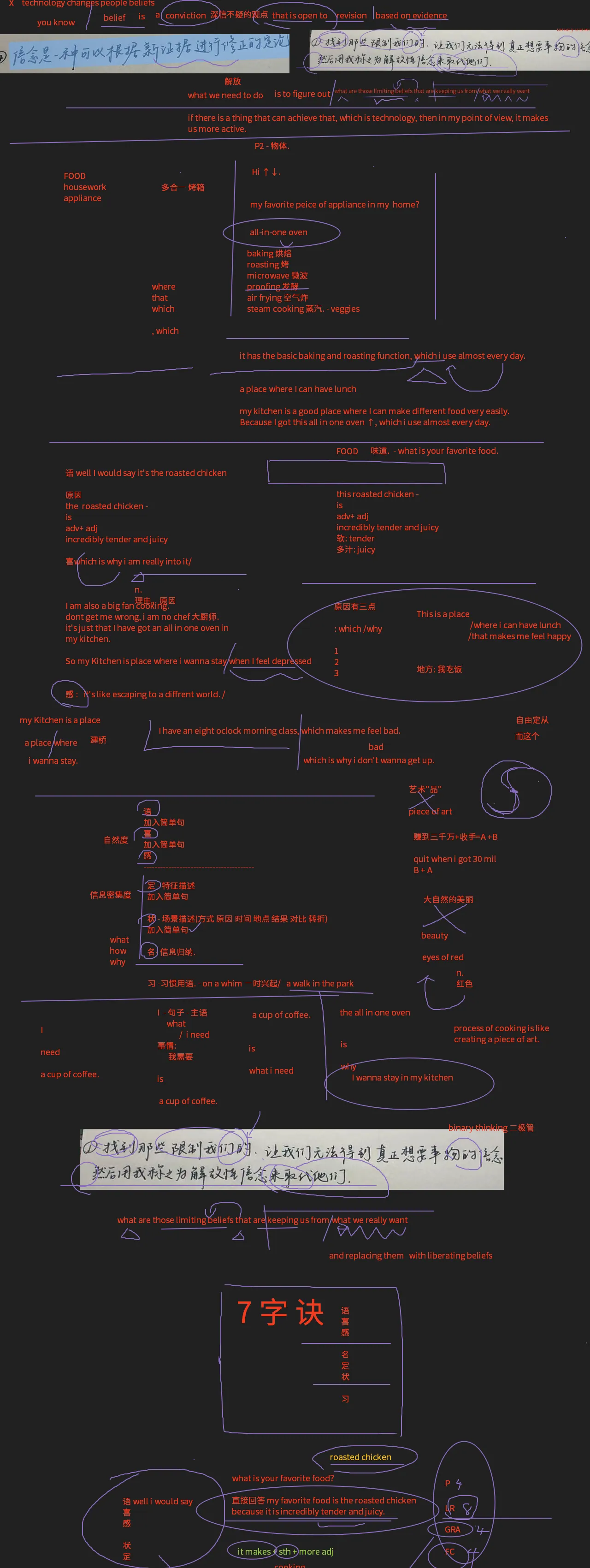
思维这条线讲的是信念:信念不是死的东西,它是一种可以根据新证据修正的定论(a conviction that is open to revision based on evidence)。我们之所以拿不到自己真正想要的东西,常常是因为脑子里有一些限制性信念(limiting beliefs)在拦路;要做的,是找到它们,再用解放性信念(liberating beliefs)把它们换掉。
口语这条线,用家电 · 食物 · 家务三个话题把 P2 的物体题打通。核心道具是多功能烤箱(all-in-one oven):从它的功能讲到做饭,从做饭讲到自己是个什么样的人 —— 也就是板书上反复强调的个人特色。
板书上还有两套"升级工具":一套是把三个话题各说三句话的练习路线,另一套是把简单句拼长的7 字诀(语 / 喜 / 感 / 名 / 定 / 状 / 习)。
🧱 信念:限制性信念 → 解放性信念
板书左上角先给信念下了定义:
belief is a conviction that is open to revision based on evidence.
中文对应写在旁边:信念是一种可以根据新证据进行修正的定论。
接下来是这个话题的固定动作,板书上是这么推的:
what we need to do is to figure out ... what are those limiting beliefs that are keeping us from what we really want, and replacing them with liberating beliefs.
拆开就是三步:
- 找到那些限制我们的、让我们无法得到真正想要事物的信念;
- 看清它;
- 用解放性信念来取代它们。
板书旁边还挂了两个标记:X technology changes people's beliefs(打叉)和一句带感叹号的结论:
If there is a thing that can achieve that, which is technology, then in my point of view, it makes us more active.
另外板书右下角把这个思路标成 binary thinking 二极管 —— 用"要么这样、要么那样"的两极思维去看问题,是限制性信念最常见的来源。
这一段的背法很简单:中文先记住三步,再把上面那两句英文原样背下来。
🧱 框架:P2 物体题,从「家电」切进「个人特色」
板书把 P2 的物体题归成一块:P2 - 物体,下面挂了三个可写的方向 —— FOOD、housework、appliance,以及那道题的入口句:
my favorite piece of appliance in my home?
答案是那个多功能烤箱(板书写作 all-in-one oven,也叫 multi-purpose 多合一烤箱)。板书把它能做的事一个个列了出来:
| 功能 | 中文 |
|---|---|
| baking | 烘焙 |
| roasting | 烤 |
| microwave | 微波 |
| proofing | 发酵 |
| air frying | 空气炸 |
| steam cooking | 蒸汽(可以蒸 veggies) |
它的基本句是:
It has the basic baking and roasting function, which I use almost every day.
然后一路把"我"带出来:
my kitchen is a good place where I can make different food very easily. Because I got this all in one oven, which I use almost every day.
So my kitchen is a place where I wanna stay when I feel depressed.
It's like escaping to a different world.
这几句的顺序就是:东西有什么功能 → 因为有了它,我在哪儿、干什么 → 它让我变成什么样的人。板书把最后这一层叫个人特色,并写了一句话点题:
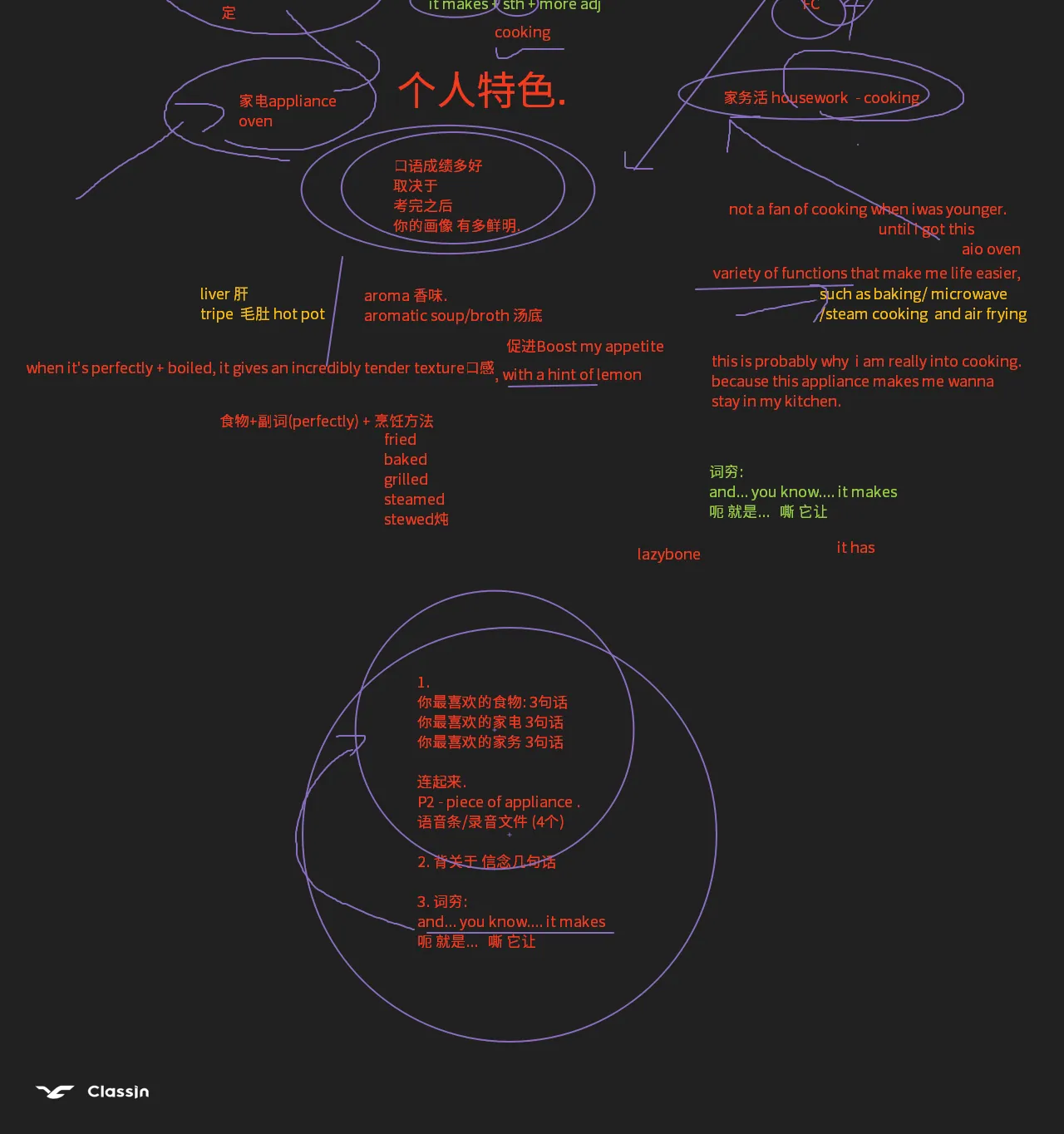
口语成绩多好,取决于考完之后,你的画像有多鲜明。
也就是说,考完试留在考官脑子里的不该是"一个考生",而是一个有画面的、鲜明的人。
板书还留了一句反差句,用来显得真实、不夸张:
don't get me wrong, I am no chef. it's just that I have got an all in one oven in my kitchen.
🧱 三句话:食物 / 家电 / 家务
板书的练习路线写得很清楚:
- 你最喜欢的食物:3 句话
- 你最喜欢的家电:3 句话
- 你最喜欢的家务:3 句话
- 连起来 → 就是 P2 - piece of appliance
三个话题共用同一套"三句话"结构:
| 位置 | 作用 | 板书上的例子 |
|---|---|---|
| 第 1 句 | 直接回答 | my favorite food is the roasted chicken |
| 第 2 句 | 原因(形容词) | because it is incredibly tender and juicy |
| 第 3 句 | 更进一步的感受 | which is why I am really into it |
家电三句话的成品,板书上是这样连的:
not a fan of cooking when I was younger, until I got this all-in-one oven.
It has a variety of functions that make my life easier, such as baking, microwave, steam cooking and air frying.
This is probably why I am really into cooking, because this appliance makes me wanna stay in my kitchen.
三句的顺序从"以前"走到"现在": 以前不喜欢 → 有了它、功能多 → 所以现在爱做饭、爱待在厨房。这个小时间线,就是"画像鲜明"的来源。
💬 直接可以说出口的句子
食物题的问法:what is your favorite food?
well I would say it's the roasted chicken.
my favorite food is the roasted chicken because it is incredibly tender and juicy.
描述口感的两句,板书专门标了词:
- the roasted chicken is incredibly tender and juicy —— 软:tender,多汁:juicy
- when it's perfectly boiled, it gives an incredibly tender texture —— 口感:texture
再加一层香味:
... with a hint of lemon, it boosts my appetite.
家电题:
my favorite piece of appliance in my home? It's the all-in-one oven.
It has the basic baking and roasting function, which I use almost every day.
地点题(把厨房写成一个地方):
This is a place where I can have lunch, that makes me feel happy.
a place where I can ... —— 只要说得出"我在这个地方干什么",这个句型就能一直用。
📐 语法点:定语从句与「一句一主语」
1. 关系词的选择 —— where / that / which / , which
板书把四个关系词单独列了一栏:
| 关系词 | 什么时候用 | 板书上的例子 |
|---|---|---|
| where | 前面是地点 | a place where I can have lunch |
| that | 限定,紧跟名词 | a good place that makes me feel happy |
| , which | 补充说明,逗号隔开 | the basic baking and roasting function, which I use almost every day |
| which | 指代前面整件事 | I have an eight o'clock morning class, which makes me feel bad |
板书用这一对句子演示「先摆事实、再上评价、最后出结论」:
I have an eight o'clock morning class, which makes me feel bad. Which is why I don't wanna get up.
2. 一句一主语 —— 想强调什么,就把什么放到 what 后面
板书给的例子是"我需要一杯咖啡":
| 想说 | 说法 |
|---|---|
| 平铺 | I need a cup of coffee. |
| 强调"我需要的" | what I need is a cup of coffee. |
板书写在旁边的一句是:一句一主语。与其堆一串小句子,不如把最重要的那件事用 what ... 顶到主语位置上。
📈 把简单句拼长:7 字诀
板书中间画了一条从"自然度"到"信息密度"的梯子,每一层都写着同一个动作:加入简单句。也就是说,句子不是背出来的长,是一句一句加上去的。
挂在这条梯子上的,是板书的 7 字诀:
| 字 | 管什么 | 板书上的例子 |
|---|---|---|
| 语 | 语气 | well I would say ... |
| 喜 | 喜好、态度 | which is why I am really into it |
| 感 | 感受 | It's like escaping to a different world. |
| 名 | 名词(把话说具体) | the all-in-one oven / my kitchen |
| 定 | 定语(从句) | where / that / which / , which |
| 状 | 状语 | when I feel depressed / when I was younger |
| 习 | 习惯用语 | on a whim 一时兴起 / a walk in the park |
描述时还可以按内容挑一类来加:
- 特征描述
- 场景描述(方式 / 原因 / 时间 / 地点 / 结果 / 对比 / 转折)
- 信息归纳
板书另外标了三个提问词 —— what / how / why,用来检查这一句加得有没有信息量。另一处板书还提醒:抽象的话要落到具体的东西上,比如 beauty(大自然的美丽)这样的抽象名词,最好能换成看得见的东西再说。
💬 词穷的时候说什么
板书专门留了一栏 词穷,给的是拖时间 + 换气的固定说法:
and ... you know ... it makes ...
中文对应板书也写了:呃就是……嘶,它让……
配套还有一个词:lazybone(懒骨头),以及把 it makes 换成更省事的 it has(It has a variety of functions ...)。
思路很简单:想不起来的时候不要停,先用 you know / it makes 把句子接上,后面再补内容。
📖 词汇与表达
| 英文 | 中文 | 搭配 / 用法 |
|---|---|---|
| belief | 信念 | belief is a conviction ... |
| conviction | 定论、深信不疑的观点 | a conviction that is open to revision |
| revision | 修正 | open to revision based on evidence |
| evidence | 证据 | based on evidence |
| limiting beliefs | 限制性信念 | those limiting beliefs that are keeping us from ... |
| liberating beliefs | 解放性信念 | replacing them with liberating beliefs |
| binary thinking | 二极管式思维 | 非黑即白 |
| appliance | 家电 | my favorite piece of appliance |
| all-in-one oven | 多功能烤箱 | 也叫 multi-purpose |
| aio oven | 多功能烤箱(缩写) | aio = all-in-one |
| baking | 烘焙 | baking function |
| roasting | 烤 | basic baking and roasting function |
| proofing | 发酵 | 烤箱功能之一 |
| air frying | 空气炸 | 烤箱功能之一 |
| steam cooking | 蒸汽烹饪 | 可以蒸 veggies |
| liver | 肝 | 火锅食材 |
| tripe | 毛肚 | hot pot |
| aroma | 香味 | 名词 |
| aromatic | 香的 | aromatic soup / broth 汤底 |
| broth | 高汤 | aromatic broth |
| boost my appetite | 促进食欲 | with a hint of lemon |
| hint | 一点点 | a hint of lemon |
| tender | 软、嫩 | incredibly tender and juicy |
| juicy | 多汁 | tender and juicy |
| texture | 口感、质地 | an incredibly tender texture |
| fried | 炸的 | 烹饪方法 |
| baked | 烤的 | 烹饪方法 |
| grilled | 炙烤的 | 烹饪方法 |
| steamed | 蒸的 | 烹饪方法 |
| stewed | 炖的 | 烹饪方法 |
| on a whim | 一时兴起 | 习惯用语 |
| a walk in the park | 小菜一碟 | 习惯用语 |
| lazybone | 懒骨头 | |
| chef | 大厨 | I am no chef |
| get me wrong | 误会我 | don't get me wrong |
| piece of art | 艺术品 | cooking is like creating a piece of art |
⚠️ 提醒 / 易错
1. 描述食物,别只说 delicious。 板书的升级路径是:先给词(tender / juicy / texture / aroma),再加副词(perfectly boiled),最后才加烹饪方法(fried / baked / grilled / steamed / stewed)。板书写成一条公式:食物 + 副词(perfectly)+ 烹饪方法。
2. 不要停在"我喜欢"。 三句话的第三句一定要往前走一步 —— 用 which is why I am really into it 这类句式,把"为什么这件事对我重要"说出来。
3. 抽象的话要落地。 说"美"就停在 beauty 这种抽象名词上,画像就模糊了;板书的做法是把它换成看得见的画面。
4. 关系词别乱用。 地点用 where,限定用 that,补充说明用逗号加 which;指代前面整件事时,which 前面要有逗号。
5. 做饭这件事的定位。 板书写了一句很妙的比喻:
process of cooking is like creating a piece of art.
把它放在三句话的最后,整段的层次就从"家电"升到了"我是什么样的人"。