📌 这节课讲了什么
这节课两条线并行,一条写作、一条阅读。
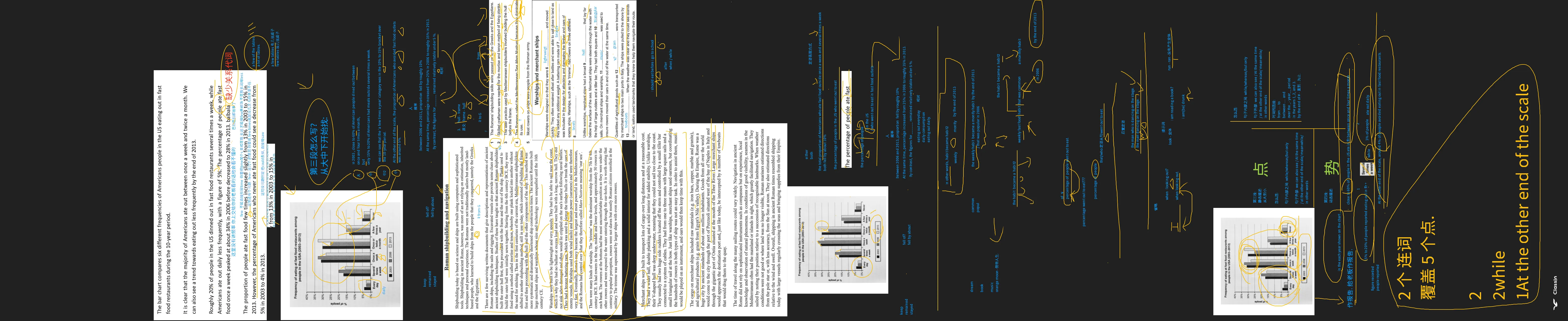
写作部分拿一篇 bar chart 的草稿逐句改:图表是 2003–2013 年美国人在快餐店就餐频率的十年变化,主体段落要拆成第三段(静态·点)和第四段(动态·势)——第三段从大到小铺数据,第四段抓十年间真正动了的那几根柱子。
阅读部分练一套 TRUE / FALSE / NOT GIVEN 判断题 + 摘要填空:文章是 Roman shipbuilding and navigation(罗马造船与航海),填空题的标题是 Warships and merchant ships。
整节课反复出现的一句话是:不要罗列所有数据,要像给老板作报告一样,只说变化。
🧱 结构:第一、二段(总起)
课上的草稿是这样开头的:
The bar chart compares six different frequencies of Americans people in the US eating out in fast food restaurants during the 10-year period.
It is clear that the majority of Americans ate out between once a week and twice a month. We can also see a trend towards eating out less frequently by the end of 2013.
第一句交代图比的是什么:六个频率(每天 / 一周几次 / 一周一次 / 一月一到两次 / 一年几次 / 从不)+ 人群 + 时间跨度。
第二句是 overview,不要报数字,只说两件事:主流区间在哪、整体往哪个方向走。板书在这里特别标了结尾的 by the end of 2013——这是 overview 的方向感来源。
🧱 结构:第三段 = 静态描述 · 点
板书给的定位非常明确:
| 第三段 | |
|---|---|
| 性质 | 静态描述 |
| 顺序 | 从大到小 |
| 一个字 | 点 |
"点"就是"哪一档占多少"。 课上老师直接问了一句:第三段怎么写?从大中下开始找——也就是先把柱子排个序,找出最大的、中间的、最小的那几档,而不是按图例顺序一排排念。
课上示范的第三段是这样排的(注意每一步都标了它落在哪一档):
大 —— 主流区间那一档:
In 2003, close to 60% of American people dined out between once and four times a month, but only 15% to 20% of Americans had meals outside several times a week.
中 —— 中间那一档:
we can see that the 'a few times a year' category was in the 10% to 15% bracket over the 10-year period.
小 —— 另一端:
At the other end of the scale, the proportion of Americans who avoided fast food outlets was around 5%.
板书在这三句旁边分别圈了 大 / 中 / 中2 / 小。这就是"从大中下开始找"的落点:一个档次一句话,配一个数字,句句有对比。
🧱 结构:第四段 = 动态描述 · 势
第四段的定位同样只有三个字:
| 第四段 | |
|---|---|
| 性质 | 动态描述 |
| 一个字 | 势 |
板书直接用口语把这段的目的说破了:作报告。给老板作报告。 —— 意思是这一段不追求覆盖全部数据,只讲"十年里真正变了的那几根柱子",把趋势一句话说清楚。
课上写出的第四段骨架:
In the each year shown on the chart, close to 60% of people in the US ate in ff between once and four times a month.
5% to 20% of people reported eating out in ff + …… while 3% of people ate out daily.
At the other end of the scale, around 4% of people avoided eating out in fast food restaurants.
这一段只用了两个连词,就覆盖了五个点:
2 2 while 1 At the other end of the scale
板书右下角把这句话单独框起来放大写了一遍:2 个连词 覆盖 5 个点。 —— while 管中间那几档的对比,At the other end of the scale 管两端收尾。
另外板书还标了两组"报数据"的动词替换:
- figure → recorded
- people → reported
也就是 the figure recorded / people reported,避免每句都用 was。
第四段的另一条写法:把"频率"换成"习惯"
板书在这里做了一次改写,把冷冰冰的百分比换成人话:
in other words, habit became habit2
the weekly habit became a monthly habit by the end of 2013
weekly fast food habit that was common in 2006
a monthly habit by the end of 2013
也就是说:2006 年流行的是"一周一次"这个习惯,到 2013 年变成了"一月一次"这个习惯。板书把 that was popular in 2006 和 by the end of 2013 分别圈出来,提醒这两头的时间锚点必须写全。
🔗 连接词清单(板书原样整理)
板书把连接词分成三类,照抄如下:
| 位置 | 可用词 |
|---|---|
| 句子内部之间 | while / whereas / but only |
| 句子外部 | we can also see / At the same time / at the other end of the scale / meanwhile / in other words |
| 时间的连接 | from ... to / between ... and / over the -year period / in the years 1, 2, and 3. / by the end of # —— 直到……为止 |
课上给的动态段例句正好把"时间连接"用满了:
Between 2006 and 2013, proportion fell by roughly 10%
At the same time, percentage increased from 25% in 2006 to roughly 35% in 2013.
By contrast, the figures for ______ remained relatively stable under 5 %.
板书在 "Between 2006 and 2013" 旁边标了两个字:人 / 频率 —— 提醒主语要说清是"人"还是"频率",否则句子读不通。在 "By contrast" 旁边标了 相对。
另外板书给了三个"下降"的同义说法,可以轮着用:
- keep
- remained
- stayed
以及一组"降了/降了多少"的区分:
- fell of ?
- fell by about
💬 课上改的句子(原稿 → 改法)
草稿的第三段原文是这样的,板书的批注一句句标在旁边:
Roughly 20% of people in the US dinned out in fast food restaurants several times a week, while Americans ate out daily less frequently, with a figure of 5%. The percentage of people ate fast food once a week peaked at about 34% in 2006 before decreased to 28% in 2013. balbala
批注分三条:
- 缺少关系代词 —— The percentage of people ate fast food once a week 里,
people后面少了关系代词,应该是 people who ate。板书把这个错误用红字写在句子上面。 - 这里没有讲频率,你上交给你的老板看的话他会看不懂的 —— 主语只说了 percentage of people,没说清是"多久吃一次"的那一档。
- 巴拉巴拉都出来了 —— 写到最后 balbala 直接唱出来了,意思是句子写崩了,越写越乱。
第四段原文:
The proportion of people ate fast food few times increased slightly from 13% in 2003 to 15% in 2013. However, the percentage of Americans who never ate fast food could see a decrease from 5% in 2003 to 4% in 2013.
批注三条:
- few 不能直接形容 time。你要把 time 加个 s 变成可数名词,才能用 few 来修饰;不可数名词用 less。
- 这里还有个问题:few 是"没几个"的意思,你要说 few times 就是"没几次",与你本意不符。 —— 想表达"几次"要用 a few times。
- 这句没问题,但是把 could 去掉,直接用 saw。
板书顺手给了 a few / few 的对比:
| 写法 | 中文 |
|---|---|
| a few tables | 有几张桌子 |
| few tables | 没几张桌子 |
| a few of the tables | 这些桌子里的几张 |
| a lot of tables | 很多张桌子 |
后置定语:能省就省
板书在另一处补了一个句型点:
| 完整写法 | 省掉关系代词 |
|---|---|
| the man who is dancing on the stage | the man dancing on the stage |
旁边标了 后置定语 → 省略。还有一组提示词练习:
- when looking out ? → when looking out .(标了 省略)
- look —— 变体
- I am reading a book ?
- I am (be) drunk
- run - ran —— 没有产生变体
意思是:分词做后置定语/状语,靠的是动词"变体"(reading / dancing / looking);run–ran 这种没有产生 -ing 变体的地方,就不能这么省。
📖 词汇与表达
| 英文 | 中文 | 搭配 / 用法 |
|---|---|---|
| frequency | 频率 | six different frequencies |
| dine out | 外出就餐 | dined out several times a week |
| eat out | 在外吃饭 | ate out between once a week and twice a month |
| fast food outlet | 快餐店 | avoided fast food outlets |
| bracket | 区间 | the 10% to 15% bracket |
| the proportion of | 比例 | the proportion of Americans who ... |
| the percentage of | 百分比 | the percentage of people who ... |
| peak at | 达到峰值 | peaked at about 34% in 2006 |
| decrease to | 降到 | before decreased to 28% in 2013 |
| increase slightly | 小幅上升 | increased slightly from 13% to 15% |
| remain stable | 保持稳定 | remained relatively stable under 5 % |
| roughly | 大约 | roughly 20% / roughly 10% |
| close to | 接近 | close to 60% |
| at the other end of the scale | 在另一端 | 收尾句用 |
| in other words | 换句话说 | 把百分比换成"习惯"说法 |
| meanwhile | 与此同时 | 句子外部连接 |
| whereas | 而、然而 | 句子内部连接 |
| by contrast | 相比之下 | 相对 |
| by the end of | 到……为止 | by the end of 2013 |
| shipbuilding | 造船 | Roman shipbuilding |
| navigation | 航海 | navigation in ancient Rome |
| hull | 船体 | built the outer hull first |
| frame | 骨架 | proceeded with the frame |
| plank | 木板 | planks were initially sewn together |
| mortise and tenon | 榫卯 | a method called mortise and tenon |
| stitching | 缝合 | without the need for stitching |
| warship | 战船 | Warships were built to be lightweight |
| merchant ship | 商船 | merchant ships had a broad hull |
| trireme | 三列桨座战船 | the 'trireme' was the dominant warship |
| oarsman | 桨手 | used both wind and human power (oarsmen) |
| battering ram | 撞角 | a bronze battering ram |
| ballast | 压舱物 | they had no ballast or excess load |
| tiller bar | 舵柄 | controlled by a small tiller bar |
| rudder | 舵 | two huge side rudders |
| towboat | 拖船 | intercepted by a number of towboats |
| quay | 码头 | drag them to the quay |
| landmark | 地标 | noting their position relative to landmarks |
| pole star | 北极星 | estimated directions from the pole star |
| swell | 涌浪 | relative to the wind and swell |
📝 阅读:Roman shipbuilding and navigation
文章主线(板书上的原文段落):
Shipbuilding today is based on science and ships are built using computers and sophisticated tools. Shipbuilding in ancient Rome, however, was more of an art relying on estimation, inherited techniques and personal experience. The Romans were not traditionally sailors but mostly land-based people, who learned to build ships from the people that they conquered, namely the Greeks and the Egyptians.
板书在 learned to build ships from ... the Greeks and the Egyptians 旁边写了 R from G(罗马人从希腊人那里学),并在批注区写了 R to G —— 方向正好相反。这是判断题的第一个坑。
There are a few surviving written documents ... Planks used to build the outer hull were initially sewn together. ... Starting from the 6th century BCE, they were fixed using a method called mortise and tenon, whereby one plank locked into another without the need for stitching. Then in the first centuries of the current era, Mediterranean shipbuilders shifted to another shipbuilding method, still in use today, which consisted of building the frame first and then proceeding with the hull and the other components of the ship.
板书在批注区写下 3. hull - frame / 原文:frame - hull —— 原文的先后顺序是"先 frame 后 hull",凡是把顺序倒过来说的选项都是错的。
判断题(板书上的五个题干,原样保留):
- The Romans' shipbuilding skills were passed on to the Greeks and the Egyptians.
- Skilled craftsmen were needed for the mortise and tenon method of fixing planks.
- The later practice used by Mediterranean shipbuilders involved building the hull before the frame.
- The Romans called the Mediterranean Sea Mare Nostrum because they dominated its use.
- Most rowers on ships were people from the Roman army.
板书上清晰可辨的批注: 第 3 题旁边写了 F,第 4 题旁边写了 T 并打了一个对勾。第 1、2、5 题的标记在图上被涂改得看不清,这里不代填。
第 5 题对应的原文句子: It is worth noting that contrary to popular perception, rowers were not slaves but mostly Roman citizens enrolled in the military. —— 板书把 not ... but mostly Roman citizens 划了出来。
摘要填空:Warships and merchant ships
板书上填好的答案(蓝字是课上写的):
Warships were designed so that they were 6 lightweight and moved quickly. They often remained afloat after battles and were able to sail close to land as they lacked any additional weight. A battering ram made of 7 bronze was included in the design for attacking and damaging the timber and oars of enemy ships. Warships, such as the 'trireme', had rowers on three different 8 levels.
Unlike warships, merchant ships had a broad 9 hull that lay far below the surface of the sea. Merchant ships were steered through the water with the help of large rudders and a tiller bar. They had both square and 10 triangular sails. On merchant ships and warships, 11 music was used to ensure rowers moved their oars in and out of the water at the same time.
Quantities of agricultural goods such as 12 grain were transported by merchant ships to two main ports in Italy. The ships were pulled to the shore by 13 towboats. When the weather was clear and they could see islands or land, sailors used landmarks that they knew to help them navigate their route.
填空对应的原文句子:
Warships were built to be lightweight and very speedy. They had to be able to sail near the coast, which is why they had no ballast or excess load and were built with a long, narrow hull.
They had a bronze battering ram, which was used to pierce the timber hulls or break the oars of enemy vessels.
They had both square and a small triangular sail at the bow. Just like warships, merchant ships used oarsmen, but coordinating the hundreds of rowers in both types of ship was not an easy task. In order to assist them, music would be played on an instrument, and oars would then keep time with this.
Large merchant ships would approach the destination port and, just like today, be intercepted by a number of towboats that would drag them to the quay.
⚠️ 提醒 / 易错
1. 第三段只写"点",第四段只写"势"。 第三段是静态的,一档一句、从大到小;第四段是动态的,只说变了的那几根。不要把整张图的数据从头念到尾。
2. 主语必须说清"人 / 频率"。
板书在水蓝色批注里写得很直白:这里没有讲频率,你上交给你的老板看的话他会看不懂的。写 The percentage of people 之后一定要把 who ate ... once a week 这类限定补上,否则读者不知道是哪一档。
3. 关系代词不能掉。
The percentage of people ate fast food once a week → 缺 who。这是这节课红字标出的第一个错误。
4. a few / few 差一个 a,意思反过来。 few times = 没几次;要表达"几次"必须写 a few times。而且 time 要变可数(time s)才能用 few 修饰,不可数名词用 less。
5. could 是多余的。 the percentage ... could see a decrease —— 板书说"这句没问题,但是把 could 去掉,直接用 saw"。
6. 判断题先看"方向"。 第 1 题的原文是罗马人从希腊人那里学(R from G),选项写成罗马人传给希腊人(R to G),方向一反就错。第 3 题同理,原文是 frame 在前、hull 在后,选项写成 hull 在前。
7. 两个连词能覆盖五个点。
while + At the other end of the scale,这是这节课在 bar chart 结尾段上最省力的组合。