📌 这节课讲了什么
这节课把雅思阅读里的匹配题拆成三类,一类一类讲:
| 三大难题 | 配的什么 |
|---|---|
| 标题 - 段落 | List of Headings,给段落选小标题 |
| 观点 - 人 | 把陈述句配到人/研究者身上 |
| 信息 - 细节 | Which paragraph contains the following information? |
板书对难度的判断很直接:
为什么觉得判断题简单:因为 - 对立面 / 同义替换 / 直接。
匹配题稍难,要理解 / 要总结;同时难度尚可,因为 list 容易理解,因为是概括性。
也就是说:判断题只要"找到那一句、比一比";匹配题必须先读懂、再概括,但好在标题/人名这些"清单"本身是概括性的,方向明确。
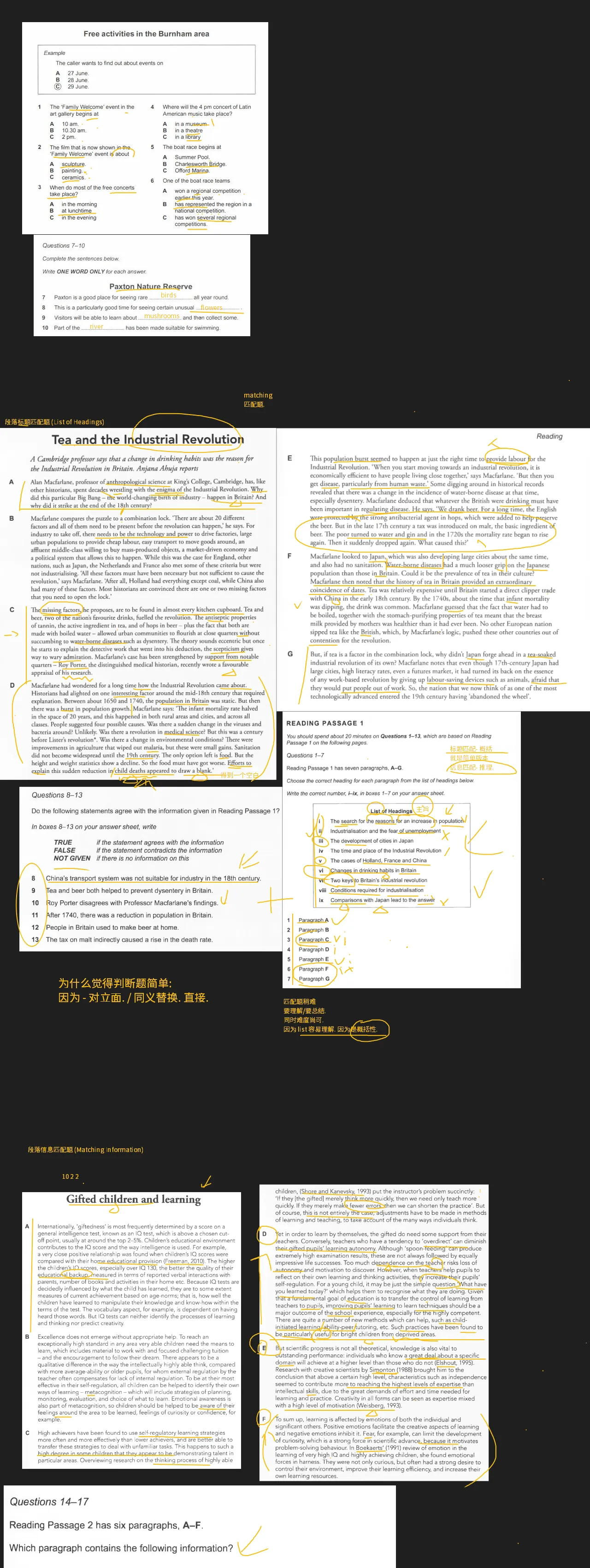
课上用两篇文章走了全程:Tea and the Industrial Revolution(Q1–7 选标题 + Q8–13 判断题)和 Gifted children and learning(Q14–17 段落信息匹配 + Q18–22 观点配人),最后用 Preface to 'How the other half thinks: Adventures in mathematical reasoning'(Q27–34)做了段落信息匹配的强化。
🧱 框架:标题 - 段落(List of Headings)
标题匹配的选项表本身就给了你"文章会讲什么"的地图。这篇的九个标题是:
| 序号 | 标题 |
|---|---|
| i | The search for the reasons for an increase in population |
| ii | Industrialisation and the fear of unemployment |
| iii | The development of cities in Japan |
| iv | The time and place of the Industrial Revolution |
| v | The cases of Holland, France and China |
| vi | Changes in drinking habits in Britain |
| vii | Two keys to Britain's industrial revolution |
| viii | Conditions required for industrialisation |
| ix | Comparisons with Japan lead to the answer |
这篇文章段落 A–G 各自在讲什么,板书上都划了线,可以直接对照:
| 段落 | 这一段的"事" |
|---|---|
| A | Macfarlane 把工业革命当成一个谜:为什么发生在英国、为什么在 18 世纪末 |
| B | 工业革命要"凑齐条件":技术、动力、大量城市人口提供廉价劳动力、便宜运输、有钱的中产市场、市场化的经济与政治制度 —— 他把这个谜比作 combination lock |
| C | 两个关键落在喝的东西上:茶里的 tannin、啤酒里的 hops,以及"用开水" |
| D | 人口问题:1650–1740 年英国人口 static,之后突然 a burst in population growth |
| E | 喝水与疾病:digging around in historical records 发现 water-borne diseases 的变化 |
| F | 用日本做对照:日本也喝开水,但没有把茶变成全国性饮料 |
| G | 再回到日本:日本放弃 labour-saving devices,"abandoned the wheel" |
选标题的具体动作:先把九个标题里反复出现的关键词圈出来(population、industrialisation、Japan、Holland France China、drinking habits、two keys、conditions、the time and place),再带着这些词回段落里找。哪一段在讲"条件",哪一段在讲"时间地点",哪一段在讲"日本",一眼就能分类。
🧱 方法:信息 - 细节(段落信息匹配)
这是三种里最"耗时间"的一种。板书给的流程只有三句:
看两题段落信息匹配。
再看一段原文段落。
直到匹配到这个段落为止。
配套的计算是:
27 28 + A = 3 信息
意思是:一次只带 2–3 道题进原文,读一段、对一次;对上了就往下走,不要在没对上的段落上反复磨。这样一遍读下来,信息题基本能扫完。
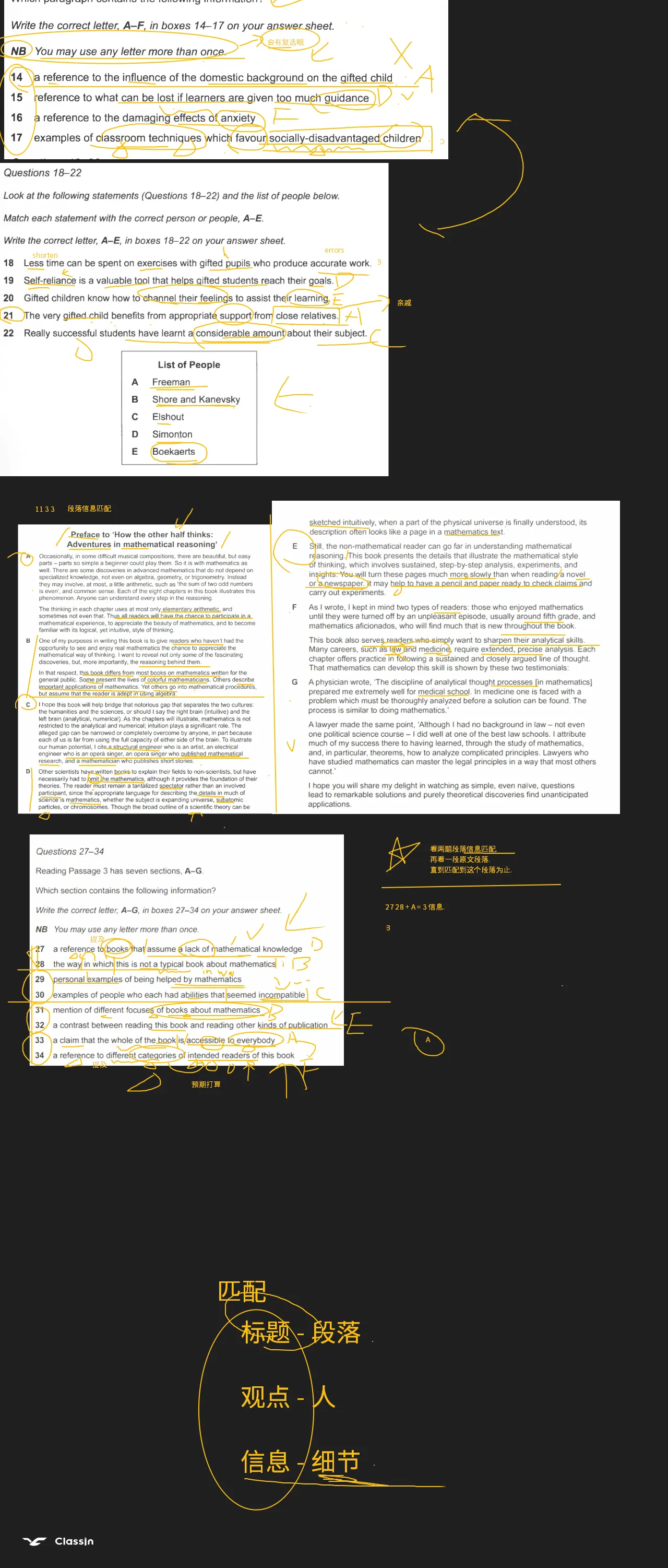
Q27–34 的八条信息(文章是 Preface to 'How the other half thinks: Adventures in mathematical reasoning',分 A–G 七节):
| 题 | 信息 |
|---|---|
| 27 | a reference to books that assume a lack of mathematical knowledge |
| 28 | the way in which this is not a typical book about mathematics |
| 29 | personal examples of being helped by mathematics |
| 30 | examples of people who each had abilities that seemed incompatible |
| 31 | mention of different focuses of books about mathematics |
| 32 | a contrast between reading this book and reading other kinds of publication |
| 33 | a claim that the whole of the book is accessible to everybody |
| 34 | a reference to different categories of intended readers of this book |
板上还标了一条指令细节:
NB You may use any letter more than once.
板书在旁边写了"参考答案"—— 也就是说,同一个段落可以用两次,别因为"应该一一对应"而把一个好用的段落排除掉。
答题时要把题干里的"抽象说法"还原成原文里的"具体内容",比如:
- intended readers(板书注:预期打算)→ 原文就是在分"两类读者"(喜欢数学的 / 非数学专业的);
- assume a lack of mathematical knowledge → 去找"给不懂数学的人写的书";
- a contrast between reading this book and reading other kinds of publication → 去找 "you will turn these pages much more slowly than when reading a novel or a newspaper" 这类对比句。
原文里那句被圈出来的是:
You will turn these pages much more slowly than when reading a novel or a newspaper. It may help to have a pencil and paper ready to check claims and carry out experiments.
🧱 方法:观点 - 人
这一类的清单就是人名表:
| 选项 | 人名 |
|---|---|
| A | Freeman |
| B | Shore and Kanevsky |
| C | Elshout |
| D | Simonton |
| E | Boekaerts |
Q18–22 的五条陈述(文章 Gifted children and learning):
| 题 | 陈述 |
|---|---|
| 18 | Less time can be spent on exercises with gifted pupils who produce accurate work. |
| 19 | Self-reliance is a valuable tool that helps gifted students reach their goals. |
| 20 | Gifted children know how to channel their feelings to assist their learning. |
| 21 | The very gifted child benefits from appropriate support from close relatives. |
| 22 | Really successful students have learnt a considerable amount about their subject. |
板书的批注很有代表性,都是"把题干换成原文说法":
- 18:旁边写了 shorten(缩短)和 errors(错误)—— 题干说的是"少花点时间做练习",原文多半是从"缩短 / 提高效率"的角度说的;
- 21:旁边写了"亲戚" ——
close relatives换成原文里的具体亲属关系; - 20:
channel their feelings(疏导情绪)这类抽象动词,要换成原文的具体动词。
做这一类的顺序建议是:先把题干里的人名相关动作划出来,再带着人名去原文扫。人名在原文里通常很显眼。
📝 这节课练了什么
| 套数 | 文章 | 题型 |
|---|---|---|
| 剑 10 Test 2 Passage 2(板书标注 10 2 2) | Gifted children and learning | Q14–17 段落信息匹配;Q18–22 观点配人 |
| 剑 11 Test 3 Passage 3(板书标注 11 3 3) | Preface to 'How the other half thinks' | Q27–34 段落信息匹配 |
| — | Tea and the Industrial Revolution | Q1–7 选标题;Q8–13 判断题 |
Q14–17 的四条信息(文章分 A–F 六段,NB 也是 letters can be used more than once):
| 题 | 信息 |
|---|---|
| 14 | a reference to the influence of the domestic background on the gifted child |
| 15 | reference to what can be lost if learners are given too much guidance |
| 16 | a reference to the damaging effects of anxiety |
| 17 | examples of classroom techniques which favour socially-disadvantaged children |
板书的批注是两句话:做段落信息匹配,先看两题,再读一段原文,直到匹配到那一段为止。
📖 词汇与表达
阅读题干里的高频说法
| 英文 | 中文 | 搭配 / 用法 |
|---|---|---|
| a reference to | 提到 | 题干标准句式 |
| domestic background | 家庭背景 | the influence of the domestic background |
| guidance | 指导 | be given too much guidance |
| anxiety | 焦虑 | the damaging effects of anxiety |
| socially-disadvantaged | 社会处境不利的 | socially-disadvantaged children |
| self-reliance | 自立 | a valuable tool |
| channel their feelings | 疏导情绪 | channel ... to assist their learning |
| close relatives | 近亲 | 板书注:亲戚 |
| a considerable amount | 相当多 | learn a considerable amount about their subject |
| incompatible | 不相容的 | abilities that seemed incompatible |
| accessible | 可理解的 | the whole of the book is accessible to everybody |
| intended readers | 目标读者 | 板书注:预期打算 |
| categories | 类别 | different categories |
| assumption | 假设 | books that assume a lack of mathematical knowledge |
| a typical book | 典型的书 | this is not a typical book about mathematics |
| focuses | 侧重点 | different focuses of books about mathematics |
文章里的词
| 英文 | 中文 | 搭配 / 用法 |
|---|---|---|
| industrialisation | 工业化 | 标题词 |
| combination lock | 密码锁、组合锁 | compares the puzzle to a combination lock |
| criteria | 标准 | meet some of these criteria |
| coal | 煤 | Holland had everything except coal |
| tannin | 单宁 | the active ingredient in tea |
| hops | 啤酒花 | a strong antibacterial agent in hops |
| antibacterial | 抗菌的 | antibacterial agent |
| malt | 麦芽 | a tax was introduced on malt |
| dysentery | 痢疾 | water-borne diseases such as dysentery |
| water-borne | 水传播的 | water-borne diseases |
| mortality rate | 死亡率 | the mortality rate began to rise again |
| infant mortality | 婴儿死亡率 | the infant mortality rate halved |
| literacy rates | 识字率 | high literacy rates |
| labour-saving devices | 省力装置 | giving up labour-saving devices |
| put people out of work | 让人失业 | afraid that they would put people out of work |
| abandoned the wheel | 放弃了轮子 | entered the 19th century having 'abandoned the wheel' |
| gifted | 天赋高的 | gifted children |
| giftedness | 天赋 | determined by a score on a general intelligence test |
| cut-off point | 分界线 | above a chosen cut-off point |
| exceptional | 超常的 | exceptionally high standard |
| qualitatively different | 质的不同 | qualitatively different in the way ... |
| mediation | 中介、调停 | 相关词 |
| metacognition | 元认知 | self-regulatory learning strategies |
| sustained | 持续的 | a sustained and closely argued line of thought |
| analytical | 分析的 | sharpen their analytical skills |
| aficionados | 爱好者 | mathematics aficionados |
| theorems | 定理 | in particular, theorems |
| physician | 内科医生 | A physician wrote ... |
| naive | 天真的、朴素的 | simple, even naive, questions |
⚠️ 提醒 / 易错
1. 匹配题和判断题的难度差在哪,先想清楚。 板书的话:判断题 = 对立面 / 同义替换 / 直接;匹配题 = 要理解 / 要总结。 所以判断题靠"找",匹配题靠"读"。
2. 段落信息匹配的正确节奏:一次带 2–3 题。 "看两题 → 读一段 → 对上就走",不要在同一个段落里死磕。
3. NB 那句一定要看。 "You may use any letter more than once" 意味着同一个答案可以用多次,不要强行一一对应。
4. 题干大多不是原文原词。 close relatives → 亲戚、a lack of mathematical knowledge → 不懂数学、intended readers → 目标读者,都得先"翻译"成原文的说法再去找。
5. 标题匹配先圈关键词。 九个标题里反复出现的那几个词(population / Japan / Holland, France and China / drinking habits / conditions),就是回段落定位的路标。
6. 选标题时,别被段落开头骗了。 概括性的标题通常对应整段,不是对应第一句。