📌 这节课讲了什么
三块内容,一块听力、两块口语:
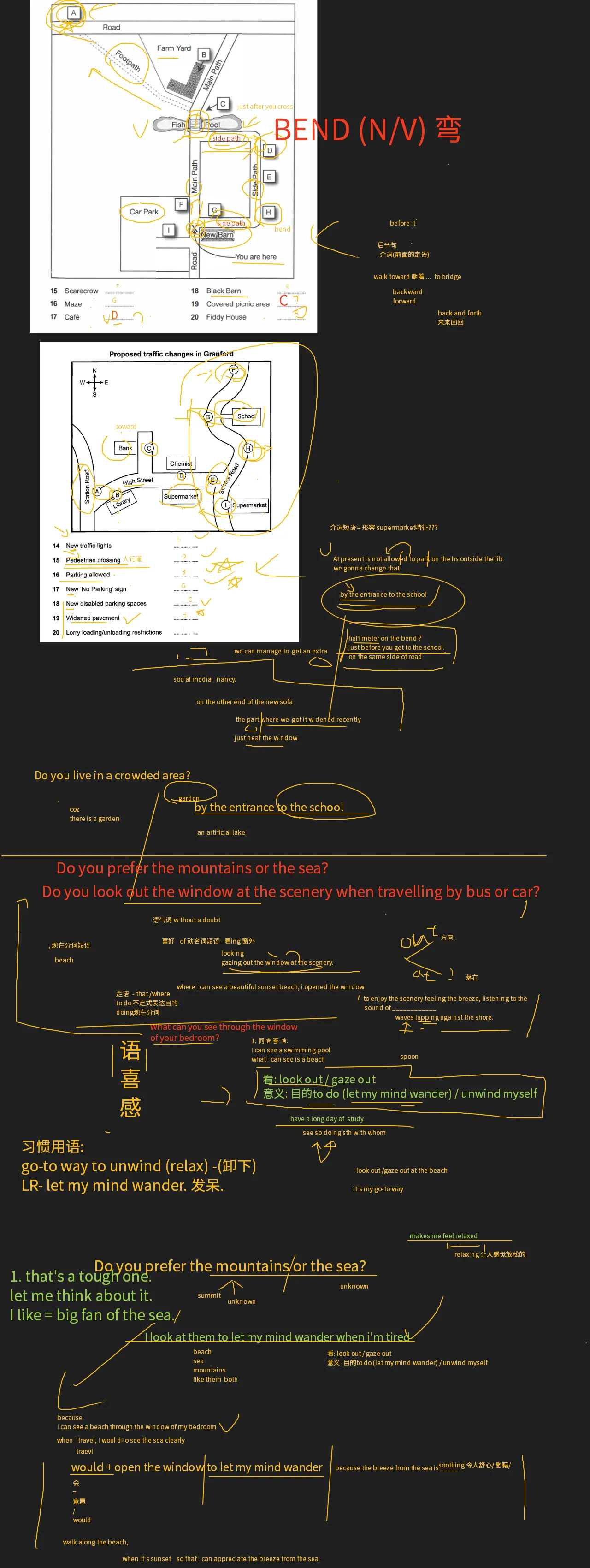
- 听力地图题 —— 两张图:一张农场/公园平面图(15–17 题 Scarecrow / Maze / Café,18–20 题 Black Barn / Covered picnic area / Fiddy House),一张 Proposed traffic changes in Granford(14–20 题)。板书的重点全在方位词和参照物上:bend、toward、back and forth、before、after。
- 口语风景题 —— Do you prefer the mountains or the sea? 和 Do you look out the window at the scenery when travelling by bus or car? —— 山、海、窗外三个语料包。
- 语法骨架 —— Do sth to do sth:to do 表目的。这是整节课的落点:所有「看风景」的动作后面,都挂一串 to do 说「为了什么」。
🧱 方法:听力地图题
图一:农场/公园图(15–20 题)
图上的地标(板书原词):Road · Farm Yard · Footpath · Main Path · side path · Fish Pool · Car Park · New Barn · You are here,选项 A–J 分布在各条路和建筑旁边。
板书的做法:
- 先认路:Footpath(小径)、Main Path(主路)、side path(侧路)—— 地图题的第一步是把「路」的名字和走向认清,答案点几乎都挂在路边。
- 抓方位短语。板书画住了 C 点旁边那句 just after you cross —— 听力里的位置就是这么给的:「你走过……之后马上就是」。
- 抓参照物:New Barn 旁边标着 You are here(出发点),后面所有方位都是从这里算的。
板书标出的答案:
| 题号 | 地点 | 板书答案 |
|---|---|---|
| 15 | Scarecrow | F |
| 16 | Maze | G |
| 17 | Café | D |
| 18 | Black Barn | H |
| 19 | Covered picnic area | C(板书在旁边打了个问号) |
| 20 | Fiddy House | A(圈出) |
图二:Granford 交通改造图(14–20 题)
图上地标:Bank · Chemist · School · Supermarket · Library · Station Road · High Street · Stour Road,左上角有 N / W / E / S 指北针(板书把指北针圈了 —— 地图题第一眼看方向)。选项 A–I 钉在各个路口。
题目全是「新增设施」:New traffic lights / Pedestrian crossing / Parking allowed / New 'No Parking' sign / New disabled parking spaces / Widened pavement / Lorry loading/unloading restrictions。
板书标出的答案:
| 题号 | 题干 | 板书答案 |
|---|---|---|
| 14 | New traffic lights | E |
| 15 | Pedestrian crossing(人行道) | D |
| 16 | Parking allowed | B |
| 17 | New 'No Parking' sign | G |
| 18 | New disabled parking spaces | C(打勾) |
| 19 | Widened pavement | H(打勾) |
| 20 | Lorry loading/unloading restrictions | (板书空着) |
地图题要认的词(板书原话)
BEND (N/V) 弯
bend 既是名词(拐弯处)也是动词(拐弯),地图里出现一个弯,地址就爱挂在弯上:
half meter on the bend ?
just before you get to the school.
on the same side of road
walk toward 朝着 ... to bridge
backward / forward / back and forth 来来回回
- toward —— 朝着某个方向走;
- forward / backward —— 往前 / 往后;
- back and forth —— 来来回回,在两点之间往返;
- before it / 后半句 · 介词(前面的定语) —— 板书这条批注是提醒:方位词后面跟的那个介词短语,才是真正的定位信息(「在……之前」的「什么」在后面)。
改造类地图的固定套路
At present is not allowed to park on the hs outside the lib
we gonna change that
we can manage to get an extra ...
「现在不行、但我们准备改」—— 这是改造类地图题的出题模板:现状一句、改动一句,听力里听到 At present 就要准备记「改完之后」的位置。
🧱 方法:位置怎么描述(口语也能直接用)
by the entrance to the school
the part where we got it widened recently
on the other end of the new sofa
just near the window
social media - nancy.
介词短语 = 形容词 supermarket 特征???
板书的批注「介词短语 = 形容词」是这套说法的核心:想描述一个地方的特征,不用形容词,直接挂一个介词短语 —— by the entrance to the school(在学校入口旁边)、on the other end of the new sofa(新沙发的另一头)、just near the window(就在窗边)、the part where we got it widened recently(我们最近拓宽的那一块)。
「Do you live in a crowded area?」这种题的答案就是这么来的:
coz there is a garden by the entrance to the school
an artificial lake
🧱 框架:山 or 海(喜好题怎么开口)
题目:
Do you prefer the mountains or the sea?
第一步:先缓一拍(语气)。
- that's a tough one.
let me think about it.
第二步:表态。 like = 很喜欢:
I like = big fan of the sea.
第三步:给理由,理由里必须带画面。 板书给的语料:
| 山 | 海 |
|---|---|
| greenery(山-绿) | beach(海-沙滩) |
| summit | sea |
I like them both
look at them to let my mind wander when i'm tired
because I can see a beach through the window of my bedroom
when I travel, I would open the window to see the sea clearly
because the breeze from the sea is soothing(令人舒心 / 慰藉)
walk along the beach, when it's sunset so that I can appreciate the breeze from the sea.
注意两个句式:
- would + open the window —— 板书标注:会 / 意愿。说「(每次)我都会开窗」用 would,不是 will;
- so that I can appreciate ... —— 目的从句的另一种说法。
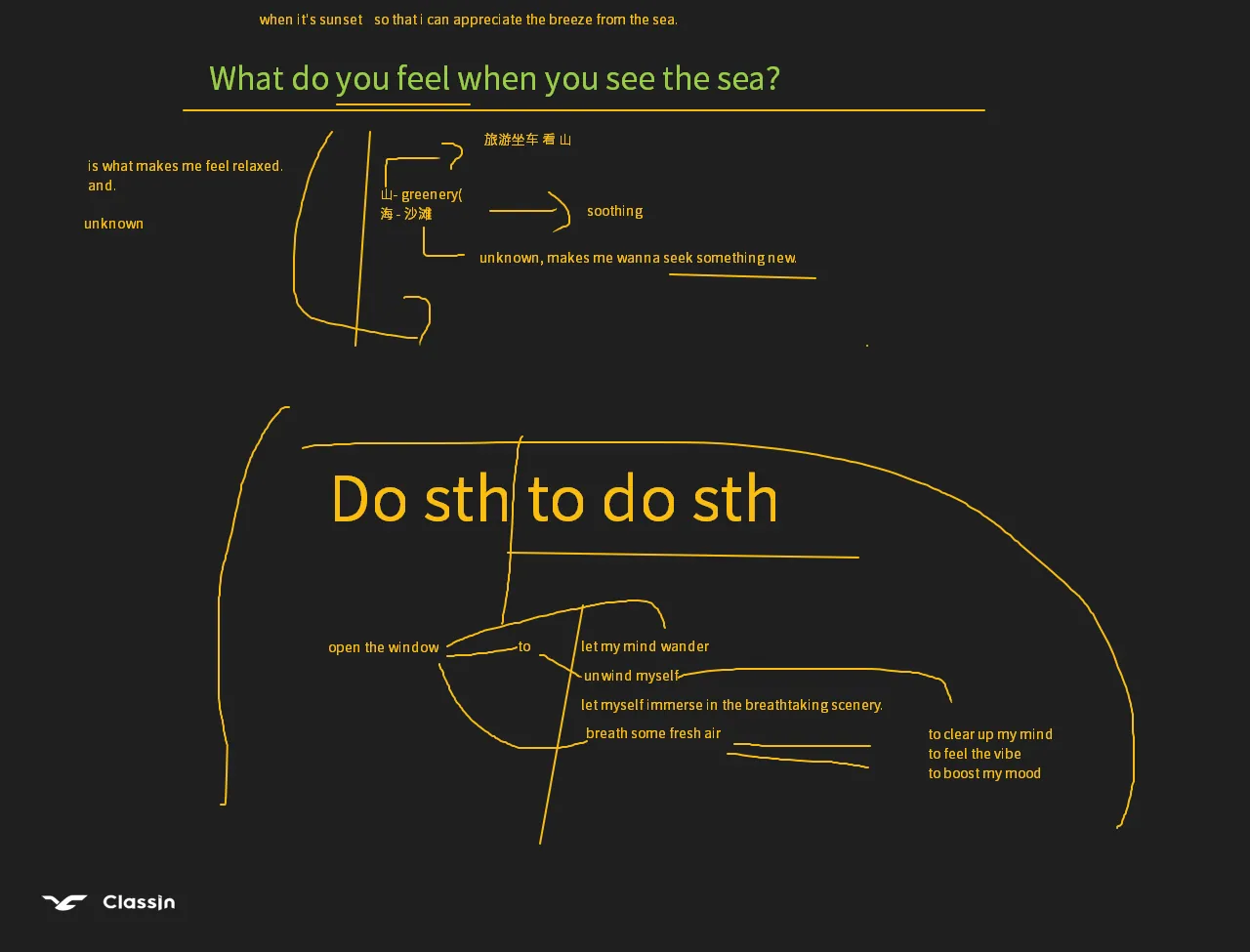
第四步:换个人称继续答(和山海的对照)。 板书在「What do you feel when you see the sea?」下面写了:
旅游坐车 看山
unknown, makes me wanna seek something new.
is what makes me feel relaxed.
语气词(板书「情感/语感」区):
without a doubt. 真好
🧱 语法点:to do 表目的(Do sth to do sth)
板书用大字写了一整块:
Do sth to do sth
结构就是「做一件事,为了……」。左边是动作,右边一排全是目的:
open the window to let my mind wander
unwind myself
let myself immerse in the breathtaking scenery.
breathe some fresh air to clear up my mind
to feel the vibe
to boost my mood
这一个结构可以套在所有「看风景」的答案上:
- open the window → to let my mind wander(开窗 → 让脑子放空)
- open the window → to breathe some fresh air → to clear up my mind(开窗 → 呼吸新鲜空气 → 清醒一下)
- 旅行 → open the window → to see the sea clearly → to feel the vibe
板书的批注:
意义:目的 to do (let my mind wander) / unwind myself
习惯用语:go-to way to unwind (relax) -(卸下)
LR- let my mind wander. 发呆.
look out / gaze out at the beach
it's my go-to way
makes me feel relaxed
relaxing 让人感觉放松的
- go-to way = 首选方式、惯用的一招;
- unwind = 卸下(压力)、放松;
- let my mind wander = 让思绪飘一会儿、发呆;
- makes me feel relaxed(让我放松)和 relaxing(让人放松的)一主动一形容,别写混。
🧱 框架:看窗外那一题
题目:
Do you look out the window at the scenery when travelling by bus or car?
"看"的动词(板书):
look out / gaze out at the scenery
looking / gazing out the window at the scenery.
gaze 比 look 更「凝视」,搭配都是 at。
定语和分词(板书批注):
现在分词短语.
定语. - that / where
to do 不定式表达的
doing 现在分词
用句子看:
where i can see a beautiful sunset beach, i opened the window
i opened the window of your bedroom?
you see through the window
to enjoy the scenery feeling the breeze, listening to the sound of waves lapping against the shore.
最后这句是两个现在分词短语挂在同一句上 —— feeling the breeze / listening to the sound of waves lapping against the shore,画面感一下就出来了(lapping against the shore = 拍着岸)。
问啥答啥(板书「1. 问啥答啥」):
What can you see through the window of your bedroom?
I can see a swimming pool
what i can see is a beach
题目问 what can you see,就用 I can see / What I can see is 直接接住,别绕。
see sb doing sth:
see sb doing sth with whom
have a long day of study.
📖 词汇与表达
| 英文 | 中文 | 搭配 / 用法 |
|---|---|---|
| bend | 拐弯(处) | half meter on the bend |
| toward | 朝着 | walk toward the bridge |
| forward / backward | 往前 / 往后 | |
| back and forth | 来来回回 | |
| just after you cross | 你走过……之后马上 | 方位提示 |
| on the same side of road | 在马路的同一侧 | |
| by the entrance to the school | 在学校入口旁 | 介词短语当形容词用 |
| pavement | 人行道 | Widened pavement |
| pedestrian crossing | 人行横道 | 板书注「人行道」 |
| disabled parking spaces | 残疾人车位 | New disabled parking spaces |
| traffic lights | 红绿灯 | New traffic lights |
| loading / unloading restrictions | 装卸限制 | Lorry loading/unloading restrictions |
| scarecrow | 稻草人 | |
| maze | 迷宫 | |
| barn | 谷仓 | New Barn / Black Barn |
| covered picnic area | 有顶的野餐区 | |
| footpath / side path / main path | 小径 / 侧路 / 主路 | |
| farm yard | 农场院子 | |
| car park | 停车场 | |
| artificial lake | 人工湖 | |
| summit | 山顶 | 山的话题 |
| greenery | 绿植 | 山的话题 |
| beach | 沙滩 | 海的话题 |
| soothing | 令人舒心的 | the breeze is soothing |
| breeze | 微风 | appreciate the breeze |
| sunset | 日落 | when it's sunset |
| waves lapping against the shore | 浪拍着岸 | listening to the sound of |
| breathtaking scenery | 令人屏息的风景 | immerse in |
| let my mind wander | 让脑子放空、发呆 | LR 亮点 |
| unwind | 卸下、放松 | go-to way to unwind |
| go-to way | 首选方式 | it's my go-to way |
| boost my mood | 提振心情 | to boost my mood |
| feel the vibe | 感受氛围 | to feel the vibe |
| clear up my mind | 清醒一下 | breathe fresh air to clear up my mind |
| gaze out | 凝视 | gaze out at the beach |
| without a doubt | 毫无疑问 | 语气词 |
| a big fan of | 超级喜欢 | big fan of the sea |
| that's a tough one | 这题有点难 | 缓冲语 |
⚠️ 提醒 / 易错
1. 地图题先看指北针。 图二左上角 N / W / E / S 被板书圈出来 —— 方向词(left / right / north / east)全部靠它定。
2. 方位信息挂在「参照物 + 介词短语」上。 half meter on the bend / just before you get to the school / on the same side of road / by the entrance to the school —— 听力里听到参照物,马上在图上点住,再等后半句的介词。
3. bend 是一词两性。 名词「弯道」、动词「拐弯」,听力里不管听到 in the bend 还是 it bends,都是同一个位置点。
4. 「现在是……,我们要改」是改造图的标准出题句式。 At present is not allowed to ... we gonna change that —— 听到 At present 只是铺垫,答案在后面。
5. to do 表目的,一个动作挂一串目的。 open the window to let my mind wander / to breathe some fresh air / to boost my mood —— 说风景题时,不要停在「我开窗」,一定要说出「为了什么」。
6. 定语用 that 还是 where。 先行词是地方就用 where(where i can see a beautiful sunset beach),是物就用 that/which。
7. 现在分词做状语 = 一个句子里塞两个动作。 to enjoy the scenery feeling the breeze, listening to the sound of waves lapping against the shore —— 主动作 enjoy the scenery,后面的 -ing 全是伴随动作,这是把答案拉长的关键。
8. 表态的前一步是先缓一拍。 that's a tough one / let me think about it —— 不是废话,是给自己争取造句的时间。