📌 这节课讲了什么
两件事,一件阅读、一件口语:
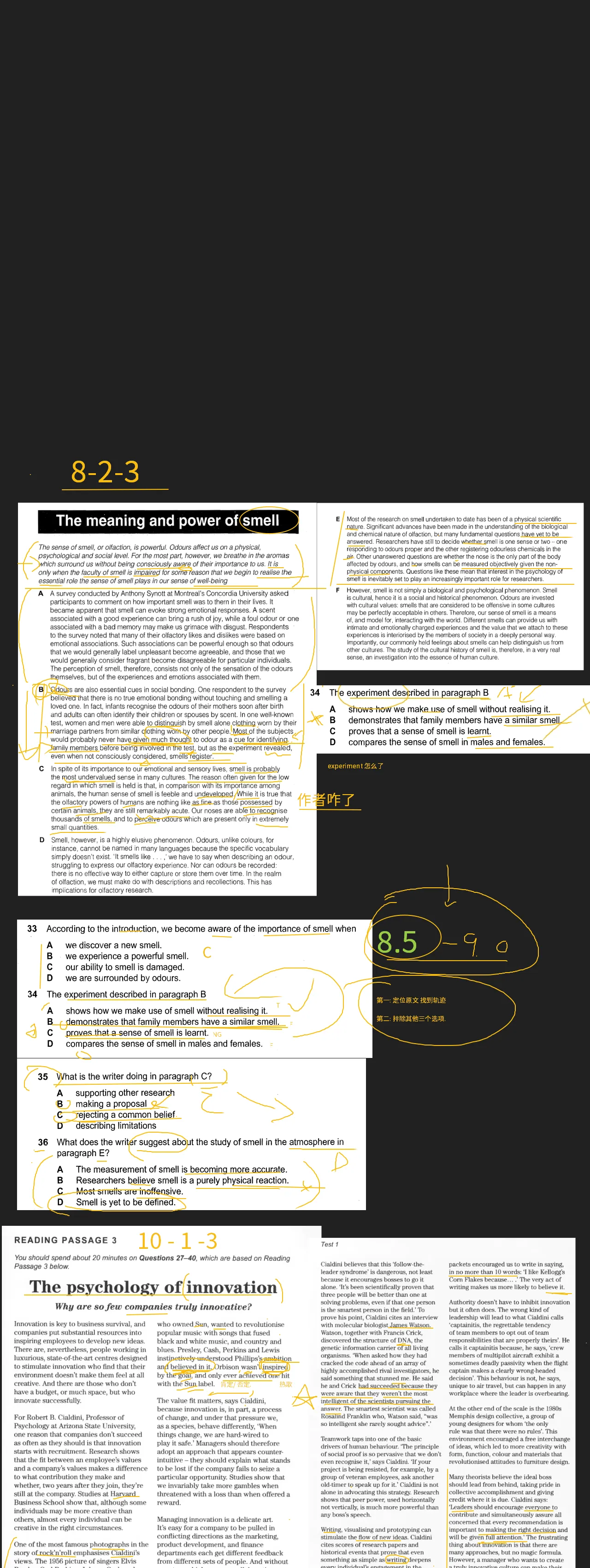
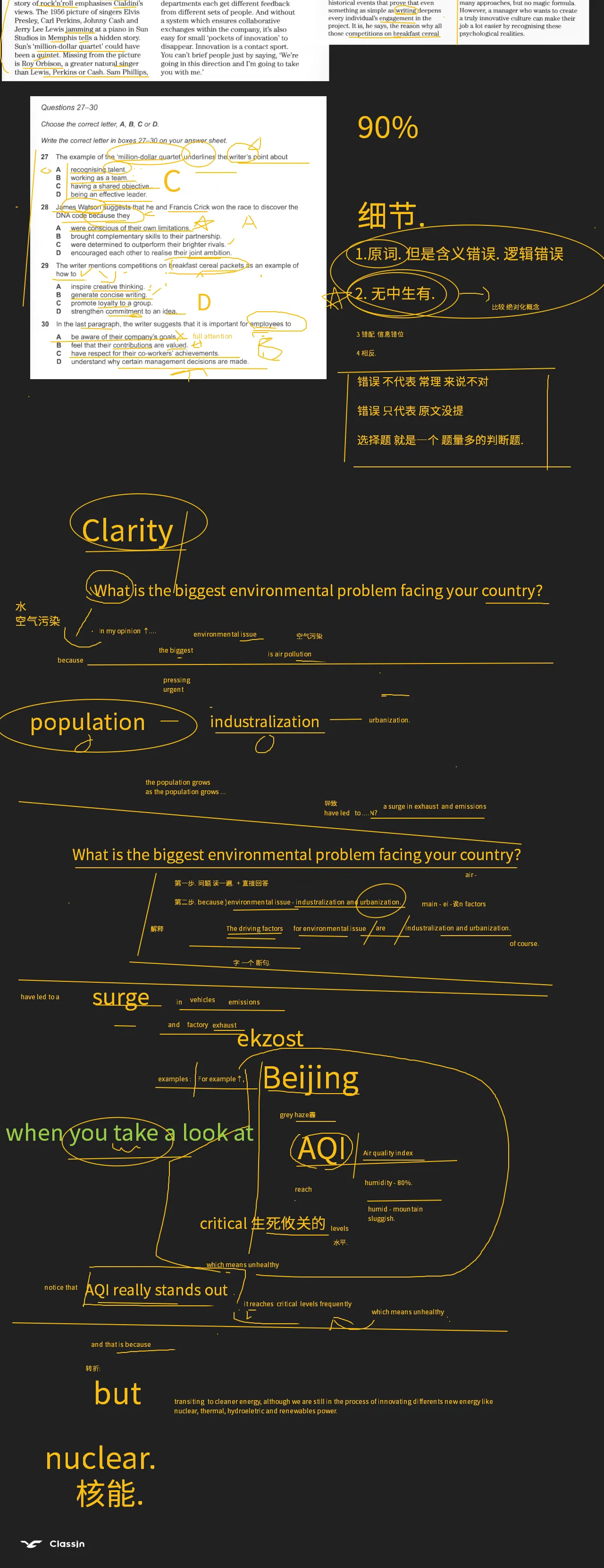
- 阅读:选择题就是判断题。 板书用两篇真题实证 —— The meaning and power of smell(板书标 8-2-3,33–36 题)和 The psychology of innovation(板书标 10-1-3,27–30 题)。做题只有两个动作:第一,定位原文找到轨迹;第二,排除其他三个选项。选项错法被归纳成四类。
- 口语:环境问题 P3 的四步 —— 直接 → 原因 → 例子 → 转折。板书标了「90%」,意思是这套框架能覆盖绝大多数题;右下角还有一条:断句。
🧱 方法:选择题就是一个题量多的判断题
板书原话:
第一:定位原文找到轨迹
第二:排除其他三个选项.
选择题就是一个题量多的判断题.
四个选项里,三个是错的。错法只有四类(板书原文):
| # | 错法 | 说明 |
|---|---|---|
| 1 | 原词,但是含义错误,逻辑错误 | 选项里全是原文的词,但意思被拧了 |
| 2 | 无中生有(比较绝对化概念) | 原文压根没提;出现比较、绝对化说法要警惕 |
| 3 | 错配;信息错位 | 把 A 段的特征安到 B 段头上 |
| 4 | 相反 | 和原文说的正好反过来 |
两条判断原则(板书原文):
错误 不代表 常理 来说不对
错误 只代表 原文没提
意思是:不要用常识判题。一个选项听起来再合理,只要原文没说,它就是错的;一个选项再离谱,只要原文写了,它就是对的。
选项比对时要做的事(板书在题干和选项上画满的线):
- 题干里的关键词圈出来 —— the example of the 'million-dollar quartet'、James Watson suggests、competitions on breakfast cereal packets;
- 回到原文把那句话划出来(轨迹);
- 把选项和原句逐词比:同义替换的留下,原词但含义变的划掉。
🔍 真题一:The meaning and power of smell(8-2-3)
33–36 题板书给出的答案
| 题号 | 题干 | 板书答案 |
|---|---|---|
| 33 | According to the introduction, we become aware of the importance of smell when ... | C(our ability to smell is damaged) |
| 34 | The experiment described in paragraph B ... | B(demonstrates that family members have a similar smell) |
| 35 | What is the writer doing in paragraph C? | 板书在 B、C 两项上都画了圈(课上重点比较的两项) |
| 36 | What does the writer suggest about the study of smell in paragraph E? | D(Smell is yet to be defined) |
33 题的「轨迹」长什么样
题干问「什么时候我们才意识到嗅觉的重要」,板书在引言段划出这一句:
It is only when the faculty of smell is impaired for some reason that we begin to realise the essential role the sense of smell plays in our sense of well-being
「只有当嗅觉受损时,我们才开始意识到它多重要」→ 选项 C 说的 our ability to smell is damaged,就是 impaired 的同义替换。
34 题的四个选项,被当成判断题处理
板书的做法是把四个选项逐个判 T / NG / F:
| 选项 | 板书标注 |
|---|---|
| A shows how we make use of smell without realising it | T |
| B demonstrates that family members have a similar smell | 答案(划线) |
| C proves that a sense of smell is learnt | NG |
| D compares the sense of smell in males and females | F |
B 的证据在 B 段最后(板书划线):
infants recognise the odours of their mothers soon after birth and adults can often identify their children or spouses by scent ... women and men were able to distinguish by smell alone clothing worn by their marriage partners
「家人之间有相似的气味 / 能靠气味认出家人」→ family members have a similar smell。
板书还在这一段标了「Most of the subjects would probably never have given much thought to odour as a cue for identifying family members before being involved in the test, but as the experiment revealed, even when not consciously considered, smells register.」,并写下「experiment 怎么了」—— 提醒:34 题问的是「这个实验说明了什么」,答案要落在实验结论上,不是实验过程。
35 题:段落 C 在干什么
板书画圈的段落 C 原文:
While it is true that the olfactory powers of humans are nothing like as fine as those possessed by certain animals, they are still remarkably acute. Our noses are able to recognise thousands of smells ...
这一段先摆出「人的嗅觉比动物差」这个普遍看法,再用 While it is true ... they are still remarkably acute 把它翻过来。板书画了「作者咋了」四个字 —— 问「作者在干嘛」,就是问这一段对某个说法是支持、反对还是提出新方案。
36 题:E 段里的问号
E 段板书画线的句子:
many fundamental questions have yet to be answered
Researchers have still to decide whether smell is one sense or two ... Other unanswered questions are whether the nose is the only part of the body affected by odours, and how smells can be measured objectively ...
全是「还没答案」→ 选项 D Smell is yet to be defined。板书在 D 上画了圈,旁边写了一个「D」。
🔍 真题二:The psychology of innovation(10-1-3)
27–30 题板书给出的答案
| 题号 | 题干 | 板书答案 |
|---|---|---|
| 27 | The example of the 'million-dollar quartet' underlines the writer's point about ... | C(having a shared objective) |
| 28 | James Watson suggests that he and Francis Crick won the race to discover the DNA code because they ... | A(were conscious of their own limitations) |
| 29 | The writer mentions competitions on breakfast cereal packets as an example of how to ... | D(strengthen commitment to an idea) |
| 30 | In the last paragraph, the writer suggests that it is important for employees to ... | B(feel that their contributions are valued) |
板书在原文上做的两处批注
① 肯定 / 否定
Elvis 那一段原文用词明显分两拨:
Presley, Cash, Perkins and Lewis instinctively understood Phillips's ambition and believed in it. Orbison wasn't inspired by the goal, and only ever achieved one hit with the Sun label.
「理解了、相信了」是肯定;「没被激励、只火过一首」是否定 —— 板书标了肯定 / 否定,提醒:例子题考的就是这种态度对照,选项里哪个跟原文的态度一致,哪个就是答案。
② 熟词
板书在旁边写了「熟词」两个字 —— 那些你一眼就认识的词,往往是陷阱词:文章里的常用词在这里可能被赋予了特别的意思,不能凭印象选。
③ 星号
板书在 James Watson 那一处画了星 —— 28 题的定位句就在那里:
he and Crick had succeeded because they were aware that they weren't the most intelligent of the scientists pursuing the answer
「他们成功是因为知道自己不是最聪明的」→ 选项 A were conscious of their own limitations(意识到自己的局限)。
🧱 框架:环境问题 P3 四步
题目:
What is the biggest environmental problem facing your country?
板书写了「直接 · 原因 · 例子 · 转折」四个字,然后一步步展开。
第一步:问题读一遍 + 直接回答
第一步. 问题读一遍 + 直接回答
in my opinion ↑....
the biggest environmental issue is air pollution
(板书在题目下圈了 the biggest、environmental issue,在旁边写了「空气污染」—— 把题目的关键词先接住,再给答案。)
第二步:because + 解释
第二步. because)
The driving factors for environmental issue are industrialization and urbanization.
板书画了圈的地方是 industrialization and urbanization(工业化和城市化),旁边写 main - ei- 谈 factors(主要的因素)。「解释」两个字写在旁边,提示这一层要展开说原因。
两个可以替换的形容词(板书):
pressing
urgent
第三步:例子
have led to a surge in vehicles emissions and factory exhaust
surge in vehicles emissions / and factory exhaust
ekzost —— exhaust 的读音
examples: For example,
Beijing
grey haze 霾
AQI —— Air quality index
reach / critical 生死攸关的 / levels 水平
which means unhealthy
notice that AQI really stands out.
it reaches critical levels frequently, which means unhealthy
因果的说法:have led to ...(导致了……)。
第四步:转折(but)
转折:
but
transiting to cleaner energy, although we are still in the process of innovating different new energy like nuclear, thermal, hydroelectric and renewables power.
nuclear. 核能.
「但是我们在转向清洁能源,虽然还在研发各种新能源的过程里 —— 核能、火电、水电、可再生能源」—— 一句 although 把「进步 + 还没完成」两层意思同时说掉。
断句
板书在这套答案下面写了一行:
…字一个断句.
意思是:说的时候按意群断开,几个字一停,不要一口气冲到底。 P3 的答案句子长(像上面那句 transiting to cleaner energy ...),不断句就会听不清重点。
💬 直接可以说出口的句子
In my opinion, the biggest environmental issue is air pollution.
The driving factors for environmental issue are industrialization and urbanization.
... have led to a surge in vehicles emissions and factory exhaust.
For example, Beijing ... grey haze ... AQI ...
It reaches critical levels frequently, which means unhealthy.
But we are transiting to cleaner energy, although we are still in the process of innovating different new energy like nuclear, thermal, hydroelectric and renewables power.
📖 词汇与表达
| 英文 | 中文 | 搭配 / 用法 |
|---|---|---|
| environmental issue | 环境问题 | the biggest environmental issue |
| air pollution | 空气污染 | |
| driving factors | 驱动因素 | The driving factors for ... are ... |
| industrialization | 工业化 | |
| urbanization | 城市化 | |
| pressing / urgent | 紧迫的 | 替换 big 的词 |
| surge | 激增 | a surge in vehicles emissions |
| emissions | 排放 | vehicles emissions |
| exhaust | 尾气 | factory exhaust(板书注了读音 ekzost) |
| grey haze | 灰霾 | 板书注「霾」 |
| AQI (Air quality index) | 空气质量指数 | |
| critical | 生死攸关的、危急的 | reach critical levels |
| level | 水平 | critical levels |
| unhealthy | 不健康的 | which means unhealthy |
| stand out | 突出 | AQI really stands out |
| frequently | 频繁地 | it reaches critical levels frequently |
| transit to | 转向 | transiting to cleaner energy |
| cleaner energy | 清洁能源 | |
| nuclear | 核能 | 板书注「核能」 |
| thermal | 火电、热能 | thermal power |
| hydroelectric | 水电 | |
| renewables | 可再生能源 | renewables power |
| in the process of | 在……的过程中 | we are still in the process of innovating |
| smell / odour | 气味 | the meaning and power of smell |
| olfaction | 嗅觉 | the sense of smell, or olfaction |
| impaired | 受损的 | the faculty of smell is impaired |
| faculty | 官能、能力 | the faculty of smell |
| well-being | 健康、幸福 | our sense of well-being |
| evoke | 唤起 | smell can evoke strong emotional responses |
| olfactory | 嗅觉的 | their olfactory likes and dislikes |
| fragrance / fragrant | 香味 / 香的 | consider fragrant |
| bonding | 联结 | essential cues in social bonding |
| spouse | 配偶 | identify their children or spouses by scent |
| acute | 敏锐的 | they are still remarkably acute |
| elusive | 难以捉摸的 | smell is a highly elusive phenomenon |
| quantified / measured objectively | 被客观测量 | how smells can be measured objectively |
| innovation | 创新 | The psychology of innovation |
| recruitment | 招聘 | innovation starts with recruitment |
| counter-intuitive | 反直觉的 | an approach that appears counter-intuitive |
| gamble | 赌一把 | take more gambles |
| follow-the-leader syndrome | 从众症 | the 'follow-the-leader syndrome' |
| peer power | 同伴影响力 | peer power, used horizontally |
| commitment | 投入、承诺 | strengthen commitment to an idea |
| contribution | 贡献 | feel that their contributions are valued |
⚠️ 提醒 / 易错
1. 选择题丢分,丢在「懒得排除」。 板书的顺序是死的:先定位原文找到轨迹,再排除其他三个选项。找到对的还不够,要能说出另外三个错在哪一类。
2. 不要用常识做题。 「错误不代表常理来说不对,错误只代表原文没提」—— 你越觉得某个选项「有道理」,越要回原文确认。
3. 原词是最大的陷阱。 四个错误类型里排第一的就是「原词,但是含义错误」:选项抄了原文的词,却把逻辑关系拧了。看到原词先别高兴,回去看句子。
4. 绝对化和比较要警惕。 无中生有一类,最爱加 more、most、only、all 这类词,还有原文没有的比较。
5. 例子题盯态度词。 million-dollar quartet 那种例子题,先用肯定/否定把原文态度分成两拨,再挑选项。
6. P3 答题按四步走,别忘了最后一步。 直接 → 原因 → 例子 → 转折。少了转折,答案就停在「问题很严重」;加上 but / although,才有「在改善」的层次。
7. 断句。 长句按意群断开说,别一口气念完。