📌 这节课讲了什么
这节课是三块内容拼在一起:
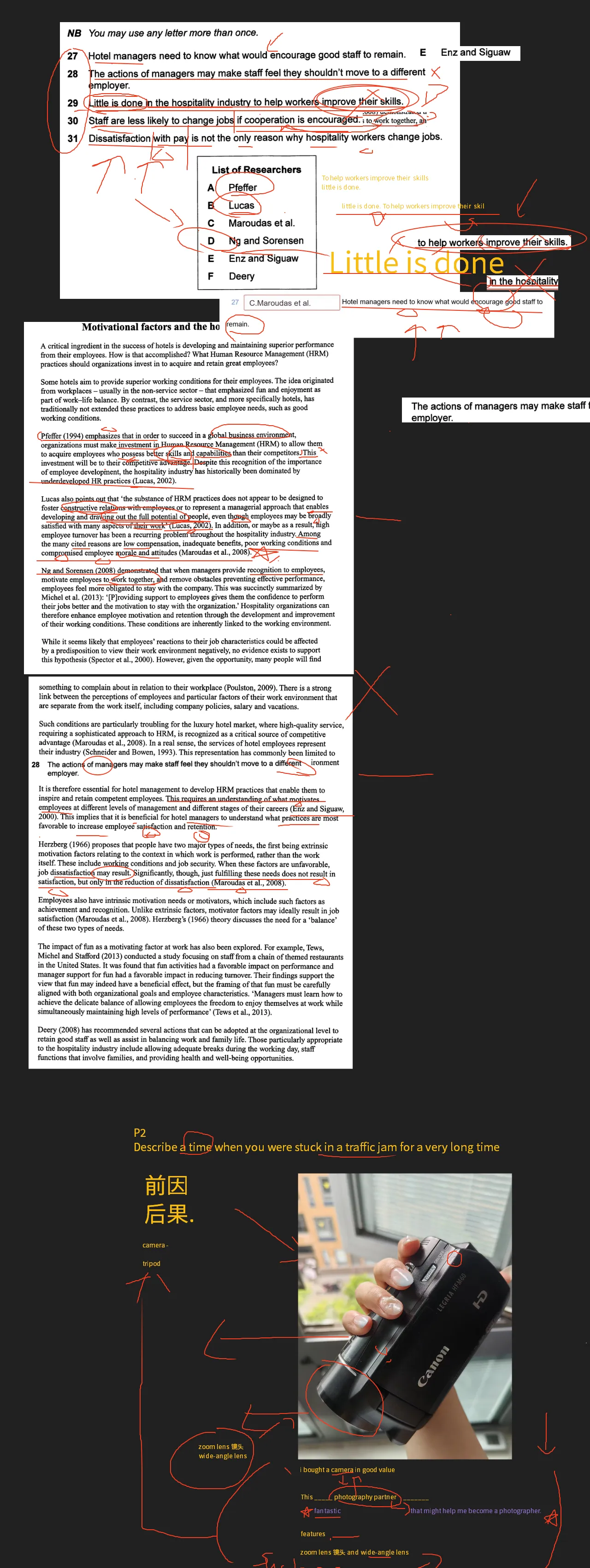
- 阅读:观点匹配题 —— 一篇文章 Motivational factors and the hotel industry,配 5 道"观点属于哪位研究者"的题(27–31),练的是"题干 → 人名 → 人名后面那句话"这条定位线;
- 口语 P2:堵车 —— Describe a time when you were stuck in a traffic jam for a very long time,用板书写的大字 前因 / 后果 搭故事骨架,再用一部相机的故事把它填满;
- 口语 P3:科技 —— "工作被机器取代"这一类题的双刃剑说法,以及一组褒义、一组贬义的谓语动词。
🧱 方法:观点匹配怎么定位
题干上方是这一题的规则:
NB You may use any letter more than once.
—— 同一个字母可以用不止一次,所以不要因为"用过 D 了"就把 D 排除掉。
研究员名单(板书原文,顺序照抄):
| 字母 | 人名 |
|---|---|
| A | Pfeffer |
| B | Lucas |
| C | Maroudas et al. |
| D | Ng and Sorensen |
| E | Enz and Siguaw |
| F | Deery |
板书把 A(Pfeffer)、B(Lucas)、D(Ng and Sorensen) 圈了出来,并在每道题的原文位置画了线。
定位动作:
- 先读题干里的观点(比如 "Little is done in the hospitality industry...");
- 回原文扫人名(Pfeffer / Lucas / Maroudas et al. / Ng and Sorensen / Enz and Siguaw / Deery);
- 重点读人名后面那一句 —— 观点就挂在那里。
📝 这节课练的题:Motivational factors and the hotel industry
| 题干 | 原文里的对应句 |
|---|---|
| 27 Hotel managers need to know what would encourage good staff to remain. | This requires an understanding of what motivates employees at different levels of management and different stages of their careers (Enz and Siguaw, 2000). This implies that it is beneficial for hotel managers to understand what practices are most favorable to increase employee satisfaction and retention. |
| 28 The actions of managers may make staff feel they shouldn't move to a different employer. | Ng and Sorensen (2008) demonstrated that when managers provide recognition to employees, motivate employees to work together, and remove obstacles preventing effective performance, employees feel more obligated to stay with the company. |
| 29 Little is done in the hospitality industry to help workers improve their skills. | Despite this recognition of the importance of employee development, the hospitality industry has historically been dominated by underdeveloped HR practices (Lucas, 2002). |
| 30 Staff are less likely to change jobs if cooperation is encouraged. | 与 28 同一句:Ng and Sorensen (2008) demonstrated that when managers provide recognition to employees, motivate employees to work together, and remove obstacles preventing effective performance, employees feel more obligated to stay with the company. |
| 31 Dissatisfaction with pay is not the only reason why hospitality workers change jobs. | Among the many cited reasons are low compensation, inadequate benefits, poor working conditions and compromised employee morale and attitudes (Maroudas et al., 2008). |
板书在 27 题右侧圈出的是 E(Enz and Siguaw);在 29 题旁边用大字写了 Little is done,并在下面写了 in the hospitality;在 30 题旁边标了 to work together;31 题那一句整体画了线并打了星号。
文章最后一段(Deery)板书也留着:
Deery (2008) has recommended several actions that can be adopted at the organizational level to retain good staff as well as assist in balancing work and family life. Those particularly appropriate to the hospitality industry include allowing adequate breaks during the working day, staff functions that involve families, and providing health and well-being opportunities.
🧱 P2 骨架:前因 后果
题目(板书用红框圈了 a time):
Describe a time when you were stuck in a traffic jam for a very long time
题目下面板书用大字写了四个字:
前因 后果
—— 讲一个"事故类"故事,顺序是:先交代为什么会发生,再讲结果。不要一上来就说"我堵车了",要让听的人知道"我本来是要去干什么"。
板书画的图是一部握在手里的相机,旁边标:
camera - tripod
i bought a camera in good value
This ___ photography partner ___ that might help me become a photographer.
fantastic
features
zoom lens 镜头 and wide-angle lens
注意中间那个句式:This _ (photography partner) _ that might help me become a photographer. —— "这个……是能帮我成为摄影师的东西"。后面接 features(功能)和两个具体的镜头名:zoom lens(变焦镜头)、wide-angle lens(广角镜头)。
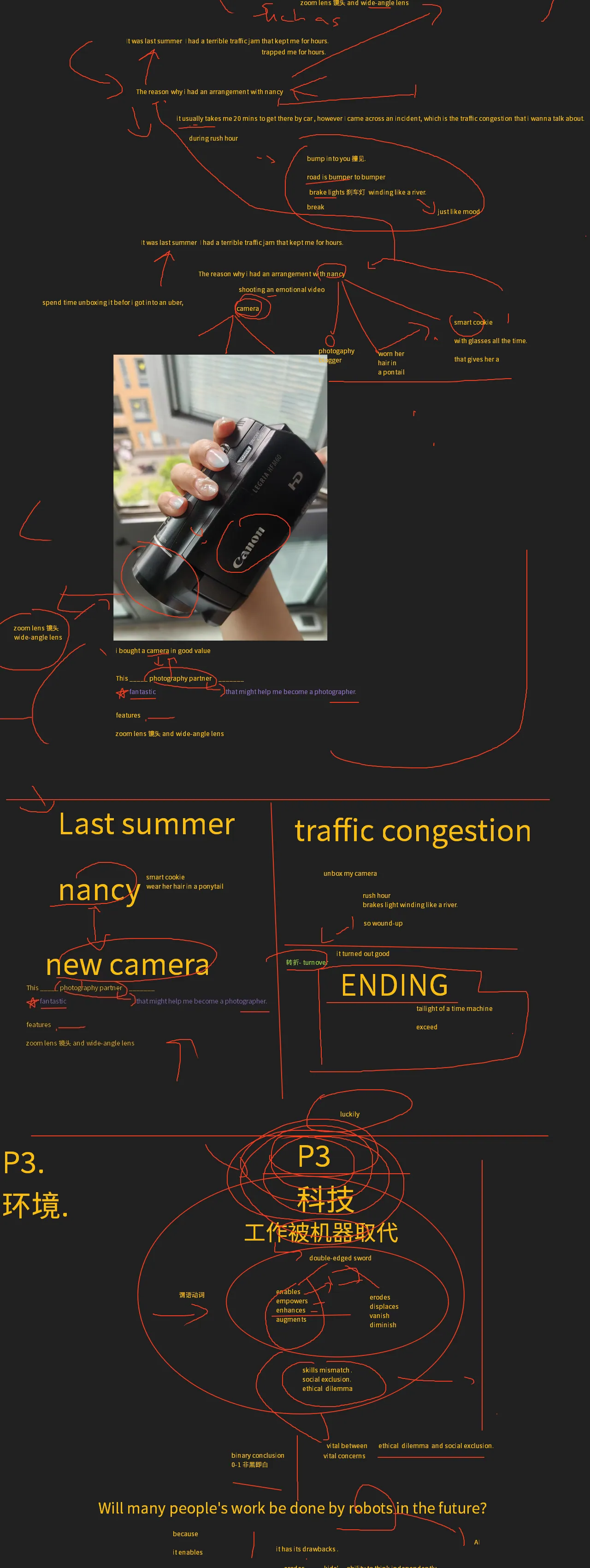
🧱 P2 故事板:五个格子
板书把整个故事切成五块,每一块都是一个大词:
| 板书的格子 | 挂在下面的内容 |
|---|---|
| Last summer | 时间起点 |
| nancy | smart cookie / with glasses all the time. / worn her hair in a ponytail / photography blogger / that gives her a ... |
| new camera | This ___ photography partner ___ that might help me become a photographer. / fantastic / features / zoom lens 镜头 and wide-angle lens |
| traffic congestion | unbox my camera / rush hour / brakes light winding like a river. / so wound-up / 转折(turn) / it turned out good |
| ENDING | tailight of a time machine / exceed / luckily |
看这个顺序:Last summer(时间)→ nancy(人物)→ new camera(起因)→ traffic congestion(事故)→ ENDING(收尾)。相机的来龙去脉在前,堵车在中,情绪和转折在最后。
💬 课上精听的句子(P2 素材)
It was last summer. I had a terrible traffic jam that kept me for hours. (板书另标了一版 trapped me for hours.)
The reason why i had an arrangement with nancy
it usually takes me 20 mins to get there by car, however i came across an incident, which is the traffic congestion that i wanna talk about.
during rush hour
spend time unboxing it before i got into an uber,
shooting an emotional video
描述堵车的画面,板书给了这几个词:
bump into you(撞见)
road is bumper to bumper
brake lights 刹车灯 winding like a river.
just like mood
winding like a river(像河一样蜿蜒)配 brake lights(刹车灯),就是"一眼望不到头的红色尾灯"这个画面。
🧱 P3 科技:工作被机器取代
板书右侧写的是:
P3 · 科技 · 工作被机器取代
整块的定性:
double-edged sword(双刃剑)
谓语动词分成两列(板书原文):
| 正面 | 负面 |
|---|---|
| enables | erodes |
| empowers | displaces |
| enhances | vanish |
| augments | diminish |
也就是说:讲 AI / 机器,要么用"使能、赋能、增强、扩大"这一组,要么用"侵蚀、取代、消失、缩小"这一组 —— 选哪一组动词,就决定了你的立场。板书在"谓语动词"四个字下面画了箭头,指的就是这件事。
负面往下挂的名词:
skills mismatch. / social exclusion. / ethical dilemma
板书还写了一个提醒:
binary conclusion 0:1 非黑即白
—— 不要写成非黑即白(只有 0 或 1)。配套的说法:
vital between ethical dilemma and social exclusion.
vital concerns
题目(板书原文):
Will many people's work be done by robots in the future?
板书给的两个开头:
because
it enables
以及一个转折:
it has its drawbacks.
现成的一句(板书原文):
erodes kids' ability to think independently
💬 可套用的句式
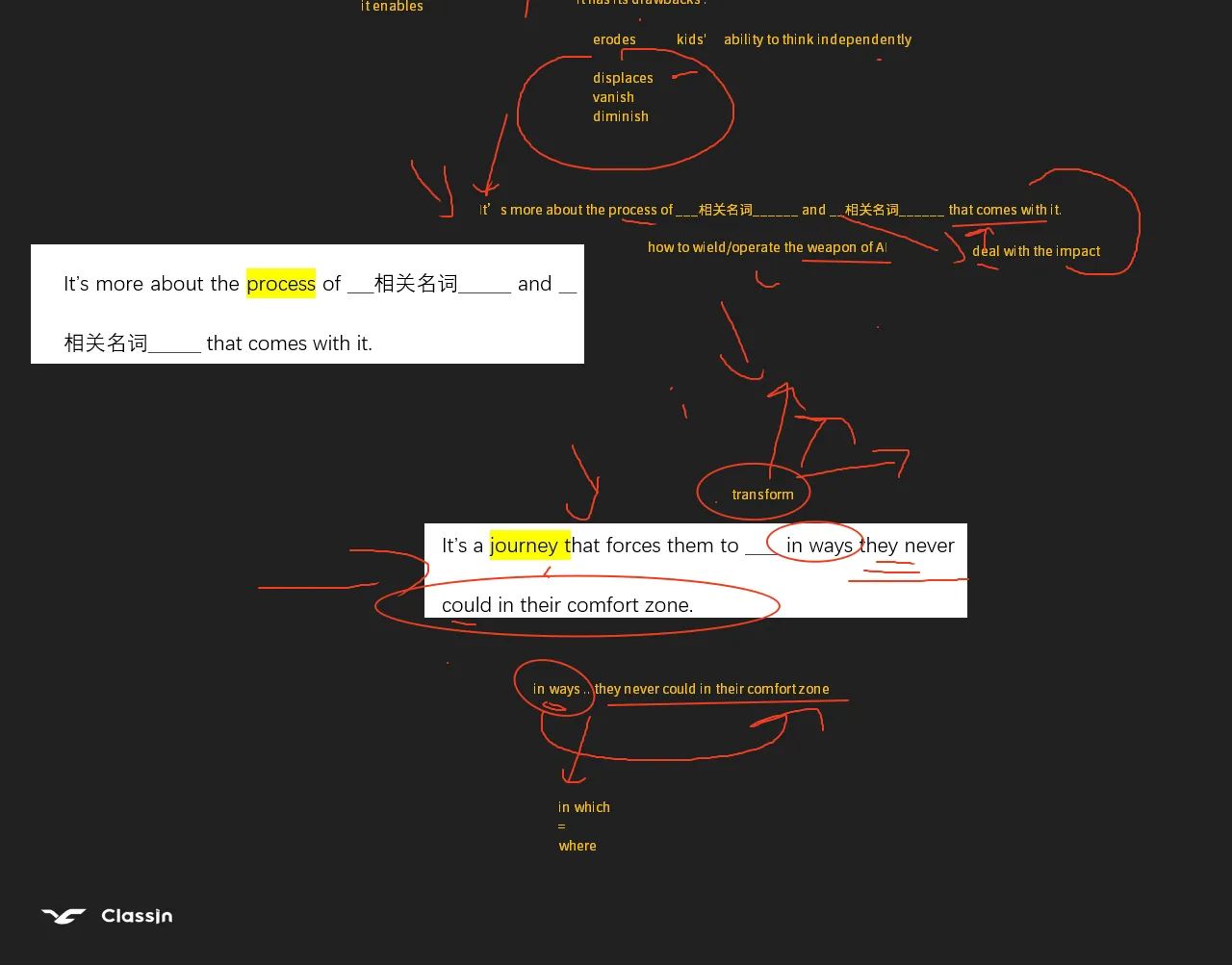
It's more about the process of 相关名词 and 相关名词 that comes with it.
how to weld/operate the weapon of AI
deal with the impact
It's a journey that forces them to ___ in ways they never could in their comfort zone.
in which = where
最后一条是语法提示:in which 就等于 where,定语从句里两个可以互换着用。板书还在 transform(转变)上画了圈,提示"变化"这个意思可以收在这一句里。
📖 词汇与表达
| 英文 | 中文 | 搭配 / 用法 |
|---|---|---|
| stuck in a traffic jam | 堵在路上 | Describe a time when you were stuck in a traffic jam |
| traffic congestion | 交通拥堵 | the traffic congestion that i wanna talk about |
| incident | 事故、意外 | came across an incident |
| rush hour | 高峰时段 | during rush hour |
| bump into | 撞见、碰到 | bump into you |
| bumper to bumper | 车挨着车 | road is bumper to bumper |
| brake lights | 刹车灯 | brakes light winding like a river. |
| winding | 蜿蜒的 | winding like a river |
| unbox | 开箱 | unbox my camera |
| arrangement | 约定 | an arrangement with nancy |
| photography blogger | 摄影博主 | 描述 nancy |
| smart cookie | 机灵鬼 | 描述 nancy |
| ponytail | 马尾 | worn her hair in a ponytail |
| glasses | 眼镜 | with glasses all the time |
| tripod | 三脚架 | camera - tripod |
| good value | 划算 | i bought a camera in good value |
| features | 功能 | 相机那一块 |
| zoom lens | 变焦镜头 | zoom lens 镜头 |
| wide-angle lens | 广角镜头 | 与上并列 |
| fantastic | 极好的 | 板书原词 |
| wound-up | 紧张的 | so wound-up |
| turned out good | 结果还不错 | it turned out good |
| luckily | 幸好 | ENDING 里的词 |
| exceed | 超过 | ENDING 里的词 |
| tailight | 尾灯 | tailight of a time machine |
| double-edged sword | 双刃剑 | P3 定性用 |
| enables | 使能够 | 正面谓语 |
| empowers | 赋能 | 正面谓语 |
| enhances | 增强 | 正面谓语 |
| augments | 扩大 | 正面谓语 |
| erodes | 侵蚀 | 负面谓语 |
| displaces | 取代 | 负面谓语 |
| vanish | 消失 | 负面谓语 |
| diminish | 减少 | 负面谓语 |
| skills mismatch | 技能错配 | 负面往下挂的名词 |
| social exclusion | 社会排斥 | 同上 |
| ethical dilemma | 伦理困境 | 同上 |
| binary conclusion | 非黑即白的结论 | 0:1 |
| vital concerns | 至关重要的关切 | vital between ... and ... |
| weld | 焊接 | how to weld the weapon of AI |
| operate | 操作 | operate the weapon of AI |
| weapon | 武器 | the weapon of AI |
| impact | 影响 | deal with the impact |
| comfort zone | 舒适区 | in their comfort zone |
| transform | 转变 | 板书圈出的动词 |
| recruitment / retention | 招聘 / 留任 | 阅读里的 retention |
| employee turnover | 员工流动 | 阅读里的 recurring problem |
| compensation | 报酬 | low compensation |
| benefits | 福利 | inadequate benefits |
| morale | 士气 | compromised employee morale |
| HRM | 人力资源管理 | Human Resource Management |
| underdeveloped | 发展不足的 | underdeveloped HR practices |
⚠️ 提醒 / 易错
- NB 别忘了:一个字母可以用多次。 28 和 30 落在同一个人名上是允许的;
- 观点匹配的答案就在人名后面那句。 板书把 Pfeffer / Lucas / Ng and Sorensen 都圈了出来,是要你养成"看到人名停下来读后一句"的习惯;
- P2 讲事故,先把"前因"交代清楚。 板书的大字顺序是 前因 → 后果;
- P3 别写成非黑即白(binary conclusion 0:1)。 用 double-edged sword 起头,再用两组谓语动词把两面都说出来;
- 动词选边:enables / empowers / enhances / augments 是正面,erodes / displaces / vanish / diminish 是负面。 同一件事,换一组动词,立场就变了。