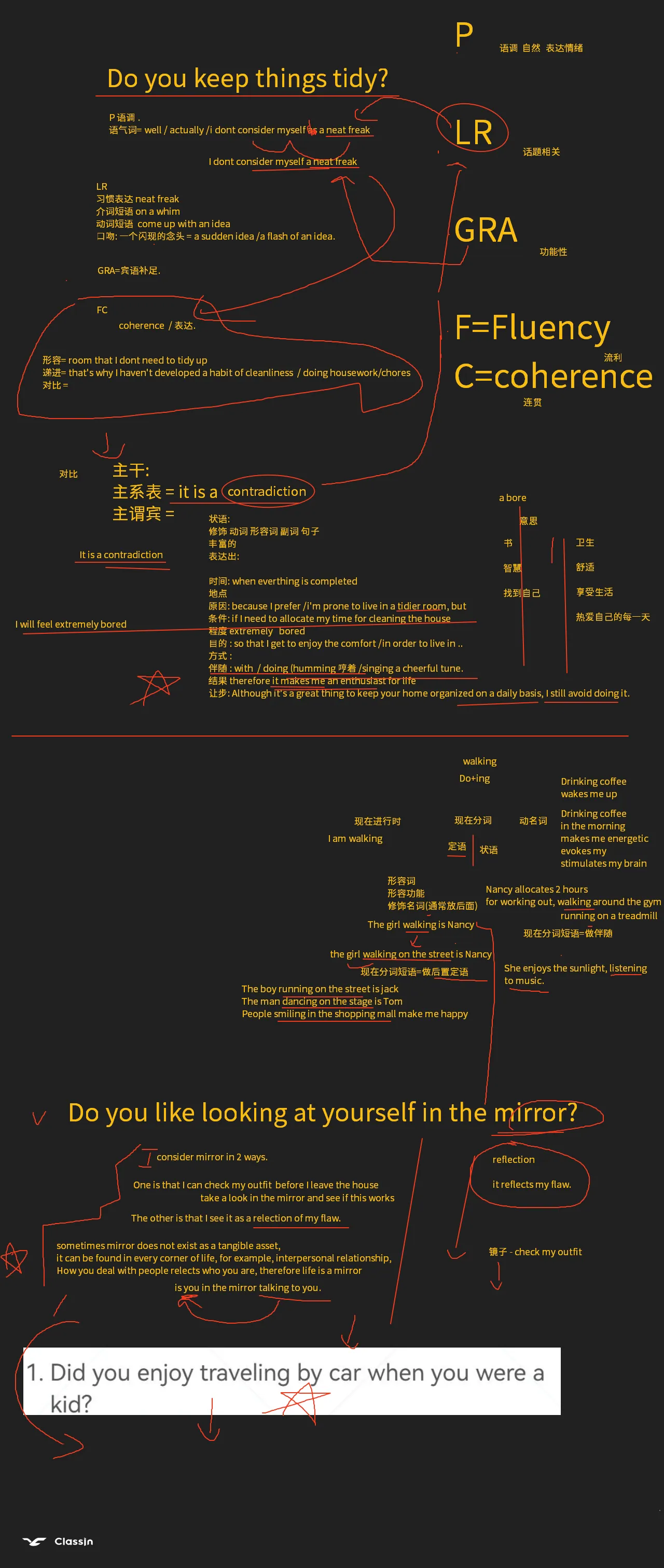
📌 这节课讲了什么
这节课是语法课,但落点在口语上,两条线:
- 状语的丰富性 —— 一个句子的主干只有"主系表"或"主谓宾"这么短,靠状语(时间、地点、原因、条件、程度、目的、方式、伴随、结果、让步)一层层挂上去,话才立得住;
- 给口语回答加意义感 —— 回答不能停在"事实"上,要落到"这件事对我意味着什么"。板书的例子是:一张书桌 → 卫生 → 舒适 → 享受生活 → 热爱自己的每一天。
课上用三个问题串起来:Do you keep things tidy? / Do you like looking at yourself in the mirror? / 1. Did you enjoy traveling by car when you were a kid?
🧱 评分标准的四项
板书把口语评分标准拆成四块:
| 缩写 | 板书写的意思 |
|---|---|
| P | 语调自然、表达情绪 |
| LR | 话题相关 |
| GRA | 功能性;板书另写 GRA = 宾语补足 |
| FC | coherence / 表达 |
板书在右下角把 FC 拆开写全了:
F = Fluency 流利
C = coherence 连贯
四个字母里,这节课重点动的是 P(语调)和 FC(连贯)。
🧱 从一个问题开始:Do you keep things tidy?
板书原文:
Do you keep things tidy?
回答的第一句,板书用的是"语气词 + 否定式自嘲":
语气词 = well / actually / i dont consider myself a neat freak
I dont consider myself a neat freak
neat freak(有洁癖的人)是 LR 里的"习惯表达"。
LR 里放什么(板书原文):
习惯表达 neat freak
介词短语 on a whim
动词短语 come up with an idea
口吻:一个闪现的念头 = a sudden idea / a flash of an idea.
FC 里的"连贯"怎么来(板书原文):
形容 = room that I dont need to tidy up
递进 = that's why I haven't developed a habit of cleanliness / doing housework/chores
对比 =
三种衔接动作:形容(给名词挂一个定语从句)、递进(用 that's why 往下推)、对比。
🧱 主干:先把骨架立住
板书把主干单独列出来:
主干:
主系表 = it is a contradiction
主谓宾 =
It is a contradiction
主系表是最好用的骨架:一个抽象名词(contradiction 矛盾)做表语,后面再用状语解释"为什么矛盾"。
🧱 状语:十种挂法
板书把状语的定义和清单一起写了:
状语:
修饰 动词 形容词 副词 句子
丰富的
表达出:
| 类型 | 板书原文 |
|---|---|
| 时间 | when everything is completed |
| 地点 | (板书留空) |
| 原因 | because I prefer / i'm prone to live in a tidier room, but |
| 条件 | if I need to allocate my time for cleaning the house |
| 程度 | extremely bored |
| 目的 | so that I get to enjoy the comfort / in order to live in .. |
| 方式 | (板书留空) |
| 伴随 | with / doing (humming 哼着 / singing a cheerful tune.) |
| 结果 | therefore it makes me an enthusiast for life |
| 让步 | Although it's a great thing to keep your home organized on a daily basis, I still avoid doing it. |
板书在旁边还挂了一句:
I will feel extremely bored
—— extremely bored 就是"程度状语"的样本,extremely 修饰形容词。
看这张表就明白:主干只负责"是什么",状语负责"什么时候、为什么、什么条件下、到什么程度、为了什么、伴随什么、导致什么、虽然什么"。一段口语回答的长度和画面感,全在状语这一栏。
🧱 Do + ing 的三种身份
板书把 Do+ing 的三种用法摆在一起:
| 身份 | 板书原文 |
|---|---|
| 现在进行时 | I am walking |
| 现在分词 | 定语 | 状语 |
| 动名词 | Drinking coffee wakes me up |
动名词做主语(板书原文):
Drinking coffee in the morning makes me energetic
evokes my
stimulates my brain
现在分词短语 = 后置定语(板书原文):
形容词 / 形容功能 / 修饰名词(通常放后面)
The girl walking is Nancy
the girl walking on the street is Nancy
The boy running on the street is jack
The man dancing on the stage is Tom
People smiling in the shopping mall make me happy
现在分词短语 = 伴随(板书原文):
Nancy allocates 2 hours for working out, walking around the gym
running on a treadmill
She enjoys the sunlight, listening to music.
注意这两组的分工:做后置定语时,分词短语是"限定那个名词是谁"(the girl walking on the street);做伴随时,分词短语是"跟着主句一起发生的动作"(She enjoys the sunlight, listening to music)。
💬 Do you like looking at yourself in the mirror?
板书的整段回答:
I consider mirror in 2 ways.
One is that I can check my outfit before I leave the house
take a look in the mirror and see if this works
The other is that I see it as a reflection of my flaw.
接着往"意义感"上翻一层:
sometimes mirror does not exist as a tangible asset, it can be found in every corner of life, for example, interpersonal relationship, How you deal with people reflects who you are, therefore life is a mirror
is you in the mirror talking to you.
板书右侧单独圈了两个词:
reflection
it reflects my flaw.
并标了中文:镜子 - check my outfit。
这一段的结构值得抄下来:先分两层(One is that... / The other is that...),再把"镜子"从实物翻成"人际关系的隐喻",最后用一个反问收尾。
💬 下一个问题
板书最后留了一道题:
- Did you enjoy traveling by car when you were a kid?
—— 这类"小时候"的题,正好用上面那张状语表里的时间状语来开:when 开头,把时间定住。
📖 词汇与表达
| 英文 | 中文 | 搭配 / 用法 |
|---|---|---|
| neat freak | 有洁癖的人 | I dont consider myself a neat freak |
| keep things tidy | 保持整洁 | 话题句 |
| tidy up | 收拾 | room that I dont need to tidy up |
| on a whim | 一时兴起 | 介词短语 |
| come up with an idea | 想出一个主意 | 动词短语 |
| a sudden idea | 一闪现的念头 | 口吻 |
| a flash of an idea | 一闪现的念头 | 同上 |
| cleanliness | 清洁 | a habit of cleanliness |
| housework / chores | 家务 | doing housework/chores |
| contradiction | 矛盾 | It is a contradiction |
| prone to | 倾向于 | i'm prone to live in a tidier room |
| allocate | 分配 | allocate my time for cleaning the house |
| extremely bored | 极其无聊 | 程度状语 |
| comfort | 舒适 | enjoy the comfort |
| in order to | 为了 | in order to live in .. |
| so that | 以便、所以 | so that I get to enjoy the comfort |
| humming | 哼着 | 伴随状语 |
| a cheerful tune | 欢快的调子 | singing a cheerful tune |
| enthusiast | 爱好者 | it makes me an enthusiast for life |
| organized | 有条理的 | keep your home organized |
| on a daily basis | 每天 | 与 organized 同句 |
| a bore | 无聊的人/事 | 板书右侧单独列的词 |
| drinking coffee | 喝咖啡 | Drinking coffee wakes me up |
| energetic | 精力充沛 | makes me energetic |
| evoke | 唤起 | evokes my ... |
| stimulate | 刺激 | stimulates my brain |
| walking | 走路 | walking around the gym |
| treadmill | 跑步机 | running on a treadmill |
| gym | 健身房 | around the gym |
| outfit | 一身搭配、衣着 | check my outfit |
| reflection | 倒影;反思 | it is a reflection of my flaw |
| flaw | 缺点 | reflects my flaw |
| tangible asset | 有形资产 | mirror does not exist as a tangible asset |
| interpersonal relationship | 人际关系 | every corner of life 的例子 |
| deal with | 应对、与人相处 | How you deal with people |
| reflect | 反映 | reflects who you are |
⚠️ 提醒 / 易错
- 状语不是越多越好,是"挂对地方"。 时间、原因、条件、程度、目的、伴随、结果、让步 —— 每挂一个,句子就多一点信息,但要和主干对得上;
Do+ing三个身份别混: 现在进行时(I am walking)、现在分词(做定语或状语)、动名词(做主语,Drinking coffee wakes me up);- 现在分词短语做定语要放名词后面: the girl walking on the street is Nancy —— 不能说 the walking girl;
- 宾语补足是 GRA 的抓手:
it makes me an enthusiast for life就是"make + 宾语 + 宾补"; - "意义感"靠三个动作翻上去: 形容(给名词挂定语)、递进(that's why)、对比 —— 从"桌子乱"翻到"热爱自己的每一天",靠的就是这三步。