📌 这节课讲了什么
这节课回答一个问题:阅读到底是为了什么。 答案不是"把文章从头到尾读懂",而是 —— 与原文找根据。读懂不是目的,找到那道题对应的那一句、那一个词,才是。
课上用剑桥 17 Test 3 Passage 3(对 Jason Barr 的书 Building the Skyline 的书评)完整走了一遍 Q27–40:五道选择题、四道判断题、五道填空题。
贯穿全课的三个动作:
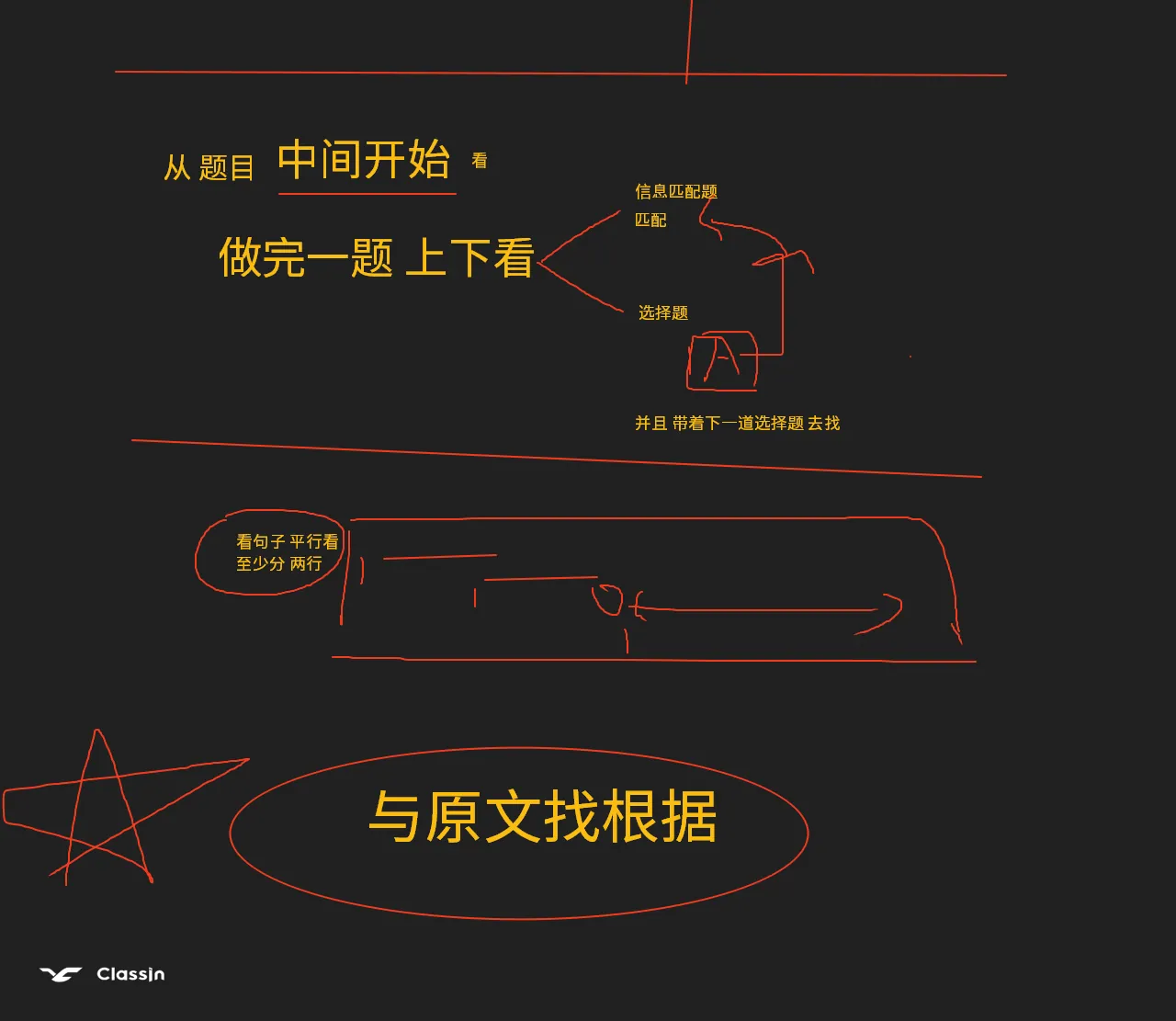
- 从题目中间开始看;
- 做完一题上下看;
- 与原文找根据。
后面所有的技巧,都是这三句话的展开。
🧱 方法:找根据是唯一的动作
板书写得很直白:「与原文找根据」。
也就是说,每一道题的答案都要在原文里落到具体的位置上 —— 选择题落到"哪句话支持它",判断题落到"哪句话和它矛盾/一致",填空题落到"哪个词被同义改写了"。没有"我觉得""听起来对"这种选法。
由此推出两条操作习惯:
- 从题目中间开始看。 不要习惯性地从题干第一个字读起,先看中间部分把题目的骨架拎出来,再回头看修饰。
- 做完一题上下看。 一道题的答案往往不止一行;做完一题,不要跳走,先把这道题所在位置的上一行和下一行扫一眼。
🧱 方法:做完一题上下看,两类题两种看法
板书写:
- 信息匹配题 → 匹配
- 选择题 → 圈住选项字母,并且带着下一道选择题去找
意思是:做完信息匹配,靠的是"这段和哪条题干是同一件事"的匹配关系;而做选择题时,不要做完一题才去看下一题的题干 —— 手上永远同时握着两道题,一边核对当前这道的选项,一边注意下一道题的定位词有没有出现。答案常常挨着出现,带着下一题去找,才不会来回翻。
还有一句:看句子平行看,至少分两行。 读原文的时候不要一行一行地抠,视线一次覆盖至少两行,读的是一整句/一整块意思,而不是一个一个词。
🧱 方法:选择题怎么做
板书上的选择题区域写着两个词:
- 选择它的时候 → 找对应:选项里的词,一定能在原文里找到同一意思的另一种说法,对应上了才选。
- 排除 → 选择题排除的时候,问问题:有没有。
也就是说,排除一个选项不是凭感觉"这个不像",而是回原文问一句:原文有没有说这件事? 没有,才能排除。
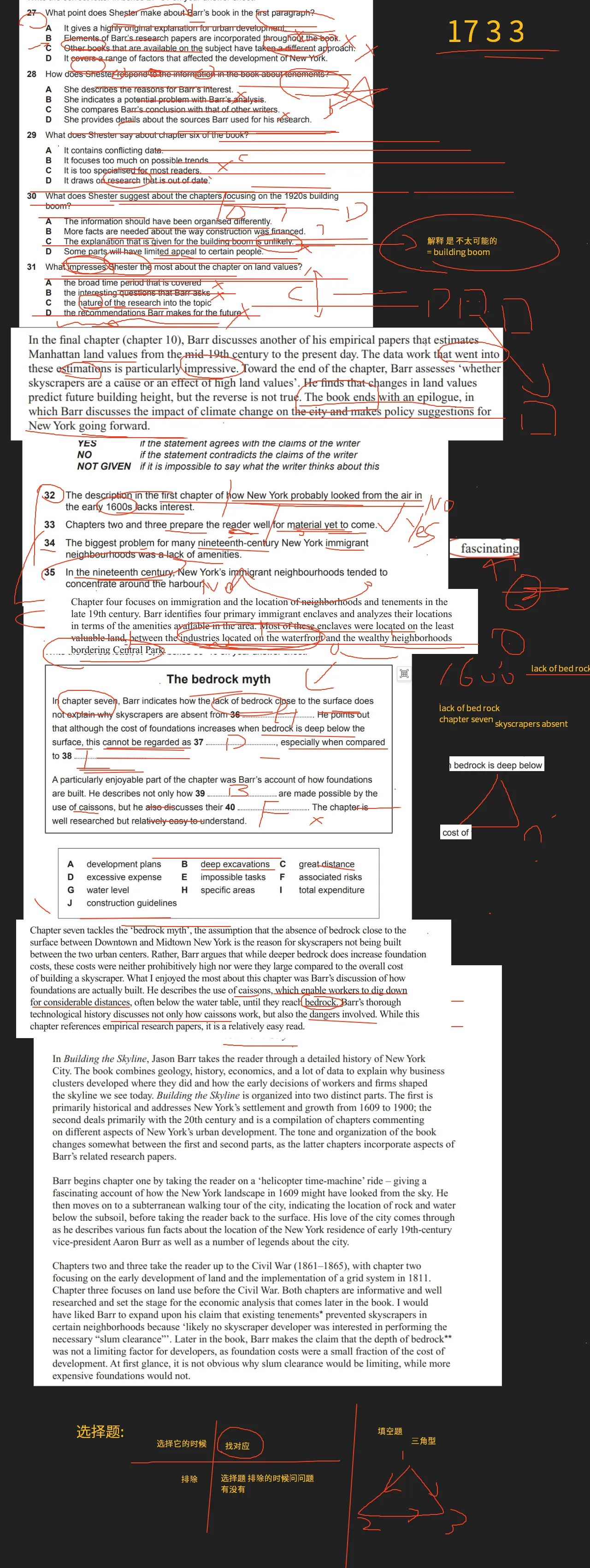
例(第 27 题):问 Shester 在第一段对 Barr 这本书的评价。正确答案是 B — Elements of Barr's research papers are incorporated throughout the book. 板书上把这句话整句划了线 —— 因为原文里正有"书的后半部分把 Barr 的相关研究论文揉了进来"的表达,这就是"找对应"。
例(第 30 题):问 Shester 对讲 1920 年代建筑热潮那几章的看法,答案是 C — The explanation that is given for the building boom is unlikely. 板书上在 unlikely 上画了圈,旁边写:解释是不太可能的 = building boom。也就是说,选项里把原文的意思压成了"unlikely"这一个词,抓住它,对应就找到了。
例(第 31 题):问 Shester 最欣赏讲地价那一章的哪一点,答案是 C — the nature of the research into the topic. 板书上把 nature 圈了出来,并且把原文里的那半句 "The data work that went into these estimations is particularly impressive." 划了线 —— "impressive" 对上的就是"研究本身的性质(做得有多好)"。
第 29 题(问第六章)答案是 D — It draws on research that is out of date.,板书上把 research that is out of date 圈了出来,其余三个选项都被划掉。
🧱 方法:填空题三角型
板书右侧画了一个三角形,旁边写"填空题 三角型"。
三角形是从上往下收窄的:先定位段落 → 再定位句子 → 最后收到那一个空格。 板上在三角形旁边标出的三个节点,对应的正是这次练习的填空链条:
- 先找到段落:chapter seven
- 再找到这一段在讲的事:skyscrapers absent(摩天大楼缺席)
- 再收到具体一句:lack of bed rock(缺少基岩)
- 再收到下一个空的条件:when bedrock is deep below(当基岩深埋在下面)
- 最后收到空前的词:cost of(……的成本)
也就是说,填一个空要走四步:段落 → 话题 → 句子 → 空前的搭配词。三角形越往下越小,范围越收越窄,最后落在空格上。
📝 这节课练了什么:17-3-3 Building the Skyline
文章:Jason Barr 写的纽约城市史 Building the Skyline 的书评(评论者 Shester)。书把地质学、历史、经济学和大量数据合在一起,解释纽约的商业区为什么长在它们所在的地方。
判断题规则(板书记录):
| 选项 | 含义 |
|---|---|
| YES | if the statement agrees with the claims of the writer |
| NO | if the statement contradicts the claims of the writer |
| NOT GIVEN | if it is impossible to say what the writer thinks about this |
判断题 32–35,板书核出的答案:
- 32 → NO。 The description in the first chapter of how New York probably looked from the air in the early 1600s lacks interest. 原文第一章的介绍是 "a fascinating account of how the New York landscape in 1609 might have looked from the sky" —— 板书上专门贴出单词 fascinating。"fascinating" 对 "lacks interest",直接矛盾,判 NO。
- 33 → YES。 Chapters two and three prepare the reader well for material yet to come. 原文:两章 "are informative and well researched and set the stage for the economic analysis that comes later in the book" —— "set the stage for" 就是"为后面做准备"。
- 35 → NO。 In the nineteenth century, New York's immigrant neighbourhoods tended to concentrate around the harbour. 原文说这些聚居区 "were located on the least valuable land, between the industries located on the waterfront and the wealthy neighborhoods bordering Central Park" —— 是在滨水工业和中央公园旁富人区之间的最不值钱的地带,不是围着港口。
填空题 36–40:标题 The bedrock myth("基岩神话")。词库 A–J:
| A development plans | B deep excavations | C great distance |
|---|---|---|
| D excessive expense | E impossible tasks | F associated risks |
| G water level | H specific areas | I total expenditure |
| J construction guidelines |
小结原文(板书上划线的句子):
In chapter seven, Barr indicates how the lack of bedrock close to the surface does not explain why skyscrapers are absent from 36 ___ . He points out that although the cost of foundations increases when bedrock is deep below the surface, this cannot be regarded as 37 ___ , especially when compared to 38 ___ . A particularly enjoyable part of the chapter was Barr's account of how foundations are built. He describes not only how 39 ___ are made possible by the use of caissons, but he also discusses their 40 ___ . The chapter is well researched but relatively easy to understand.
板书上核出的手写答案:
- 39 → B(deep excavations):原文 "He describes the use of caissons, which enable workers to dig down for considerable distances, often below the water table, until they reach bedrock." —— "dig down for considerable distances" 被改写成了 deep excavations。
- 40 → F(associated risks):原文 "Barr's thorough technological history discusses not only how caissons work, but also the dangers involved." —— "dangers" 对应词库里的 associated risks。
- 37 → D(excessive expense):对应原文 "these costs were neither prohibitively high nor were they large compared to the overall cost of building a skyscraper" —— 成本没有高到"过分"。
- 36 → H(specific areas):对应原文 "the assumption that the absence of bedrock close to the surface between Downtown and Midtown New York is the reason for skyscrapers not being built between the two urban centers" —— 摩天大楼缺席的是特定的区域。
🔁 原文对应核对
板书在原文里划线的位置,可以直接当"对应词典"来用:
| 原文 | 题目里的改写 |
|---|---|
| a fascinating account of how the New York landscape in 1609 might have looked from the sky | lacks interest(反义 → NO) |
| are informative and well researched and set the stage for the economic analysis that comes later | prepare the reader well for material yet to come |
| could not be regarded as prohibitively high / large compared to the overall cost | excessive expense(反过来说:没有过度) |
| enable workers to dig down for considerable distances | deep excavations |
| the dangers involved | associated risks |
| were located on the least valuable land, between the industries located on the waterfront and the wealthy neighborhoods bordering Central Park | concentrate around the harbour(不符 → NO) |
📖 词汇与表达
| 英文 | 中文 | 搭配 / 用法 |
|---|---|---|
| bedrock | 基岩 | lack of bedrock; bedrock is deep below the surface |
| skyscraper | 摩天大楼 | skyscrapers are absent from ... |
| tenement | 廉租公寓 | existing tenements prevented skyscrapers |
| amenities | 生活配套、便利设施 | the amenities available in the area |
| enclave | 聚居区、飞地 | four primary immigrant enclaves |
| harbour | 港口 | concentrate around the harbour |
| waterfront | 滨水区、码头区 | industries located on the waterfront |
| slum clearance | 贫民窟清拆 | likely no developer was interested in "slum clearance" |
| foundation | 地基 | the cost of foundations |
| caisson | 沉箱 | the use of caissons |
| water table | 地下水位 | often below the water table |
| excavation | 挖掘 | deep excavations |
| empirical | 实证的 | his empirical papers |
| epilogue | 尾声、后记 | the book ends with an epilogue |
| land values | 地价 | Manhattan land values |
| policy suggestions | 政策建议 | makes policy suggestions for New York |
| grid system | 网格(街道)系统 | the implementation of a grid system in 1811 |
| subsoil | 底土层 | the location of rock and water below the subsoil |
| subterranean | 地下的 | a subterranean walking tour of the city |
| out of date | 过时 | research that is out of date |
| conflicting data | 互相矛盾的数据 | contains conflicting data |
| trend | 趋势 | focuses too much on possible trends |
| specialised | 专门的、专业的 | too specialised for most readers |
| boom | 热潮、繁荣 | the 1920s building boom |
| unlikely | 不太可能的 | the explanation ... is unlikely |
| incorporate | 纳入、包含 | incorporated throughout the book |
| assess | 评估 | Barr assesses whether skyscrapers are a cause or an effect of high land values |
⚠️ 提醒 / 易错
- 判断题先定"矛盾还是没提"。 32 题里原文用的是赞扬词(fascinating),题干说"缺兴趣",这是矛盾,判 NO;只有原文真的对这种说法没有表态,才是 NOT GIVEN。判断的第一动作永远是:回去找那句话。
- 选择题的错项,回到原文问"有没有"。 排除要有依据;板书上第 27、29、30、31 题的错项都被划掉,靠的不是印象,是一个一个回原文核对。
- 抓选项里的"锚点词"。 第 30 题的 unlikely、第 31 题的 nature,板书上都被圈出来 —— 这些词就是选项和原文对接的钩子。
- 填空题走三角形。 先段落,后句子,再收到空格前的搭配词(如 cost of)再落笔;别拿词库硬套。
- "做完一题上下看"。 相邻题目的答案在原文里常挨在一起,做完一题顺手扫上下两行,能省一大截回头找的时间。