📌 这节课讲了什么
这节课讲长难句,而且是两头都讲:读的时候怎么把它拆开,说的时候怎么把它造出来。
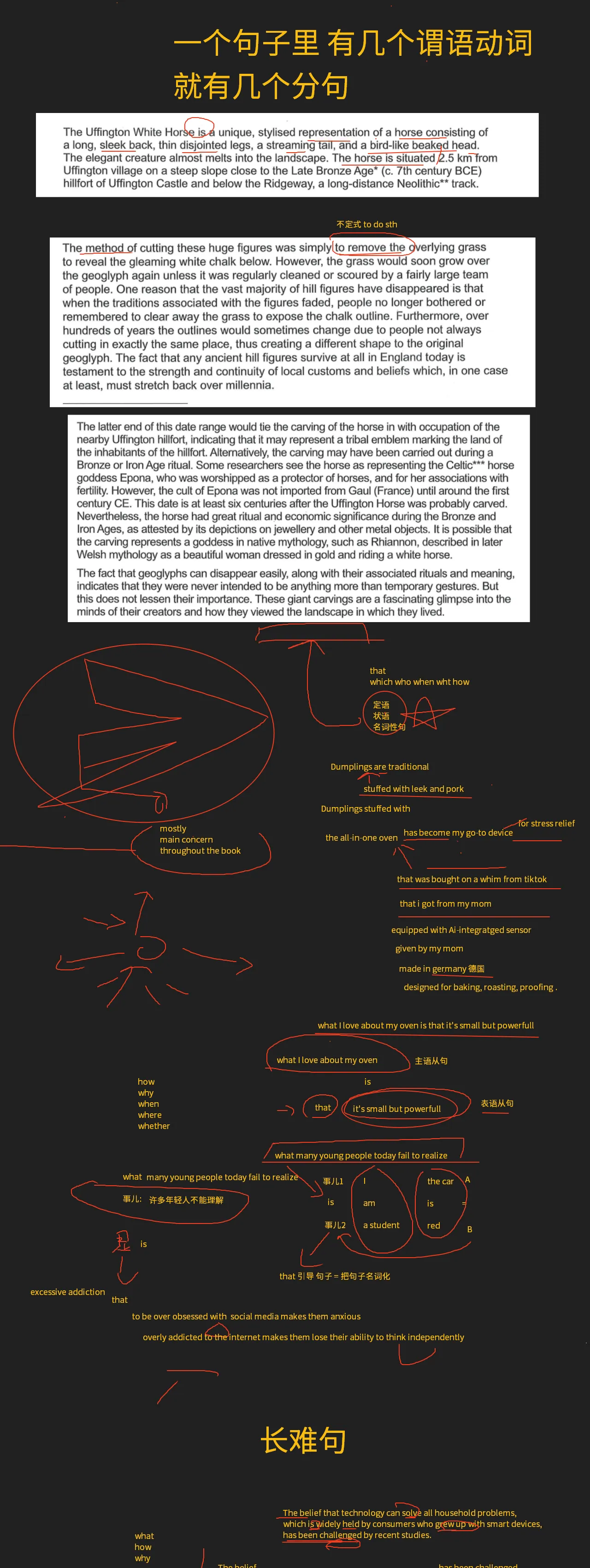
- 读:板书第一句话就是方法 —— 一个句子里有几个谓语动词,就有几个分句。 课上用 Uffington 白马(地画)的阅读文章逐句数谓语动词。
- 说:口语里把长句用对地方,是有效炫技;板书用 many 个"后置修饰"和一个 what 从句串出了现成的句型。
- 练:读了一篇 How to make wise decisions,做了第 27–30 题。
🧱 方法:数谓语动词,数分句
一个句子里有几个谓语动词,就有几个分句。 看到长句不要怕,先数动词 —— 数出几个动词,就知道这句话是由几块拼起来的。
课上用的例子(白马地画 The Uffington White Horse 一文):
The Uffington White Horse is a unique, stylised representation of a horse consisting of a long, sleek back, thin disjointed legs, a streaming tail, and a bird-like beaked head.
The horse is situated 2.5 km from Uffington village on a steep slope close to the Late Bronze Age (c. 7th century BCE) hillfort of Uffington Castle and below the Ridgeway, a long-distance Neolithic track.
However, the grass would soon grow over the geoglyph again unless it was regularly cleaned or scoured by a fairly large team of people.
One reason that the vast majority of hill figures have disappeared is that when the traditions associated with the figures faded, people no longer bothered or remembered to clear away the grass to expose the chalk outline.
第三句里 would grow / was cleaned 两个动词 → 两个分句(主句 + unless 条件);第四句里 have disappeared / is / faded / bothered / remembered 一串动词 → 主句 + 定语从句 + 表语从句里的时间状语从句,层层套。板书上在这些句子上画满了圈,圈的就是谓语动词和它带出来的分句。
不定式也能当动词用。 板书标了 不定式 to do sth 的例子:
The method of cutting these huge figures was simply to remove the overlying grass to reveal the gleaming white chalk below.
一个句子里 to remove / to reveal 两个不定式,意思上是连着发生的两件事 —— 数是这么数的,意思也是这么一层层接下去的。
🧱 方法:名词后面可以挂一串(后置定语)
板书把一长串修饰语挂在同一个名词后面,演示"句子怎么变长":
Dumplings(饺子)后面:
- Dumplings are traditional
- stuffed with leek and pork
the all-in-one oven(多功能烤箱)后面,一连挂了六个:
- that was bought on a whim from tiktok(一时兴起从抖音买的)
- that i got from my mom
- equipped with AI-integrated sensor(带 AI 集成传感器)
- given by my mom
- made in Germany(德国制造)
- designed for baking, roasting, proofing(为烘焙、烧烤、发酵而设计)
前面还有一句总的:
The all-in-one oven has become my go-to device for stress relief.
也就是说:名词 + for ... / that ... / who ... / equipped with ... / given by ... / made in ... / designed for ...,一路挂下去都不换主语,这就是长句的"生长"方式。口语里想炫技,不用换句型,挂就是了。
📐 语法点:what 从句
板书上最大的那个词是 WHAT,旁边标注:支付手段 —— 意思是这类句型是说话时的"通用筹码",先把要说的"事儿"端出来。
1. 主语从句 + 表语从句
What I love about my oven is that it's small but powerful.
- what I love about my oven = 主语从句(我最喜欢这台烤箱的地方)
- that it's small but powerful = 表语从句
2. what = 「事儿」
What many young people today fail to realize ...
板书直接在旁边标注:事儿:许多年轻人不能理解。也就是说 what 在这一类句子里不翻译成"什么",它指的就是后面那件"事儿"。
3. not just ... but also
What an all in one oven offers is not just the ability to air-fry, steam and bake but also cook on a whim without turning the kitchen into a hazardous environment.
板书在下面标注:一时兴起做饭而不弄乱厨房 —— "cook on a whim" 就是"一时兴起做饭",整句的骨架是"它提供的不仅是 A,还有 B"。
📐 语法点:that 把句子名词化
板书写了一句口诀:that 引导句子 = 把句子名词化。 一个完整的句子,前面加个 that,它就变成一个可以当主语、当宾语、当表语的"东西"了。
板书的例子:
to be over obsessed with social media makes them anxious
overly addicted to the internet makes them lose their ability to think independently
旁边还列着 what / how / why / when —— 同样一件事,可以从"是什么(what)""怎么做(how)""为什么(why)""什么时候(when)"几个角度去包装成主语。主语不再必须是人或物,也可以是一整件事。
主系表的基本对比(板书画了 A、B 两栏):
| 主语 | 系动词 | 表语 |
|---|---|---|
| I | am | a student |
| the car | is | red |
📐 语法点:长难句拆解示范
板书上的招牌长句:
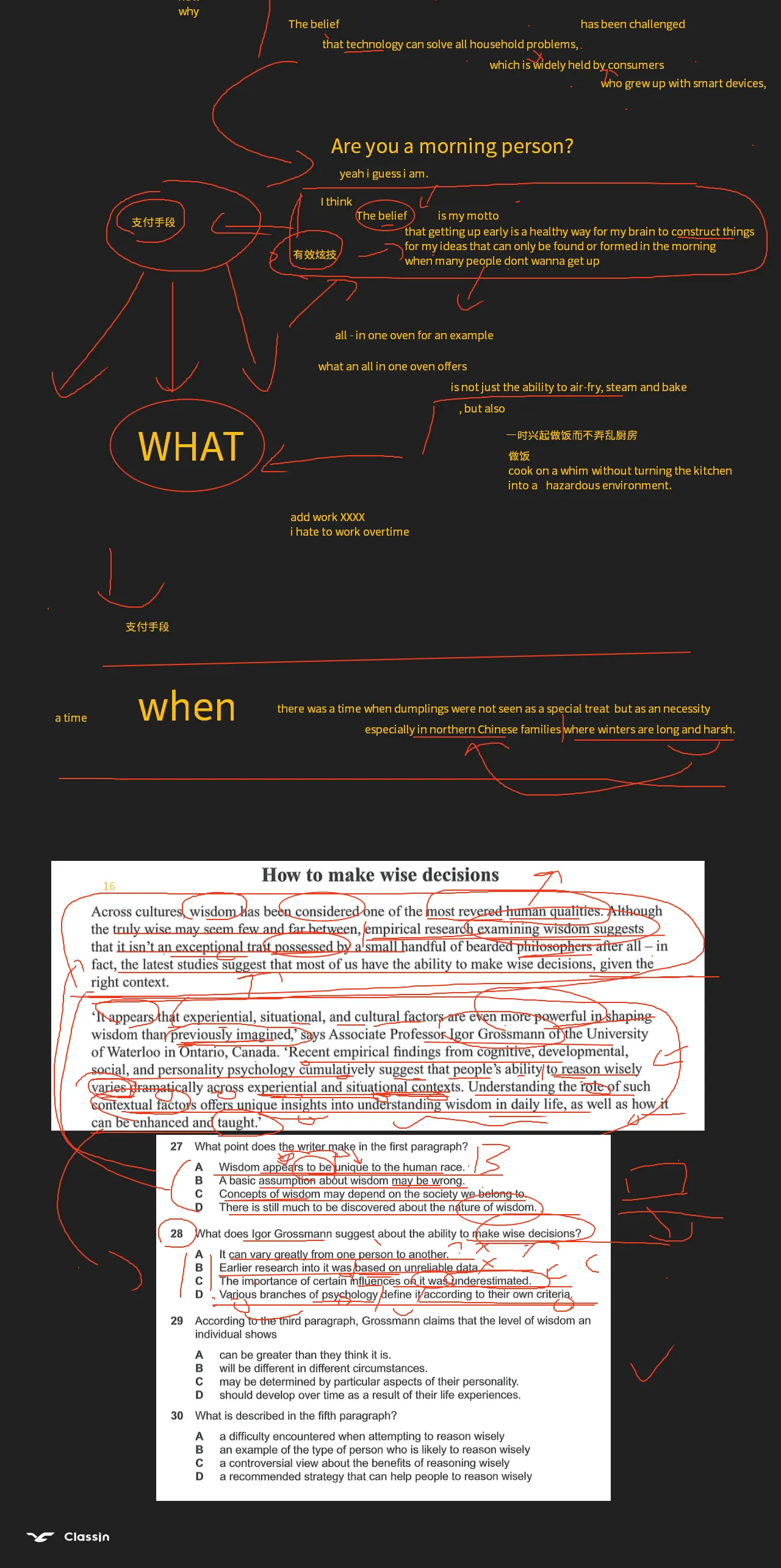
The belief that technology can solve all household problems, which is widely held by consumers who grew up with smart devices, has been challenged by recent studies.
拆法(板书把两头标了出来:主语 The belief ... has been challenged):
| 成分 | 内容 |
|---|---|
| 主语 | The belief |
| 同位语从句 | that technology can solve all household problems |
| 定语从句 | which is widely held by consumers |
| 定语从句(套在 consumers 上) | who grew up with smart devices |
| 谓语 | has been challenged by recent studies |
主干就是 The belief has been challenged by recent studies. —— 中间塞了两层修饰,数出三个谓语动词(is held / grew up / has been challenged),就知道是三层。
💬 说:长难句怎么用在口语里(有效炫技)
板书写了有效炫技四个字。示范(回答 Are you a morning person?):
— Are you a morning person? — yeah i guess i am. I think the belief is my motto that getting up early is a healthy way for my brain to construct things — my ideas that can only be found or formed in the morning when many people don't wanna get up.
一句话里塞进了:表语从句(I think ...)、同位语 that 从句(that getting up early is a healthy way ...)、后置定语(my ideas that can only be found or formed ...)、时间状语从句(when many people don't wanna get up)。这就是"挂"出来的效果。
when 挂时间:
there was a time when dumplings were not seen as a special treat but as an necessity especially in northern Chinese families where winters are long and harsh.
再加一层:
add work XXXX i hate to work overtime
—— 想加内容,就在句子上继续挂(when / where / that ...),而不是另起一句。
📝 这节课练了什么:How to make wise decisions
板书写着 16。文章 How to make wise decisions(关于"智慧"的研究),板书圈出来的句子:
Across cultures, wisdom has been considered one of the most revered human qualities. Although the truly wise may seem few and far between, empirical research examining wisdom suggests that it isn't an exceptional trait possessed by a small handful of bearded philosophers after all – in fact, the latest studies suggest that most of us have the ability to make wise decisions, given the right context.
'It appears that experiential, situational, and cultural factors are even more powerful in shaping wisdom than previously imagined,' says Associate Professor Igor Grossmann of the University of Waterloo in Ontario, Canada. 'Recent empirical findings from cognitive, developmental, social, and personality psychology cumulatively suggest that people's ability to reason wisely varies dramatically across experiential and situational contexts. Understanding the role of such contextual factors offers unique insights into understanding wisdom in daily life, as well as how it can be enhanced and taught.'
题目(板书上写了答案的已填):
| 题号 | 题目 | 答案 |
|---|---|---|
| 27 | What point does the writer make in the first paragraph? A Wisdom appears to be unique to the human race. B A basic assumption about wisdom may be wrong. C Concepts of wisdom may depend on the society we belong to. D There is still much to be discovered about the nature of wisdom. | B |
| 28 | What does Igor Grossmann suggest about the ability to make wise decisions? A It can vary greatly from one person to another. B Earlier research into it was based on unreliable data. C The importance of certain influences on it was underestimated. D Various branches of psychology define it according to their own criteria. | C |
| 29 | According to the third paragraph, Grossmann claims that the level of wisdom an individual shows A can be greater than they think it is. B will be different in different circumstances. C may be determined by particular aspects of their personality. D should develop over time as a result of their life experiences. | |
| 30 | What is described in the fifth paragraph? A a difficulty encountered when attempting to reason wisely B an example of the type of person who is likely to reason wisely C a controversial view about the benefits of reasoning wisely D a recommended strategy that can help people to reason wisely |
读的时候顺手做的两件事:题干里的段落号被圈出来(the third paragraph / the fifth paragraph)—— 定位先定段落;选项里的关键短语被圈出来(previously imagined、varies dramatically across experiential and situational contexts)—— 这些都是回原文核对的钩子。
📖 词汇与表达
| 英文 | 中文 | 搭配 / 用法 |
|---|---|---|
| stylised | 风格化的 | a stylised representation of a horse |
| disjointed | 脱节的、不连贯的 | thin disjointed legs |
| geoglyph | 地画、地面图形 | the grass would soon grow over the geoglyph |
| scour | 擦洗、磨光 | cleaned or scoured by a large team of people |
| chalk | 白垩 | the gleaming white chalk below |
| hillfort | 山丘堡垒 | the hillfort of Uffington Castle |
| millennium / millennia | 千年 | stretch back over millennia |
| tribal emblem | 部落徽记 | marking the land of the inhabitants |
| ritual | 仪式 | a Bronze or Iron Age ritual |
| goddess | 女神 | the Celtic horse goddess Epona |
| fertility | 生育 | her associations with fertility |
| cult | 崇拜 | the cult of Epona |
| be attested by | 被……证实 | as attested by its depictions on jewellery |
| testament to | 是……的证明 | is testament to the strength and continuity of local customs |
| temporary gestures | 临时的姿态 | never intended to be anything more than temporary gestures |
| on a whim | 一时兴起 | bought on a whim from tiktok / cook on a whim |
| go-to device | 首选设备 | my go-to device for stress relief |
| hazardous | 有危险的 | without turning the kitchen into a hazardous environment |
| proofing | 发酵 | designed for baking, roasting, proofing |
| hazardous / harsh | 恶劣的 | winters are long and harsh |
| necessity | 必需品 | not seen as a special treat but as an necessity |
| excessive | 过度的 | excessive addiction |
| be obsessed with | 沉迷于 | over obsessed with social media |
| revered | 受尊敬的 | one of the most revered human qualities |
| few and far between | 少而分散 | the truly wise may seem few and far between |
| empirical | 实证的 | empirical research examining wisdom |
| trait | 特质 | an exceptional trait |
| cumulatively | 累积地 | cumulatively suggest that ... |
| contextual | 情境的 | contextual factors / situational contexts |
| enhance | 提升 | how it can be enhanced and taught |
| previously imagined | 之前想象的 | more powerful than previously imagined |
| underestimate | 低估 | the importance of certain influences was underestimated |
⚠️ 提醒 / 易错
- 长句先数动词。 有几个谓语动词,就切几块;不定式(to do)也算在动词链里。数完再看主干,不要在修饰语里迷路。
- 名词后面挂的一串,都是同一层。 that / who / equipped with / given by / made in / designed for,挂的都是同一个名词,不要把后一个当成前一个的宾语。
- what 不翻"什么",是"事儿"。 它自己就代表一件完整的事,所以能在句首当主语。
- that 从句 = 名词化的句子。 看见句首的 that,先把整句当一个名词读,再做主干。
- 口语里炫技要有"挂钩"。 一个句子想要长,靠的是往后挂修饰(when / where / that),而不是换一堆短句。