📌 这节课讲了什么
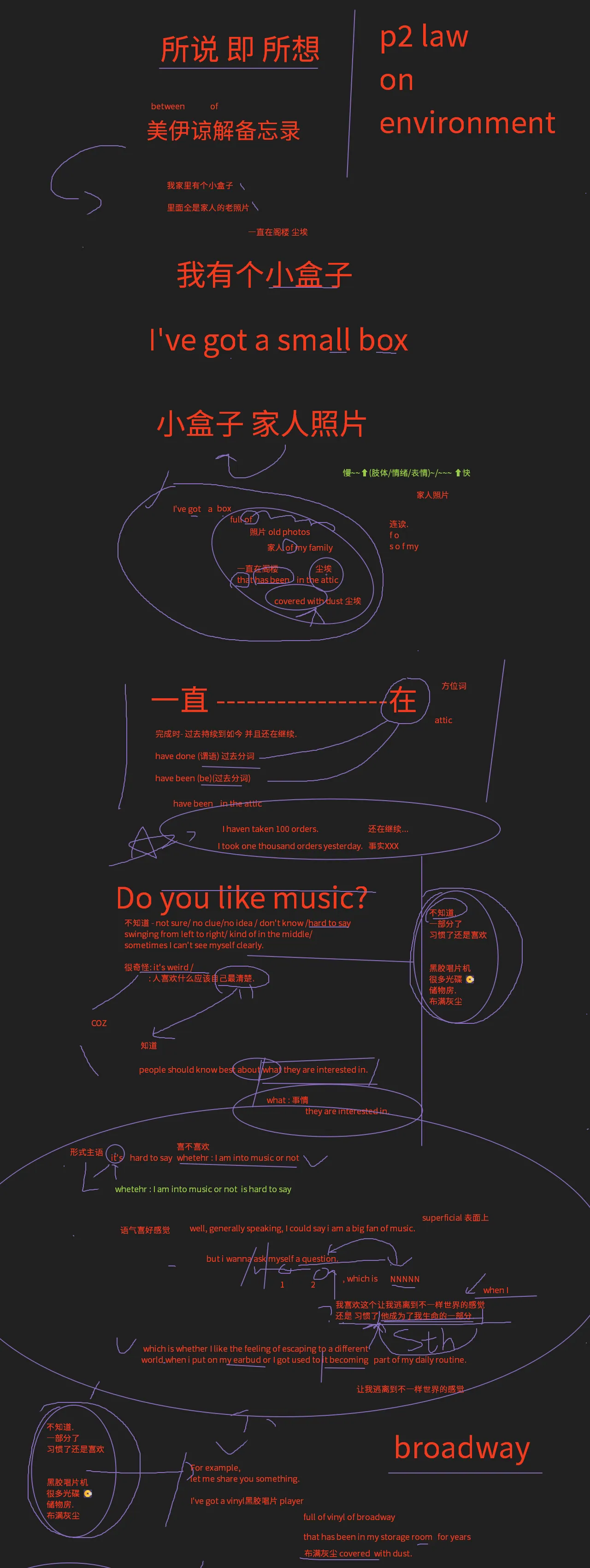
这节课的标题是所说即所想 —— 口语里说的每一句,都应该是你真的这么想。
前半节练 P1 的「喜好类」问题:Do you like music? / Do you like art?。老师给的第一条不是句型,而是态度:人喜欢什么,应该自己最清楚。所以答不上来的时候,不要硬编一个 Yes,先用 not sure / no clue / no idea / don't know / hard to say 这一组短语把「说不清」说出来,再用形式主语和 whether 从句把它撑成一段完整的长回答。
后半节是 P2 完整演示 —— Describe a law on environmental protection,从 What it is 一路讲到你自己的感觉,给了一套可以直接搬走的推进顺序。
中间还穿了两条语言线:
- 中英转换时介词的位置:「谅解备忘录」和「美伊」在英文里的先后是反过来的;
- 完成时:中文的「一直在」「还在继续」,英文靠时态 + 方位词分工。
🧱 中英转换:同一个短语,英文里的位置是反的
板书最上面写着「美伊谅解备忘录」,旁边标了两个介词:between 和 of。
| 中文顺序 | 英文 | 介词 |
|---|---|---|
| 谅解备忘录 | memorandum of understanding | of |
| 美伊 | between 美国 and 伊朗 | between |
中文是「美伊 + 谅解备忘录」,英文是 memorandum of understanding between A and B —— 谁在谁前面,完全换了个位置。
这就是「中英转换自由」要练的第一个动作:先把中文拆成块,再看每块在英文里挂哪个介词,而不是照着中文一个字一个字搬。
🧱 框架:完成时 —— 中文的「一直」和「还在继续」
板书上画了一条虚线:一直 ———————— 在 attic。
- 「一直」= 过去持续到如今,并且还在继续
- 「在」= 一个方位词(attic)
于是有了这句:
I've got a small box full of old photos of my family that has been in the attic covered with dust.
板书把结构一层层拆开:
| 层 | 内容 |
|---|---|
| 主干 | I've got a box |
| 装什么 | full of old photos / of my family |
| 一直在哪 | has been in the attic |
| 什么状态 | covered with dust |
形式对照:
| 结构 | 说明 |
|---|---|
| have + done | have 是谓语,后面跟过去分词 |
| have + been + done | be 本身也要变过去分词 → been |
要不要用完成时,看「还在不在继续」:
I have taken 100 orders. —— 还在继续……
I took one thousand orders yesterday. —— 只是事实陈述
同样的道理放在小盒子上:has been in the attic 不是「曾经在阁楼」,是「一直在,而且现在还在」。
💬 连读:of my 会读成 o' my
板书在「家人照片」旁标了连读:
full of my family → 听起来像
o' my/so my
of 在语流里几乎不发音,只留一个很轻的 /ə/ 或 /s/ 的过渡。听的时候不要去找 of 这个词,它常常是粘在前一个词尾巴上的。
🧱 框架:Do you like music? —— 说不清怎么答
第一组:先把「说不清」说出口
| 英文 | 说明 |
|---|---|
| not sure | 不确定 |
| no clue | 完全没头绪 |
| no idea | 不知道 |
| don't know | 不知道 |
| hard to say | 很难说 |
| it's weird | 很奇怪 |
后面还能接状态描述:
swinging from left to right / kind of in the middle / sometimes I can't see myself clearly.
也就是:一会儿偏这边,一会儿偏那边,大概在中间,有时候自己也看不清自己。
第二组:给出理由
'coz people should know best about what they are interested in.
拆开看:
- what = 事情(前面那个「东西」)
- they are interested in = 修饰这个 what
中文是「人喜欢什么,自己最清楚」;英文先起主干 people should know best about…,再把「喜欢什么」变成 what they are interested in 挂到 about 后面。
第三组:形式主语接管长主语
「我到底喜不喜欢音乐,这件事很难说」—— 主语太长,就推到后面去:
It's hard to say whether I am into music or not.
Whether I am into music or not is hard to say.
两句意思一样。it 只是占位,真正的主语是 whether 那一整句。口语里几乎永远用第一句。
第四组:语气 + 递进
先铺垫语气:
well, generally speaking, I could say I am a big fan of music.
然后自己给自己抛一个问题,分两条路往下走:
but I wanna ask myself a question —— 1. ___, which is NNNNN(用一个名词性从句把话说完整) 2. when I ___(用时间从句把场景铺开)
板书上给出的完整版是:
which is whether I like the feeling of escaping to a different world when I put on my earbud, or I got used to it becoming part of my daily routine.
这句话把两条路并成了一条:一种是喜欢那种逃离到不一样世界的感觉,另一种是已经习惯了它成为我生命的一部分。板书中这一句上方写着:
我喜欢这个让我逃离到不一样世界的感觉 / 还是习惯了它成为了我生命的一部分
第五组:落回一个具体的东西
说完抽象的,马上拿一个实物接住:
For example, let me share you something.
I've got a vinyl player, full of vinyl of Broadway, that has been in my storage room for years, covered with dust.
🧱 框架:Do you like art? —— 喜欢,但不一定擅长
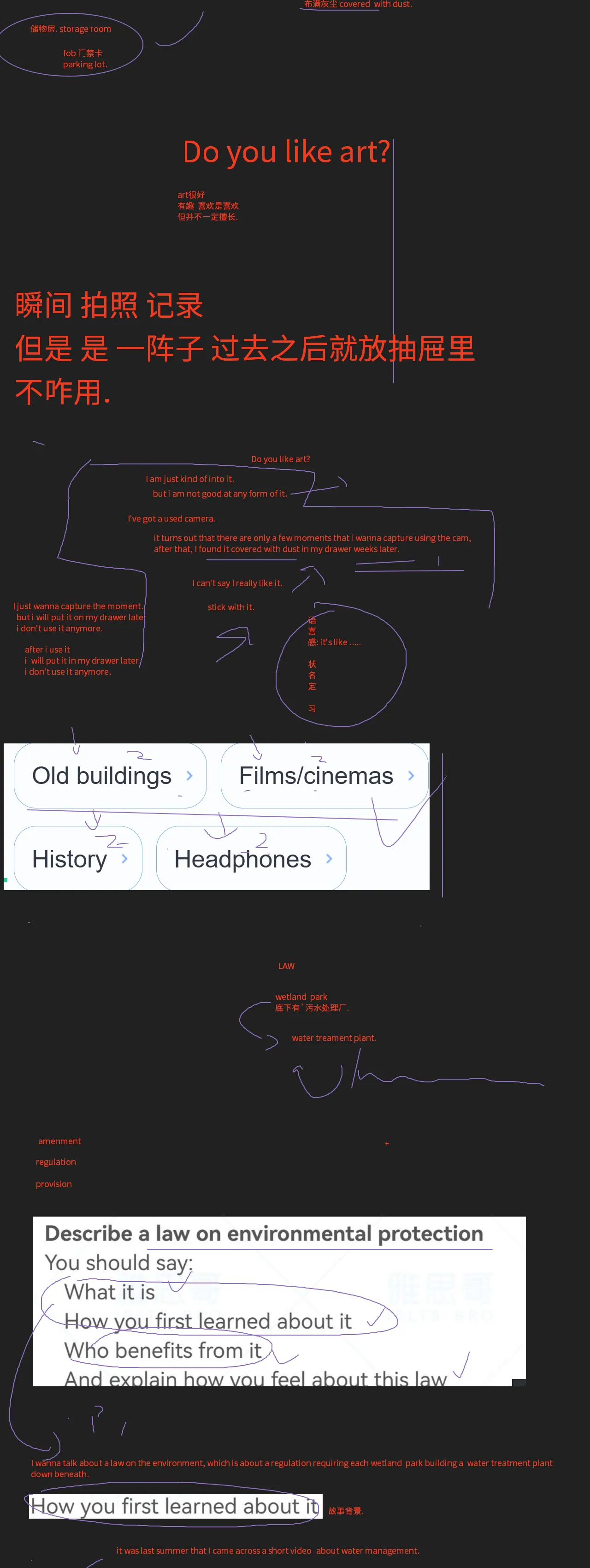
板书上先把中文思路记下来:
art 很好 / 有趣 / 喜欢是喜欢,但并不一定擅长 / 但是一阵子过去之后就放抽屉里 / 不咋用
英文版本:
I am just kind of into it, but I am not good at any form of it.
I've got a used camera. It turns out that there are only a few moments that I wanna capture using the cam; after that, I found it covered with dust in my drawer weeks later.
I can't say I really like it. stick with it.
I just wanna capture the moment, but I will put it in my drawer later, I don't use it anymore.
同一套「反悔结构」重复了两遍:
I've got a ___ → it turns out that ___ → after that, I found it covered with dust in my drawer → I can't say I really like it.
中间那三个中文关键词是板书的骨架:瞬间 / 拍照 / 记录,然后是但是,是一阵子过去之后就放抽屉里,不咋用。
📖 词汇与表达
| 英文 | 中文 | 搭配 / 用法 |
|---|---|---|
| memorandum of understanding | 谅解备忘录 | between A and B |
| vinyl / vinyl player | 黑胶 / 黑胶唱片机 | full of vinyl of Broadway |
| storage room | 储物房 | has been in my storage room for years |
| covered with dust | 布满灰尘 | 可挂在句尾当补语 |
| drawer | 抽屉 | in my drawer |
| earbud | 耳机 | put on my earbud |
| fob | 门禁卡 | parking lot |
| capture the moment | 记录瞬间 | a few moments that I wanna capture |
| stick with it | 继续用它 / 不放弃 | I can't say I really like it. stick with it. |
| superficial | 表面上 | 板书标在「表面上」旁 |
| get used to doing | 习惯了 | got used to it becoming part of my daily routine |
| escape to a different world | 逃离到不一样的世界 | the feeling of escaping to… |
| be into sth | 喜欢 | I am just kind of into it |
| hard to say | 很难说 | It's hard to say whether… |
| amendment / regulation / provision | 修正案 / 法规 / 条款 | law 的三个近义词 |
| wetland park | 湿地公园 | 底下有污水处理厂 |
| water treatment plant | 污水处理厂 | down beneath |
| sewage | 污水 | handles sewage from thousands of homes |
| pipeline | 管道 | linked by 50,000 kilometres of pipelines |
🧱 框架:P2 —— Describe a law on environmental protection
题目四问(板书上勾了后两问):
What it is / How you first learned about it / Who benefits from it / And explain how you feel about this law
What it is —— 一句话把法案说清
I wanna talk about a law on the environment, which is about a regulation requiring each wetland park building a water treatment plant down beneath.
中文思路:湿地公园底下有污水处理厂。
How you first learned about it —— 故事背景
板书在这一问旁边写了四个字:故事背景。三句话铺开:
It was last summer that I came across a short video about water management.
(强调句把时间顶到前面。)
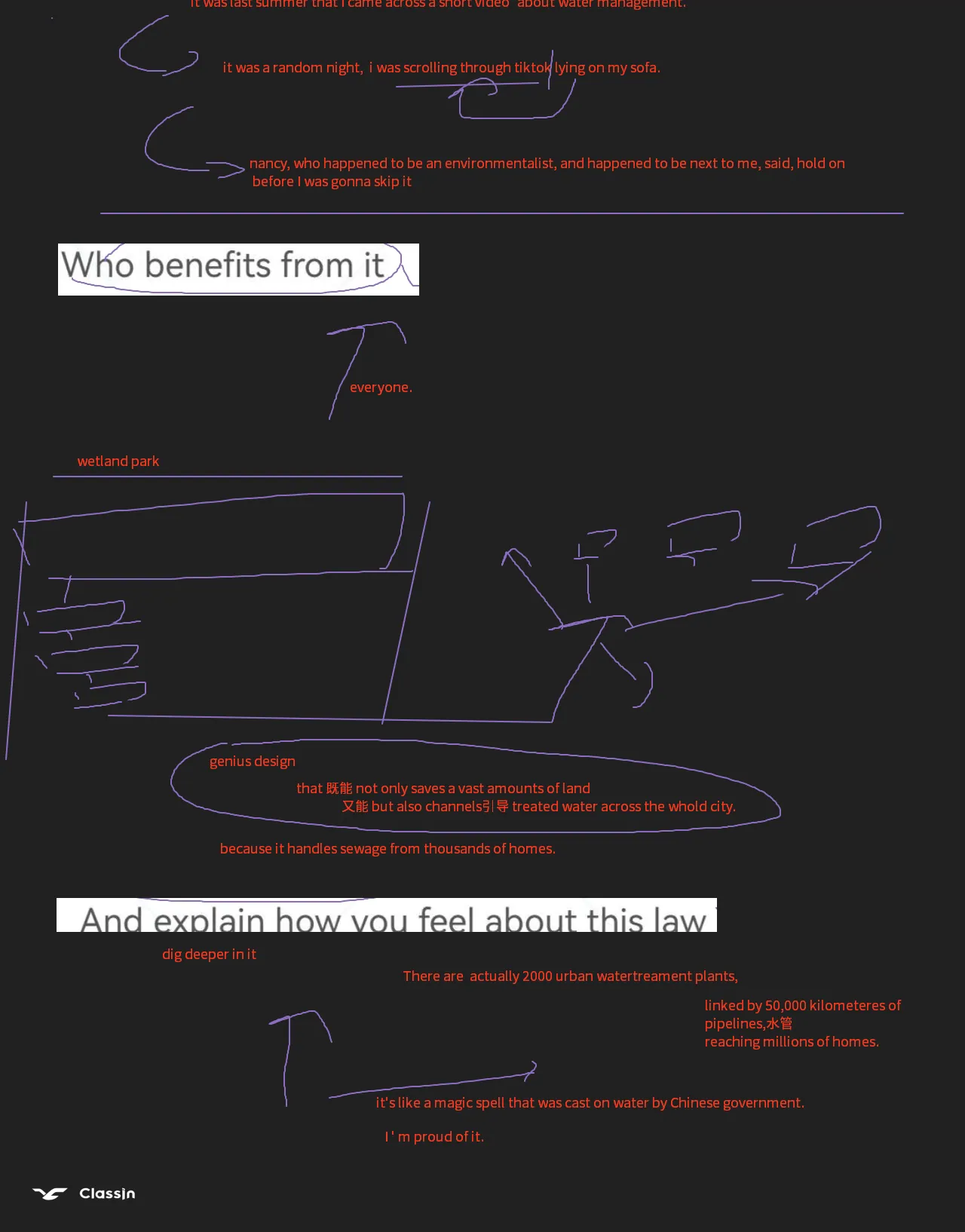
It was a random night, I was scrolling through TikTok lying on my sofa.
Nancy, who happened to be an environmentalist, and happened to be next to me, said, hold on before I was gonna skip it.
两个 happened to be 连着用:一个交代她的身份,一个交代她当时就在旁边。最后 hold on before I was gonna skip it —— 我差点划走,她喊住了我。
Who benefits from it —— 一句话先答,再展开
先给答案:
everyone.
然后解释这个设计为什么成立:
genius design that not only saves a vast amounts of land but also channels treated water across the whole city, because it handles sewage from thousands of homes.
板书在这里画了湿地公园的示意图,还标了连接词的位置:
- not only … but also … 一对
- because 引出原因
And explain how you feel about this law —— 往深里挖
板书写着 dig deeper in it,然后一层层加信息量:
There are actually 2000 urban water treatment plants, linked by 50,000 kilometres of pipelines, reaching millions of homes.
三个动词一路往下挂:linked by → reaching。
最后收在情绪上:
It's like a magic spell that was cast on water by Chinese government.
I'm proud of it.
⚠️ 提醒 / 易错
1. 不知道就说不知道。 板书上那句「人喜欢什么应该自己最清楚」是这节课的地基。答 Do you like music? 的时候,如果答案是「说不清」,那就把这个「说不清」明说出来,再用 whether 从句展开 —— 这本身就是一段完整的高分回答,比硬编一个 Yes 要稳。
2. 长主语一定用形式主语。 「Whether I am into music or not is hard to say」语法没错,但口语里说 It's hard to say whether… 更自然。
3. 完成时看「还在不在继续」。 have taken 100 orders(还在继续)和 I took one thousand orders yesterday(只是事实)是两种时态的分工;小盒子 has been in the attic 的重点是「一直在」。
4. 抽象的说完,马上接一个具体的东西。 板书的路径是固定的:说完「逃离到不一样的世界」,立刻接 For example, let me share you something → 黑胶唱片机 → 储物房 → 布满灰尘。反过来,说 art 的时候就接二手相机 → 抽屉 → 布满灰尘。同一个「布满灰尘」用了两次,这就是可以重复使用的细节模板。
5. 介词不要照中文搬。 谅解备忘录是 memorandum of understanding between A and B —— 中文的先后顺序在英文里是反的。
板书上还标了一条语气提示:
慢 →↑(肢体 / 情绪 / 表情),后面接~ →↑ 快,记的是讲快讲慢时状态往上提。