📌 这节课讲了什么
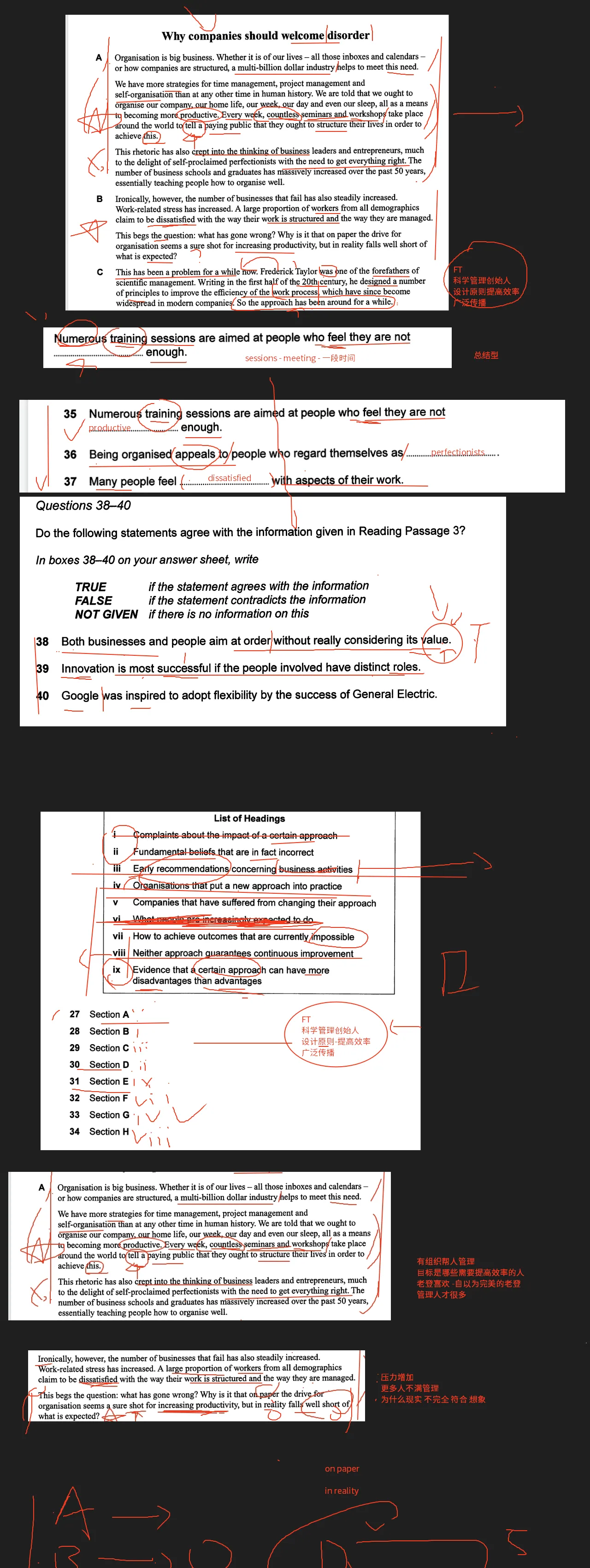
这节课完整过了一遍一篇 Reading Passage 3 —— Why companies should welcome disorder,后面跟着三种题型:
- List of Headings(27–34,给 A–H 八个段落选标题)
- Sentence Completion(35–37,填空)
- TRUE / FALSE / NOT GIVEN(38–40)
方法就两条,标题里写着的:
- 联系上下文 —— 一段一段读,读完就用中文给自己下一个结论(板上一段一段写了「有组织帮人管理」「压力增加」……),再看下一段的开头是怎么接上去的;
- 带好奇心 —— 板子把文中的 FT 圈起来,写上他是谁;看到 Oticon、General Electric、Google 这些公司名,也要停下来想一想:这段到底在说「谁」做了什么。
课的最后,每道题都在板书上做了 题干 ↔ 原文 对照。
📄 文章讲了什么(结构图 A–H)
| 段 | 板书上的中文小结 | 这一段在说什么 |
|---|---|---|
| A | 有组织帮人管理 / 目标是哪些需要提高效率的人 / 老登喜欢–自以为完美的老登 / 管理人才很多 | 组织化是一门大生意,所有人都在被教导「要更有效率」 |
| B | 压力增加 / 更多人不满管理 / 为什么现实不完全符合想象 | 可是倒闭的企业、压力、不满,一样在增加 |
| C | (板上圈出 FT:科学管理创始人 / 设计原则–提高效率 / 广泛传播) | 这套做法由来已久,Frederick Taylor 是源头之一 |
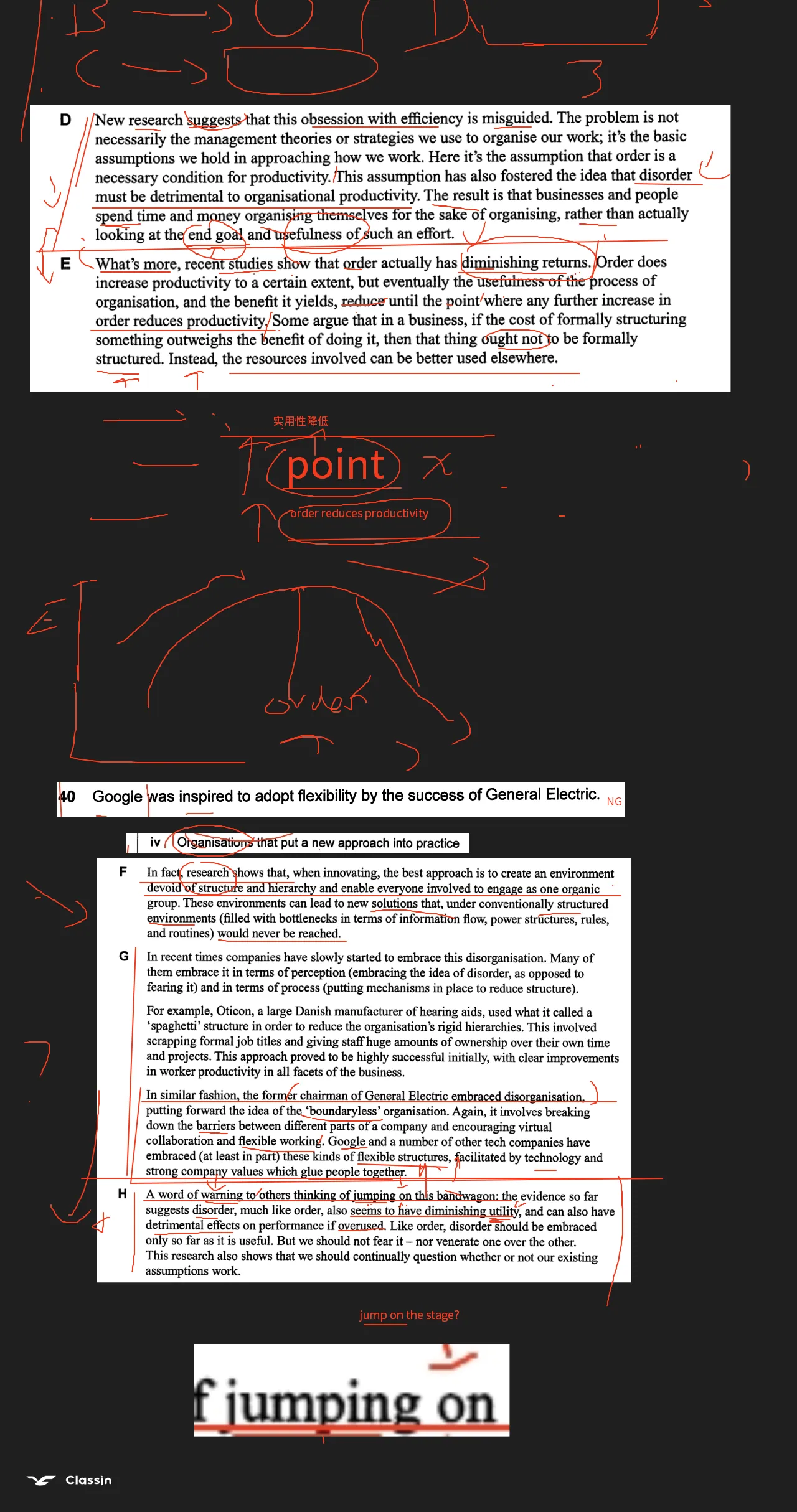
| D | (板上在下文标了 实用性降低) | 问题不在方法,在假设错了 |
| E | 实用性降低 | 秩序也有边际递减,过了某个点,再增加秩序反而降低生产力 |
| F | —— | 创新时最好的做法是「没有结构和层级」的环境 |
| G | —— | 已经有公司在这么做了(Oticon、General Electric、Google) |
| H | —— | 警告:无序也不要迷信,别把任何一边供起来 |
一句话串起来:A 说大家拼命组织 → B 说然而出问题了 → C 说这套东西年头很久了 → D 说假设错了 → E 说秩序会递减 → F 说那该怎么做 → G 说有人已经做了 → H 说别又走极端。
这就是「联系上下文」:每一段都在回答上一段留下的问题。
🧱 方法:连接词就是段落之间的路标
板子在这些词上划了线,它们是读懂长文的「关节」:
| 连接词 | 出现位置 | 作用 |
|---|---|---|
| Ironically, however | B 段开头 | 把 A 段整个翻过来:说好的效率,结果呢? |
| This begs the question | B 段结尾 | 提出问题,引出后面的回答 |
| New research suggests | D 段开头 | 回答 B 段的问题 |
| What's more | E 段开头 | 在 D 段的基础上再加一层 |
| In fact | F 段开头 | 接着说「应该怎么做」 |
| For example / In similar fashion | G 段 | 举例:一个公司、再一个公司 |
| A word of warning | H 段开头 | 收尾,给出警告 |
读长文的动作:每段读完,先看下一段开头那个连接词,你就知道文章要往哪拐。
🧱 方法:带好奇心,先搞清「谁是谁」
板子在 C 段旁边画了一个圈,里面写着:
FT 科学管理创始人 设计原则–提高效率 广泛传播
—— 这就是 Frederick Taylor。有了这个背景,再读 C 段就顺了:
Frederick Taylor was one of the forefathers of scientific management. Writing in the first half of the 20th century, he designed a number of principles to improve the efficiency of the work process, which have since become widespread in modern companies. So the approach has been around for a while.
同样的,读到 G 段时,板上把三个「谁」都标出来了:
- Oticon —— a large Danish manufacturer of hearing aids,用了 'spaghetti' structure;
- General Electric —— 前董事长提出 'boundaryless' organisation;
- Google —— 也 embrace 了这类 flexible structures。
好奇心的用处:你不需要事先认识这些公司,但你要在原文里找到「它们各做了什么」,因为题目就考这个。
📝 题目与原文对照
Sentence Completion(35–37)
板上把答案直接写在空上:
| 题 | 答案 | 原文 |
|---|---|---|
| 35 Numerous training sessions are aimed at people who feel they are not ___ enough. | productive | We are told that we ought to organise our company, our home life, our week, our day and even our sleep, all as a means to becoming more productive. |
| 36 Being organised appeals to people who regard themselves as ___ | perfectionists | much to the delight of self-proclaimed perfectionists with the need to get everything right |
| 37 Many people feel ___ with aspects of their work. | dissatisfied | A large proportion of workers from all demographics claim to be dissatisfied with the way their work is structured and the way they are managed. |
板上还专门给 sessions 作了注:
sessions - meeting - 一段时间
并给这类题标了两个字:总结型 —— 题干是把整段话总结成一句,答案往往就是原文里那个「关键词」。
TRUE / FALSE / NOT GIVEN(38–40)
| 题 | 原文 | 判断 |
|---|---|---|
| 38 Both businesses and people aim at order without really considering its value. | The result is that businesses and people spend time and money organising themselves for the sake of organising, rather than actually looking at the end goal and usefulness of such an effort. | 题干和原文说的是同一件事:organising for the sake of organising = without really considering its value(板上把 value 圈了出来,对应原文的 usefulness / end goal)→ 与原文一致 |
| 39 Innovation is most successful if the people involved have distinct roles. | when innovating, the best approach is to create an environment devoid of structure and hierarchy and enable everyone involved to engage as one organic group | 原文说的是「不要结构和层级、大家像一个整体」,和 distinct roles(各司其职)相反 |
| 40 Google was inspired to adopt flexibility by the success of General Electric. | Google and a number of other tech companies have embraced (at least in part) these kinds of flexible structures, facilitated by technology and strong company values | 板上在句尾写了一个 NG —— 原文只说了 Google 也这么做了,没有说是「因为 GE 成功才被启发」 |
Q40 是这节课最关键的一道题。 原文里 Google 和 GE 出现在同一段,但两者的关系是「In similar fashion」(同样地),不是「inspired by」(受启发)。NOT GIVEN 就藏在这种「看起来有关系、其实没说」的地方。
🔁 同义替换核对
| 题干这么写 | 原文这么说 |
|---|---|
| training sessions | seminars and workshops |
| are aimed at people who feel they are not productive enough | a means to becoming more productive |
| regard themselves as perfectionists | self-proclaimed perfectionists |
| feel dissatisfied with aspects of their work | claim to be dissatisfied with the way their work is structured |
| considering its value | looking at the end goal and usefulness |
| have distinct roles | engage as one organic group(反义) |
| Google was inspired by … General Electric | Google … have embraced (at least in part) these kinds of flexible structures(NG) |
📚 List of Headings(27–34):标题表
板上给的九个标题,以及板子在上面的笔迹:
| 编号 | 标题 | 板上的笔迹 |
|---|---|---|
| i | Complaints about the impact of a certain approach | 被划掉 |
| ii | Fundamental beliefs that are in fact incorrect | 有下划线 |
| iii | Early recommendations concerning business activities | 被划掉 |
| iv | Organisations that put a new approach into practice | 被圈出来(单独框在 Q40 下面) |
| v | Companies that have suffered from changing their approach | |
| vi | What people are increasingly expected to do | 被划掉 |
| vii | How to achieve outcomes that are currently impossible | impossible 被圈出 |
| viii | Neither approach guarantees continuous improvement | 有下划线 |
| ix | Evidence that a certain approach can have more disadvantages than advantages | ix 被圈出 |
做 Headings 的方法(这节课反复用的动作):
- 先把每段的中文小结写出来(板上 A/B 两段都是这么做的);
- 再看哪个标题只覆盖这一段,不覆盖别的段 —— 板上划掉的那三个,就是被别的段「抢走」的标题;
- viii 这个标题和 H 段的原文几乎一一对应:
Neither approach guarantees continuous improvement.
disorder, much like order, also seems to have diminishing utility … we should not fear it – nor venerate one over the other.
—— neither approach(两种做法都不)、continuous improvement(一直改善),在 H 段里都能找到落脚点。
💬 值得记住的句子
A 段(被反复划线的那几句)
We are told that we ought to organise our company, our home life, our week, our day and even our sleep, all as a means to becoming more productive.
This rhetoric has also crept into the thinking of business leaders and entrepreneurs, much to the delight of self-proclaimed perfectionists with the need to get everything right.
B 段
Ironically, however, the number of businesses that fail has also steadily increased.
Why is it that on paper the drive for organisation seems a sure shot for increasing productivity, but in reality falls well short of what is expected?
(板上单独把 on paper 和 in reality 两个短语拎出来写了一遍,这是一组对照。)
D 段(全段被下划线,这节课的核心句)
New research suggests that this obsession with efficiency is misguided. The problem is not necessarily the management theories or strategies we use to organise our work; it's the basic assumptions we hold in approaching how we work.
The result is that businesses and people spend time and money organising themselves for the sake of organising, rather than actually looking at the end goal and usefulness of such an effort.
E 段
Order does increase productivity to a certain extent, but eventually the usefulness of the process of organisation, and the benefit it yields, reduce until the point where any further increase in order reduces productivity.
if the cost of formally structuring something outweighs the benefit of doing it, then that thing ought not to be formally structured.
(板上把 ought not to 圈了出来。)
F 段
the best approach is to create an environment devoid of structure and hierarchy and enable everyone involved to engage as one organic group.
G 段
This involved scrapping formal job titles and giving staff huge amounts of ownership over their own time and projects.
it involves breaking down the barriers between different parts of a company and encouraging virtual collaboration and flexible working.
H 段
Like order, disorder should be embraced only so far as it is useful. But we should not fear it – nor venerate one over the other.
This research also shows that we should continually question whether or not our existing assumptions work.
⚠️ 提醒 / 易错
- NG 不是「错」,是「没说」。 Q40 里 Google 和 GE 出现在同一段、同一个话题下,但原文没有给出「因果」—— 这种题不要凭常识补全。
- 段落里的「例子」不等于段落大意。 G 段举了三个公司的例子,但概括句在最前面:companies have slowly started to embrace this disorganisation。
- 看连接词决定往哪拐:however / what's more / in fact / a word of warning,一个都不能滑过去。
- 板上记的一个短语:原文 H 段 jumping on this bandwagon(跟风),板子把它单独框出来,并在旁边写了 jump on the stage? 作对照 —— 别记错。
📖 词汇与表达
| 英文 | 中文 | 搭配 / 用法 |
|---|---|---|
| disorder | 无序 | welcome disorder |
| organisation | 组织、条理 | Organisation is big business |
| multi-billion dollar industry | 数十亿的产业 | a multi-billion dollar industry |
| self-organisation | 自我管理 | self-organisation |
| ought to | 应该 | we ought to organise our company |
| as a means to | 作为……的手段 | all as a means to becoming more productive |
| rhetoric | 说辞、论调 | This rhetoric has also crept into … |
| creep into | 悄悄渗入 | crept into the thinking of business leaders |
| entrepreneur | 创业者 | business leaders and entrepreneurs |
| self-proclaimed | 自封的 | self-proclaimed perfectionists |
| perfectionist | 完美主义者 | with the need to get everything right |
| demographics | 人群(统计口径) | workers from all demographics |
| dissatisfied | 不满意的 | claim to be dissatisfied with |
| ironically | 讽刺的是 | Ironically, however, |
| beg the question | 引出问题 | This begs the question |
| on paper | 纸面上 | on paper the drive for organisation |
| in reality | 现实中 | in reality falls well short |
| fall short of | 达不到 | falls well short of what is expected |
| sure shot | 稳操胜券的事 | seems a sure shot for increasing productivity |
| obsession | 执念 | this obsession with efficiency |
| misguided | 方向错了的 | is misguided |
| assumption | 假设 | the basic assumptions we hold |
| necessary condition | 必要条件 | order is a necessary condition for productivity |
| foster | 助长 | has also fostered the idea |
| detrimental | 有害的 | detrimental to organisational productivity |
| for the sake of | 为了……而…… | organising for the sake of organising |
| end goal | 最终目标 | looking at the end goal |
| diminishing returns | 收益递减 | order actually has diminishing returns |
| to a certain extent | 在一定程度上 | increase productivity to a certain extent |
| outweigh | 超过、大于 | the cost … outweighs the benefit |
| devoid of | 没有、缺乏 | an environment devoid of structure and hierarchy |
| hierarchy | 层级 | structure and hierarchy |
| organic | 有机的、整体的 | engage as one organic group |
| bottleneck | 瓶颈 | bottlenecks in terms of information flow |
| routine | 常规流程 | rules, and routines |
| embrace | 拥抱、接受 | embrace this disorganisation |
| perception | 观念 | embrace it in terms of perception |
| mechanism | 机制 | putting mechanisms in place |
| spaghetti | 意大利面(此处形容网状结构) | a 'spaghetti' structure |
| rigid | 僵化的 | the organisation's rigid hierarchies |
| scrap | 取消、废掉 | scrapping formal job titles |
| ownership | 主导权 | huge amounts of ownership over their own time |
| facet | 方面 | in all facets of the business |
| boundaryless | 无边界的 | the 'boundaryless' organisation |
| virtual collaboration | 线上协作 | encouraging virtual collaboration |
| flexible working | 弹性工作 | flexible working |
| facilitate | 促成 | facilitated by technology |
| glue … together | 把……粘在一起 | strong company values which glue people together |
| bandwagon | 潮流、风潮 | jumping on this bandwagon |
| diminishing utility | 效用递减 | seems to have diminishing utility |
| overuse | 过度使用 | detrimental effects on performance if overused |
| venerate | 供奉、崇拜 | nor venerate one over the other |
| continually question | 不断质疑 | we should continually question whether or not our existing assumptions work |