📌 这节课讲了什么
两条线并着走:
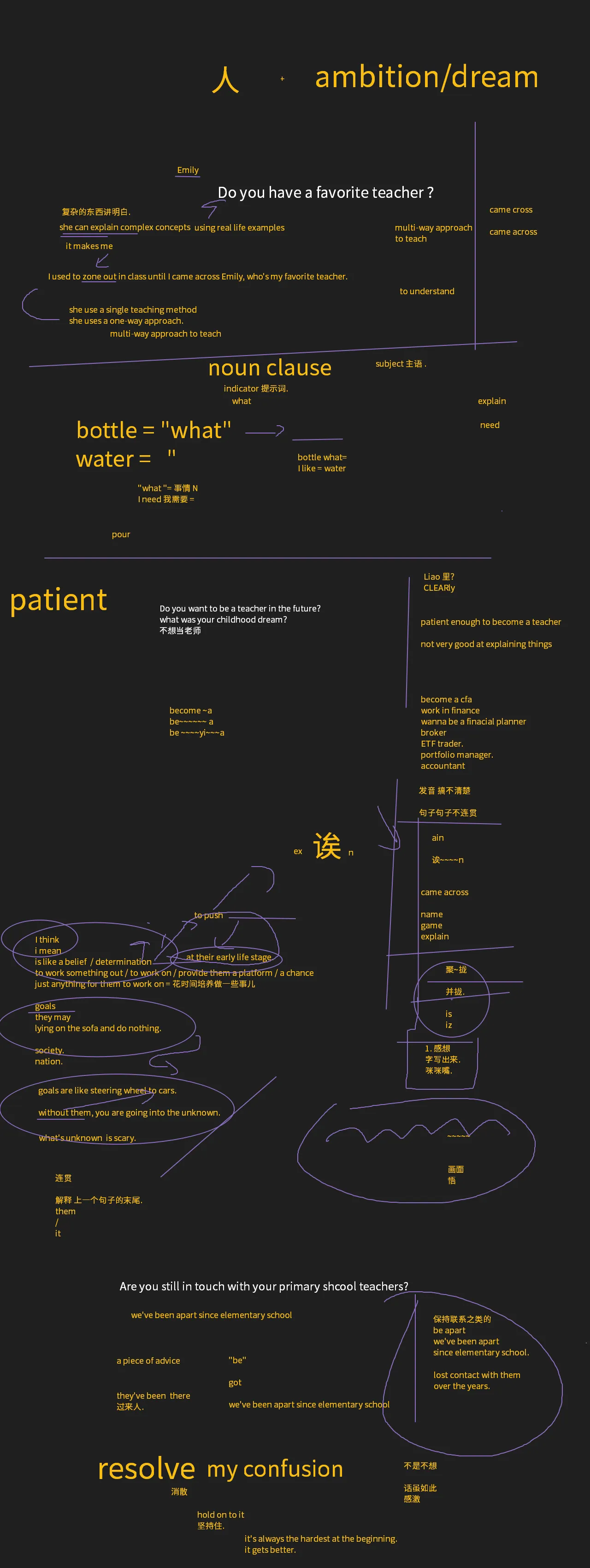
- 两个 P1 话题的实战 —— 「人 + ambition/dream」(最喜欢的老师、童年梦想、还跟小学老师联系吗)和「地方」(老建筑、现代 vs 传统建筑);
- 声音连接 —— 把这几个话题里最常说的词拆开,看声音是怎么"连"起来的:
Explain、become a、is、came across,以及指代上句末尾的 them / it。
一句话概括这节课的方法:先把内容讲明白,再把声音连起来。
🧱 框架一:人 + ambition/dream
人物类话题(包括 P2「描述一个你想见的名人/一个影响你的人」)统一挂在 人 + ambition/dream 这个骨架上。人物先立住,再往上接梦想、职业、价值观。
💬 P1:Do you have a favorite teacher?(Emily 版)
第一步:先给一句"概括",别急着描述
She can explain complex concepts using real life examples. (复杂的东西讲明白 —— 这就是"好老师"的定义句,后面所有话都是给它做证据)
第二步:给一个具体场景
I used to zone out in class until I came across Emily, who's my favorite teacher.
zone out= 走神(上课发呆)come across= 偶然遇到(注意不是"碰到困难"的 come across,这里是人)
第三步:对比,把老师的独特说清楚
She doesn't use a single teaching method. She uses a one-way approach… / She uses a multi-way approach to teach.
同一句,换说法再推一层。
📐 语法点:名词性从句 what
板书上用两个"瓶子"打比方:
bottle = "what"        ← 提问的 what
  water  = ""            ← 真正要装进去的东西
what= 一件事(名词性质),它在从句里自己充当主语或宾语,所以后面的句子不能是完整的;- 句型:
I like what you need.(我喜欢你需要的那件事)
板书上留了空位让你填:
| 提问词 | 后面接什么 |
|---|---|
| what | 半句话(缺主语或缺宾语) |
| 事情 N | I need / I like = |
配套动词:explain(解释)、need(需要)、pour(倒)。
🔊 发音:声音连接(这节课的重点)
| 板书写法 | 说明 |
|---|---|
ex 诶 n |
explain 的第一个音节是 /e/,不是 /ɪ/ |
ain 诶~~~n |
第二个音节拖长,连到 n |
be~~~a |
become a 里的 come a 连成一个 |
be~~~yi~~~a |
元音之间插一个轻微的 /j/ 音(听起来像 yi),这是自然的过渡,不用刻意断 |
is → iz |
is 在句子里读成 /ɪz/,不要读成 /ɪs/ |
CLEARly |
clearly 的重音在前面,后半段轻 |
Liao 里? |
中文"了/里"的发音位置,用来找英文元音的口型 |
"连环":英语里指代上一句末尾的东西,用 them / it 接,不要重复名词。说话时把它们连起来,句子就不"断"了。
板书还标了一个要求:发音搞不清楚 → 句子句子不连贯。发音不是独立的,它直接决定你说话顺不顺。
💬 P1:童年梦想 / 想不想当老师
问句:Do you want to be a teacher in the future? / What was your childhood dream?
板书给的两条路:
- 想当:
I'm **patient enough to become a teacher**. - 不想当:
I'm **not very good at explaining things**.(用一个具体的"不行"代替"我不想")
职业词链(从小到大的"梦想"词都在这里了):
CFA → work in finance → financial planner → broker → ETF trader → portfolio manager → accountant
💬 关于 goals(梦想的"高级说法")
板书这一段几乎可以直接背,是 P3「梦想/目标」的万能段:
Goals are like steering wheels to cars. Without them, you are going into the unknown. What's unknown is scary.
再补一句讲"为什么要有人推一把"(P3 谈父母/老师的作用):
They may push you at their early life stage. They provide you a platform / a chance — just anything for them to work on(花时间培养去做一些事).
反面例子(说明目标感有多重要):
Without goals, they may be lying on the sofa and do nothing. — for the society, for the nation.
表决心/价值观的固定开场:
I think it is like a belief / a determination — to work something out / to work on.
💬 Are you still in touch with your primary school teachers?
- 还联系:
We've been apart since elementary school… / We lost contact with them over the years. (板书把 be apart 标成"保持联系之类的"反向表达 —— 记住它是"分开")
- 老师是过来人:
They've been there. / They gave me a piece of advice.
- 从老师那儿得到的东西:
It resolved my confusion.(消散) 要坚持住的那句: It's always the hardest at the beginning. It gets better.
🧱 框架二:地方 —— building
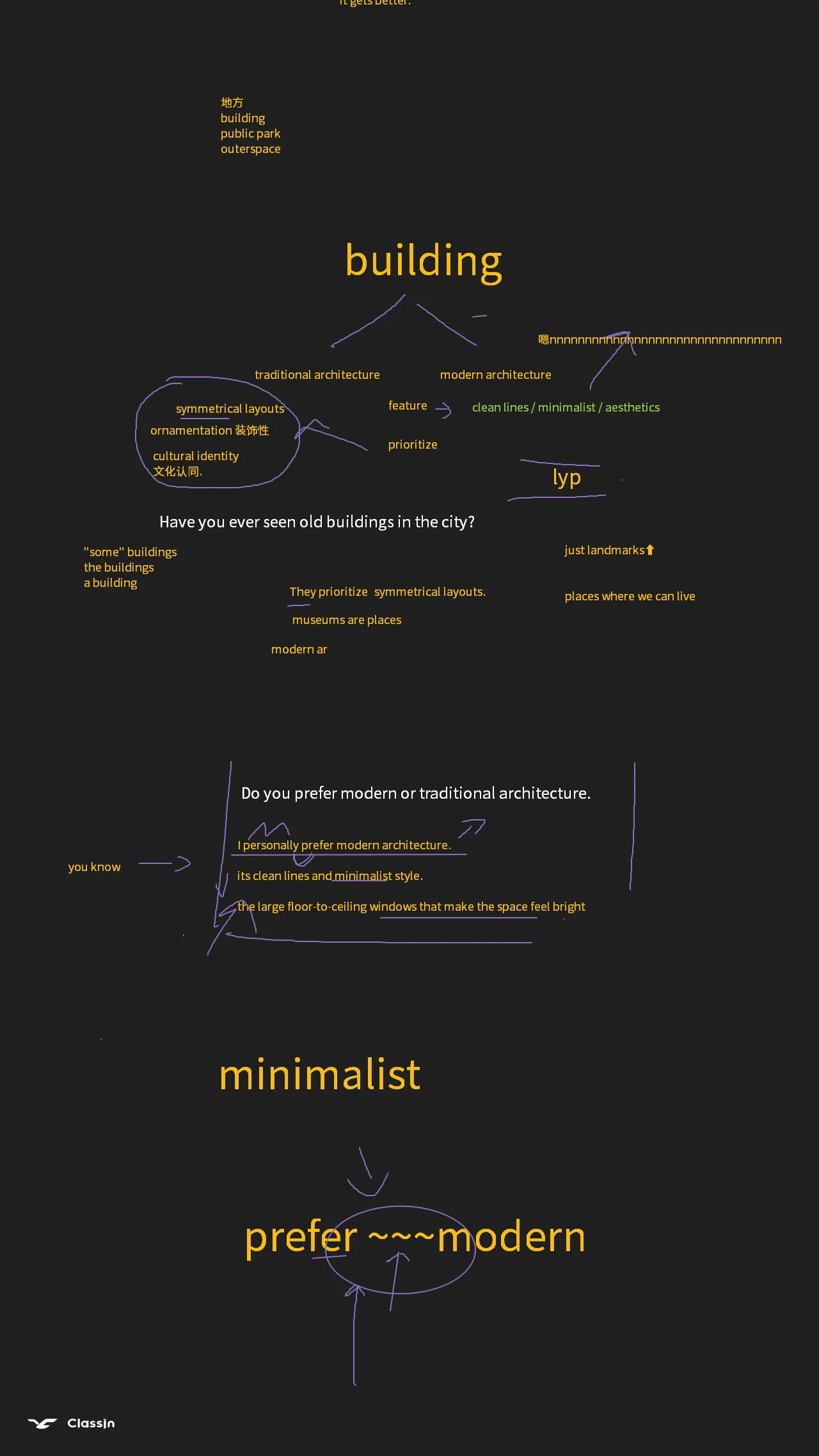
地方类话题的三件套:building / public park / outerspace。这节课只展开 building。
两种建筑,两组词:
| traditional architecture | modern architecture |
|---|---|
| symmetrical layouts(对称布局) | clean lines(干净的线条) |
| ornamentation(装饰性) | minimalist(极简) |
| cultural identity(文化认同) | aesthetics(美学) |
prioritize = 优先考虑 —— 这是区分两种建筑最省力的动词:
They prioritize symmetrical layouts.
P1:Have you ever seen old buildings in the city?
- 数量的坑:
"some" buildings/the buildings/a building—— 说之前先想清楚是"一些"还是"那些"还是"一栋"; - 两种态度:
just landmarks(就是个地标)places where we can live(是可以住的地方)
P1:Do you prefer modern or traditional architecture?
板书给的三句现成答案:
I personally prefer modern architecture. Its clean lines and minimalist style. The large floor-to-ceiling windows that make the space feel bright.
注意第三句:用 that 从句给"落地窗"补上效果 —— 有细节、有画面。
收尾句式:prefer ~~~ modern(把 prefer 和 modern 之间塞进你要的程度词)。
📖 词汇与表达
| 英文 | 中文 | 用法 / 搭配 |
|---|---|---|
| explain complex concepts | 把复杂概念讲明白 | 形容好老师 |
| real life examples | 现实生活例子 | using real life examples |
| zone out | 走神、放空 | I used to zone out in class |
| come across | 偶然遇到 | + 人 / 事物 |
| one-way approach | 单向的方式 | 对比 multi-way approach |
| multi-way approach to teach | 多向的教学法 | |
| patient enough to | 有足够耐心去 | become a teacher |
| push sb | 推一把、督促 | push you at their early life stage |
| provide a platform / a chance | 提供平台 / 机会 | for them to work on |
| work something out | 把事情弄明白 | |
| steering wheel | 方向盘 | goals are like steering wheels to cars |
| the unknown | 未知 | what's unknown is scary |
| be apart | 分开、没在一起 | we've been apart since elementary school |
| lose contact with | 失去联系 | over the years |
| they've been there | 他们是过来人 | |
| a piece of advice | 一句建议 | |
| resolve one's confusion | 打消某人的困惑 | |
| hold on to it | 坚持住 | |
| symmetrical layouts | 对称布局 | |
| ornamentation | 装饰性 | |
| cultural identity | 文化认同 | |
| clean lines | 干净的线条 | |
| minimalist | 极简的 | |
| aesthetics | 美学 | |
| prioritize | 优先考虑 | prioritize symmetrical layouts |
| floor-to-ceiling windows | 落地窗 | |
| landmark | 地标 |
⚠️ 提醒 / 易错
- 发音和连贯是一件事。 板书原话:"发音搞不清楚 → 句子句子不连贯"。
explain的 /e/、is的 /ɪz/、become a的连读,这些不解决,句子就一直是断的。 be apart是"分开",不是"保持联系"。 板书把它归在"保持联系之类的"那一栏,是提醒你别用反了。- 名词性从句的 what 后面不能是完整句 —— 完整句那是 that 的活。
- 说数量先想清楚:some / the / a 三个词对应三种完全不同的意思,考场上一犹豫就卡壳。
they've been there是英语里的固定说法(他们是过来人 / 他们经历过),不是"他们去过那儿"。